Team6 · October 8, 2026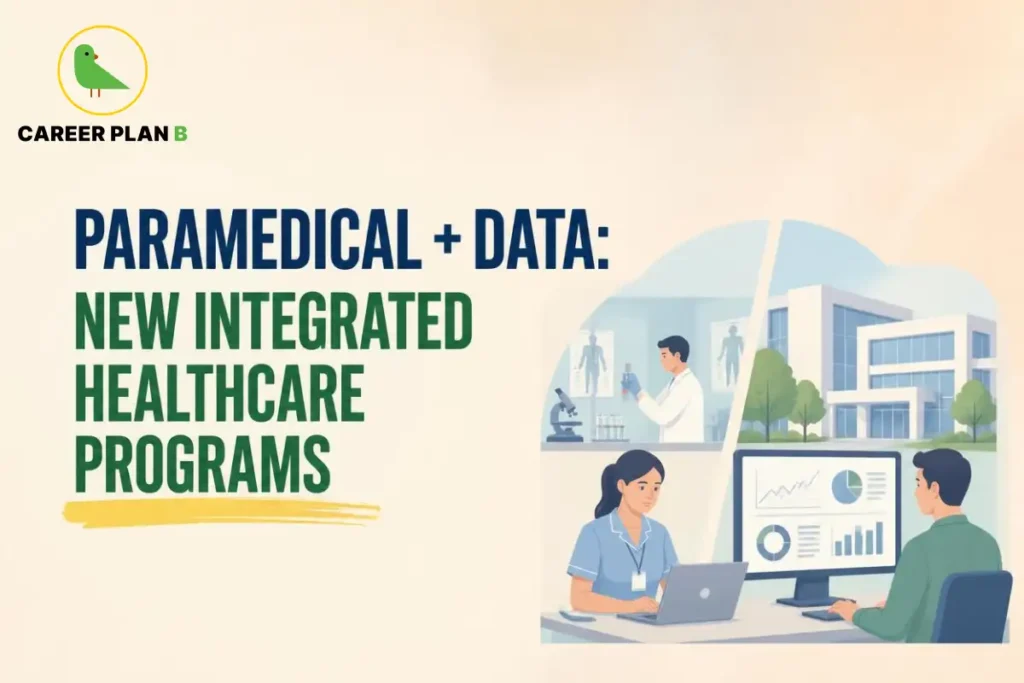
Introduction
Healthcare is no longer limited to hospitals and laboratories. Today, technology plays a major role in diagnosis, patient care, medical research, and hospital management. Artificial intelligence (AI), healthcare analytics, and digital health records are changing how healthcare professionals work every day.
As healthcare becomes more technology-driven, the demand for professionals with both clinical and digital skills is increasing. This has led universities to introduce integrated healthcare programs that combine paramedical education with data science and healthcare technology.
India is also strengthening its digital healthcare ecosystem through the Ayushman Bharat Digital Mission (ABDM). The initiative aims to create secure digital health records and improve healthcare delivery across the country. You can learn more on the official Ayushman Bharat Digital Mission .
If you are planning a healthcare career after Class 12, understanding these emerging programmes can help you choose a future-ready path.
Why Integrated Healthcare Programs Are Gaining Attention
The healthcare industry generates huge amounts of information every day. Patient records, laboratory reports, prescriptions, diagnostic images, and wearable devices all produce valuable healthcare data.
Managing this information has become just as important as collecting it. Hospitals now rely on digital systems to improve patient care, reduce errors, and make faster clinical decisions.
As a result, employers are looking for professionals who understand both healthcare and technology. This growing demand has encouraged institutions to introduce paramedical and data science programs that prepare students for modern healthcare careers.
The Government of India is also promoting digital healthcare through the National Health Authority (NHA) and the Ayushman Bharat Digital Mission. These initiatives support electronic health records and secure health information exchange across healthcare providers. Learn more at the official National Health Authority .
What Are Integrated Healthcare Programs?
Integrated healthcare programs combine traditional paramedical education with subjects like healthcare analytics, healthcare informatics, digital health technologies, and data science.
Students continue to learn core healthcare subjects such as anatomy, physiology, pathology, microbiology, and medical laboratory sciences. However, they also study how technology supports healthcare delivery.
Many programmes now include topics such as healthcare information systems, electronic health records, medical databases, healthcare analytics, AI applications, and healthcare management.
This combination prepares students for workplaces where digital technology is becoming an essential part of patient care.
Unlike conventional paramedical courses, these programmes offer broader learning and prepare graduates for both clinical and technology-enabled healthcare roles.
Why Students Should Consider These Programs
Healthcare is evolving rapidly. Professionals who understand both patient care and digital technologies are becoming increasingly valuable across hospitals, diagnostic centres, pharmaceutical companies, and healthcare startups.
Integrated healthcare programs help students build skills that remain relevant even as healthcare technologies continue to change. Instead of preparing for a single career path, graduates gain knowledge that can be applied across multiple healthcare sectors.
Another advantage is career flexibility. Students can explore opportunities in healthcare analytics, hospital management, health information systems, clinical research, and digital healthcare alongside traditional paramedical careers.
For students interested in both healthcare and technology, these programmes provide an opportunity to develop future-ready skills without moving away from the healthcare field.
Skills You Develop Through Integrated Healthcare Programs
One of the biggest strengths of integrated healthcare programs is their balanced curriculum. Students develop both healthcare knowledge and digital competencies throughout the course.
They learn how healthcare systems operate while also understanding how healthcare data is collected, managed, and analysed. This combination improves their ability to work with modern healthcare technologies.
Students also develop analytical thinking, communication skills, healthcare documentation practices, ethical handling of patient information, and familiarity with healthcare software.
These skills are becoming increasingly valuable as hospitals continue adopting digital health platforms, AI-assisted diagnostics, and electronic health record systems.
Career Opportunities After Integrated Healthcare Programs
The healthcare industry is creating new roles that combine clinical knowledge with technology. As hospitals and healthcare organisations continue adopting digital systems, graduates with interdisciplinary skills are becoming increasingly valuable.
Unlike traditional paramedical courses, integrated healthcare programs prepare students for careers beyond hospitals. Graduates can work across healthcare technology, diagnostics, research, public health, and healthcare management.
Some of the most popular career options include Healthcare Data Analyst, Healthcare Informatics Specialist, Clinical Data Associate, Health Information Manager, Clinical Research Associate, Medical Coding Specialist, Digital Health Consultant, and Healthcare Quality Analyst.
These professionals find opportunities in hospitals, diagnostic laboratories, pharmaceutical companies, health insurance providers, healthcare startups, research organisations, and government healthcare projects. As digital healthcare expands, demand for professionals with healthcare and technology skills is expected to continue growing.
Have Any Doubts?
Future Scope of Integrated Healthcare Programs
The future of healthcare is becoming increasingly data-driven. Artificial intelligence, machine learning, telemedicine, wearable health devices, and predictive analytics are already transforming patient care across the world.
India is also strengthening its digital healthcare ecosystem through the Ayushman Bharat Digital Mission (ABDM). The mission promotes secure digital health records, seamless health information exchange, and improved healthcare accessibility through technology. Learn more on the Ayushman Bharat Digital Mission (ABDM).
The National Health Authority (NHA) is leading several initiatives to modernise India’s healthcare infrastructure and promote digital health services nationwide. You can explore these initiatives on the National Health Authority.
As more hospitals adopt electronic health records, AI-assisted diagnostics, and healthcare analytics, professionals who understand both healthcare and digital technologies are expected to remain in high demand.
Challenges Students Should Consider
Although integrated healthcare programs offer exciting opportunities, students should also understand that they require learning across multiple disciplines.
Success in these programmes depends on developing both healthcare knowledge and digital skills. Students who enjoy science, technology, analytical thinking, and problem-solving are likely to adapt well to this learning environment.
Before choosing a college, compare the curriculum, faculty expertise, internship opportunities, industry collaborations, and placement support. Since these programmes are still evolving, the course structure may vary between institutions.
Making an informed decision today can create stronger career opportunities in the future.
How Career Plan B Helps
Choosing an emerging healthcare programme can be challenging because every institution offers a different curriculum, specialisation, and career pathway. Understanding which programme best matches your interests and long-term goals requires careful planning.
Career Plan B simplifies this process through personalised career counselling and scientific career assessments. Our experts evaluate your academic profile, interests, aptitude, and career aspirations before recommending suitable healthcare programs.
We help students compare colleges, understand admission requirements, evaluate future career opportunities, and build a personalised education roadmap. Whether you are considering a traditional paramedical course or an integrated healthcare programme, Career Plan B provides guidance at every stage of your admission journey.
With expert counselling and data-driven planning, you can confidently choose a healthcare programme that supports your future career goals.
Get In Touch With Us
Frequently Asked Questions
Q1. Are integrated healthcare programs different from traditional paramedical courses?
Yes. Traditional paramedical courses mainly focus on clinical skills, while integrated healthcare programs also include healthcare analytics, healthcare informatics, AI applications, and digital health technologies.
Q2. Who can apply for integrated healthcare programs?
Most institutions require students to have completed Class 12 with Science subjects. However, eligibility criteria may vary depending on the university and programme.
Q3. Is there a demand for healthcare data professionals?
Yes. The growing adoption of digital health technologies, healthcare analytics, and electronic health records has increased the demand for professionals who understand both healthcare and technology.
Q4. Where can graduates work after completing these programs?
Graduates can work in hospitals, diagnostic centres, healthcare startups, pharmaceutical companies, health insurance organisations, clinical research firms, public health agencies, and healthcare technology companies.
Q5. Are integrated healthcare programs a good career option?
Yes. These programmes prepare students for emerging careers in healthcare innovation, digital health, healthcare analytics, and healthcare informatics while building future-ready skills for a rapidly evolving industry.
Conclusion
Healthcare is changing rapidly, creating exciting opportunities for students who want to combine medical knowledge with technology. As hospitals and healthcare organisations increasingly adopt digital health systems, AI, and healthcare analytics, professionals with interdisciplinary skills will play an important role in improving patient care.
Integrated healthcare programs provide a strong foundation for these future careers by combining paramedical education with digital technologies and data-driven healthcare practices. They help students develop the skills needed to succeed in an evolving healthcare ecosystem while opening doors to diverse career opportunities.
If you are planning a healthcare career but are unsure which programme best matches your interests and goals, Career Plan B can help. Our personalised career counselling, psychometric assessments, and admission guidance enable you to choose the right course, shortlist suitable colleges, and build a clear roadmap towards a successful career in healthcare innovation.