Team6 · October 8, 2026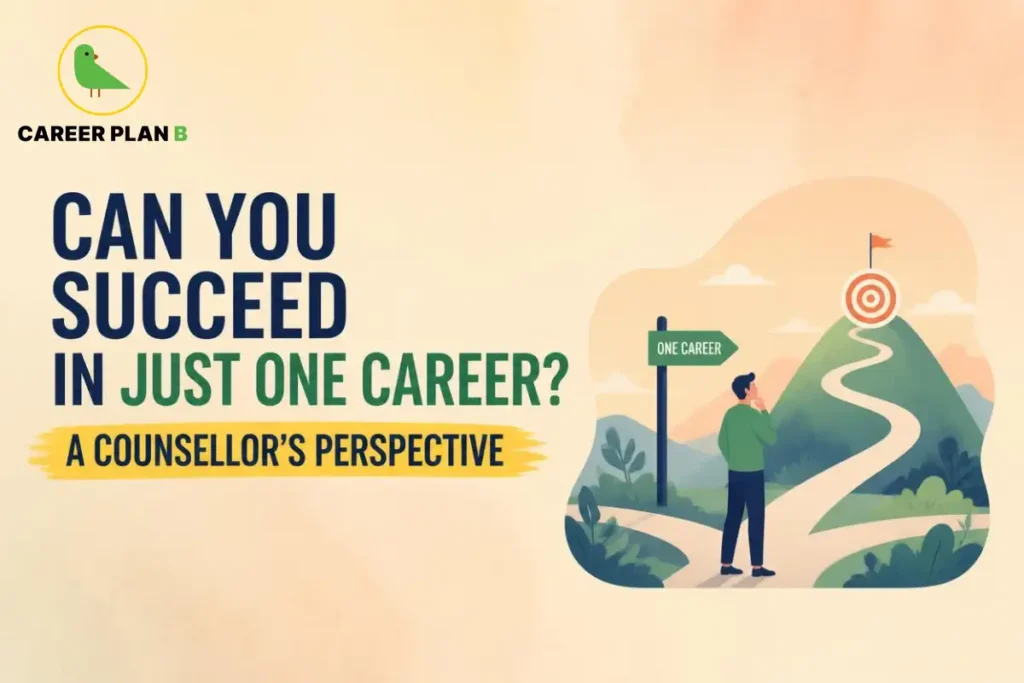
Introduction
One question comes up in almost every counselling conversation, in one form or another: “What if I choose wrong?” Behind it sits a bigger, quieter fear — that a career decision made at 17 or 18 has to be the only one, permanently. That pressure alone can make choosing a path feel unbearably heavy.
Here’s the honest answer, from a counselling perspective: no, you don’t have to succeed in just one career, and increasingly, very few people actually do. That’s not a consolation prize — it’s a genuine, structural shift in how careers work in India today, backed by real economic and policy changes, not just reassuring words.
This blog walks through what “success in one career” actually means versus what’s realistic, and how to make your first choice without the crushing weight of thinking it’s your only shot.
Can You Succeed in Just One Career? Reframing the Question
The question Can You Succeed in Just One Career often assumes success means picking correctly once and staying put forever. In practice, that’s rarely how careers unfold, for a few genuine reasons:
- Industries themselves change – Fields that didn’t exist a decade ago (data science, fintech, AI-adjacent roles) are now major career categories, while others have transformed so much that “staying in the same career” doesn’t mean doing the same work.
- Skills increasingly transfer across roles – A strong foundation, whether in mathematics, communication, or a specific technical skill, tends to open more than one door, not just the one you originally walked through.
- The structure of work itself is diversifying – India’s own policy think tank, NITI Aayog, has documented the rapid growth of the gig and platform economy, projecting the gig workforce to grow substantially by 2029-30, driven by increasing digitalization and demand for flexible work arrangements. This reflects a genuine shift away from the assumption of one linear, single-employer career path.
None of this means your first career choice doesn’t matter — it does. But it means the stakes are lower than the fear suggests.
Single Career vs Multiple Careers: What the Data Actually Shows
When weighing Single Career vs Multiple Careers, it helps to separate two different things people often conflate: changing jobs within a field, and changing fields entirely.
- Changing jobs or roles within your field is extremely common and generally considered healthy career growth, not a sign of instability.
- Changing fields entirely is less common but far from rare, especially as new sectors emerge and people’s interests and circumstances genuinely evolve over a working life.
- Building a “portfolio” of skills across fields is increasingly common, particularly given the flexible, platform-driven work arrangements NITI Aayog’s research highlights as a growing feature of India’s economy.
The counselling perspective here matters: treating your first career choice as a life sentence adds unnecessary pressure to a decision that, statistically and structurally, doesn’t have to be final.
Career Changes in India: Why This Is Becoming More Normal
Career Changes in India are increasingly supported by real structural shifts, not just individual restlessness:
- NEP 2020’s multidisciplinary education framework – India’s education policy has moved deliberately toward flexible, cross-disciplinary learning, explicitly designed to build adaptable skills rather than narrow, single-track specialization from day one.
- Growth of flexible, platform-based work – NITI Aayog’s report on India’s gig and platform economy documents genuine, substantial growth in flexible work arrangements, spanning sectors from logistics to content creation, offering more re-entry points into new fields than a traditional single-employer career path.
- Multiple entry-exit options in education – The same policy framework now allows students to exit and re-enter formal education with recognized qualifications at different stages, supporting genuine mid-career pivots more formally than before.
This doesn’t mean every career change is easy or without real cost — it genuinely is a significant undertaking. But it does mean the system around you is increasingly built to accommodate it, rather than treating it as an anomaly.
Read more:- Top 10 Career Options You Never Knew Existed (But Are Perfect for You)
Portfolio Career Explained: A Genuine Alternative to “One Career”
A Portfolio Career Explained simply: instead of one job title defining your entire working identity, you build a combination of skills, roles, or income streams that together make up your career. This might look like:
- A designer who also teaches design part-time and takes on independent freelance projects.
- A commerce graduate who works in finance while building expertise in a growing area like fintech on the side.
- A teacher who develops educational content or consults, alongside classroom teaching.
This isn’t a fallback for people who “couldn’t decide” — for many, it’s a deliberate, genuinely satisfying way to combine multiple interests rather than suppressing all but one. The growth of flexible, platform-based work in India makes this more structurally feasible than it was a decade ago.
Have Any Doubts?
Is Career Switching Normal? A Counsellor’s Honest Answer
Is Career Switching Normal is one of the most anxiety-driven questions students and even working professionals ask in counselling sessions. Here’s an honest, grounded answer:
- Yes, it’s normal, particularly as industries evolve and people’s own understanding of their strengths and interests deepens with experience — something an 18-year-old genuinely cannot fully predict about their 28-year-old self.
- It’s not something to be ashamed of or hide – A career change, when it happens for genuine, considered reasons, reflects growth and self-awareness, not failure.
- It does require real planning, not impulsiveness – The transferable-skills approach (building a foundation that opens multiple doors) tends to make eventual pivots smoother than starting from zero each time.
The counselling goal isn’t to promise you’ll never change direction — it’s to help you build a foundation flexible enough that if and when you do, it isn’t devastating.
Choosing One Career Path 2026: How to Decide Without the Pressure
If you’re currently facing Choosing One Career Path 2026, here’s how to approach it with the pressure genuinely reduced:
- Choose based on genuine current interest and aptitude, not a permanent, unchangeable life sentence — your first choice needs to be a good starting point, not a perfect final answer.
- Prioritize building transferable skills alongside subject-specific knowledge, since these are what make future pivots (if they happen) far less disruptive.
- Stay aware of how your field is genuinely evolving, rather than assuming today’s version of your chosen career will look identical in fifteen years.
- Give yourself permission to reassess periodically, rather than treating any reconsideration as a sign you chose “wrong” the first time.
How Career Plan B Helps
If the fear of “choosing wrong forever” is weighing on your decision, Career Plan B helps you approach this with real, grounded perspective.
- Personalized Career Counselling: We help you make your first career choice with genuine confidence, without the false pressure of permanence.
- Psychometric & Career Assessment Tests: Our assessments identify both your current strengths and the kind of transferable skills that keep future options open.
- Career Roadmapping: We help you build a path that’s strong for today while remaining genuinely adaptable for tomorrow.
- Admission & Academic Profile Guidance: We help you choose programs and specializations that build flexible, transferable foundations, not narrow dead ends.
Get In Touch With Us
Frequently Asked Questions
1. Is it bad to change careers later in life?
No. Career changes are increasingly normal in India, supported by genuine shifts like flexible, platform-based work and more adaptable education pathways. It reflects growth, not failure.
2. Should I choose a career based on what I’ll want forever?
Not necessarily. It’s more realistic to choose based on your genuine current interests and strengths, while building transferable skills that keep future options open.
3. What is a portfolio career?
It’s a career built from a combination of skills, roles, or income streams, rather than a single job title — an increasingly viable and deliberate choice, not just a fallback.
4. Is India’s job market actually becoming more flexible?
Yes. NITI Aayog’s official report on the gig and platform economy documents substantial, genuine growth in flexible work arrangements, reflecting a real structural shift, not just anecdotal change.
5. How can I make my first career choice without so much pressure?
Focus on genuine current fit and transferable skills rather than trying to predict a permanent, unchangeable future — this makes the decision both more manageable and more honest.
Conclusion
You don’t have to succeed in just one career to have a genuinely successful working life — and increasingly, India’s education system and economy are structured to support that reality, not fight it. The real goal of your first career choice isn’t permanence; it’s a strong, genuine starting point built on skills flexible enough to grow with you.
If the pressure of “choosing forever” is holding you back, Career Plan B is here to help you make a confident first step, without that unnecessary weight.