Team Career Plan B · October 14, 2026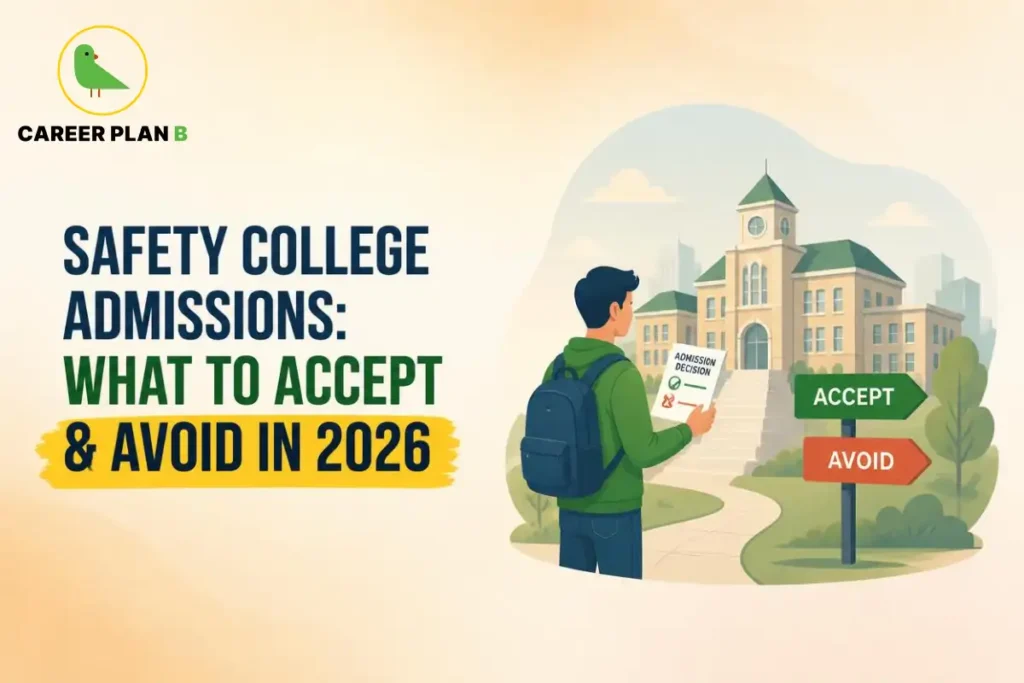
Introduction
Riya had her dream college picked out for two years. Then her CUET 2026 scores came in, and that dream suddenly felt out of reach. Sound familiar? This is exactly when safety college admissions become more than just a backup plan—they become a lifeline. Many students treat safety college admissions as a last resort, something to think about only if everything else fails.
But here’s the truth: safety college admissions deserve just as much thought as your first choice. A wrong pick here can mean wasted fees, a mismatched course, or even a lost academic year. In this blog, we’ll walk through what to accept, what to avoid, and how to make a smart, informed call when your backup plan suddenly becomes your main plan.
Why Every Student Needs a Backup Plan in 2026
Let’s be honest—admissions in India are unpredictable. With CUET 2026 results expected to roll out by June 2026, as confirmed by the National Testing Agency’s official portal, lakhs of students will be competing for limited seats across central, state, and private universities. The CUET UG 2026 results will be declared in June 2026, while the CUET PG 2026 results are scheduled for April 2026.
Even toppers sometimes don’t get their first preference because cutoffs shift every year based on the number of applicants and seat availability. That’s where backup colleges step in not as a “second-rate” option, but as a smart safety net. Think of it like carrying an umbrella on a cloudy day. You might not need it. But if it rains, you’ll be glad you packed it.
What Exactly Is a “Safety College”?
A safety college is an institution where your chances of getting admission are reasonably high based on your CUET score, board marks, or category. It’s not about settling for “less” it’s about choosing wisely so you’re never left without a seat.
Safety college admissions typically fall into a few categories:
- State universities with relatively manageable cutoffs
- Private universities accepting CUET scores for UG programmes
- Deemed universities offering merit-based or direct admission routes
- Colleges with multiple counselling rounds, giving you more chances
The goal isn’t to pick any college blindly. It’s to pick one that still aligns with your interests, career goals, and budget even if it wasn’t your first choice.
CUET 2026 and How It Changes the Admission Game
CUET has reshaped how students approach both their dream colleges and their backups. According to the official CUET portal run by the National Testing Agency, CUET scores are used for admission into UG programmes in all Central Universities and Participating Universities, including State, Deemed, and Private institutions across the country.
This is good news for students exploring safety college admissions, because one single exam score can now open doors to dozens of universities—not just one. The exam provides a common platform and equal opportunities to candidates across the country, especially those from rural and remote areas, helping establish better connections with universities.
So if your CUET 2026 score didn’t match your top university’s cutoff, don’t panic. The same score might still get you into a great private or state university, often with similar courses and faculty quality.
What to Accept When Choosing Safety College Admissions
This is the part students often rush through and regret later. Here’s what genuinely deserves a “yes.”
Recognised Universities and Valid Approvals
Always check if the university is recognised by the UGC (University Grants Commission) and approved by relevant bodies like AICTE for technical courses. For example, Amity University Noida, a well-known private university accepting CUET 2026 scores, is recognised by the UGC and holds approvals from bodies including AICTE and the Bar Council of India for law programmes, as listed on its official admissions FAQ page. CUET is organised by the National Testing Agency for admission to various undergraduate, integrated, postgraduate, diploma, and research programmes across participating universities, as per NEP 2020 guidelines.
Before accepting any seat, search for the university’s name on the UGC website and cross-check it with the CUET participating universities list on the official CUET portal.
Course Relevance Over Brand Name
A safe college offering a course closely related to your interest is far more valuable than a “bigger name” college offering something you have zero interest in. If you want to study psychology, don’t switch to commerce just because the college sounds more prestigious. Your degree should work for you, not just look good on paper.
Reasonable Fees and Transparent Refund Policies
Every legitimate university publishes its fee structure on its official website. Compare this with what you’re being asked to pay. If the numbers don’t match, or if you’re asked to pay in cash without a receipt, that’s your cue to pause and verify directly with the university’s admission office.
For Personalized Guidance
What to Avoid: Red Flags in Backup Admissions
Now let’s flip the page. While exploring safety college admissions, certain warning signs should make you stop immediately.
Unverified or “Too Good to Be True” Offers
If someone promises you “guaranteed admission” to a top course for a “special fee,” be careful. Genuine admissions, even backup ones, follow a proper process — application, eligibility check, merit list, and counselling. Skipping all of that for a shortcut usually means trouble later.
Hidden Charges and Donation Demands
Some students fall into the trap of paying “donations” or “management quota fees” that aren’t part of the official fee structure. Always insist on official receipts and cross-check the fee details mentioned on the university’s website.
Courses Without Proper Affiliation
A course might sound modern and exciting—say, a niche specialisation but if it isn’t affiliated or recognised, your degree may not hold value for further studies or jobs. Always verify the affiliation status directly through the university’s official website or the UGC portal before accepting any offer.
Quick Checklist Before Accepting a Safety College Seat
Here’s a simple table you can refer back to whenever you’re evaluating a backup college option.
| What to Check | Why It Matters |
|---|---|
| UGC recognition | Confirms the degree is valid nationwide |
| CUET participation status | Confirms the university accepts your CUET 2026 score |
| Course affiliation (AICTE, BCI, etc.) | Ensures your course is professionally recognised |
| Fee structure on official website | Avoids hidden charges or overpayment |
| Counselling rounds available | More rounds mean more chances if you don’t get in initially |
| Course relevance to your goals | Keeps your degree useful for your career path |
How Career Plan B Helps
Career Plan B helps students choose safety college options with clarity, confidence, and a structured approach instead of confusion or urgency:
- Personalized Career Counselling: Helps students evaluate backup and safety college options based on their academic profile, interests, career goals, and long-term direction.
- Psycheintel & Career Assessment Tests: Provides data-backed insights into aptitude, personality traits, learning styles, and academic/career alignment, helping students identify courses and colleges that genuinely fit them.
- Admission & Academic Profile Guidance: Supports students in comparing safety options, understanding eligibility, and building a strong academic profile to make informed backup decisions.
- Career Roadmapping: Helps students create a structured long-term plan that connects safety college choices with future academic progression and career outcomes.
- End-to-End Guidance: Assists students in making decisions that are not rushed or fear-driven, but aligned with their goals, strengths, and future aspirations.
For Latest Information
Frequently Asked Questions
Q1. Is choosing a safety college a bad sign about my performance?
Not at all. Even high-scoring students choose backup colleges because cutoffs change every year. It’s simply smart planning, not a reflection of your ability.
Q2. How many safety colleges should I apply to?
A good rule of thumb is to apply to 2-3 backup colleges along with your main choices. This gives you options without overwhelming your application process.
Q3. Can I use my CUET 2026 score for private universities too?
Yes. As per the official CUET portal, CUET scores are accepted by central, state, deemed, and private participating universities for various undergraduate programmes.
Q4. What if the safety college’s course is slightly different from what I wanted?
If the core subject area overlaps with your interest, it’s usually fine. Focus on the syllabus and specialisations offered rather than just the course title.
Q5. How do I verify if a university is genuinely recognised?
Check the UGC website’s list of recognised universities and cross-reference it with the official CUET participating universities list before accepting any offer.
Conclusion
Safety college admissions aren’t about giving up on your dreams, they’re about protecting them. A well-chosen backup keeps your education on track, your confidence intact, and your future options open, even when the first plan doesn’t work out exactly as hoped.
So take a breath, do your research, and remember Riya’s story. Sometimes, the “backup” college turns out to be exactly where you were meant to be all along. Choose wisely, verify everything, and trust the process your right path is closer than it feels.