Team6 · October 14, 2026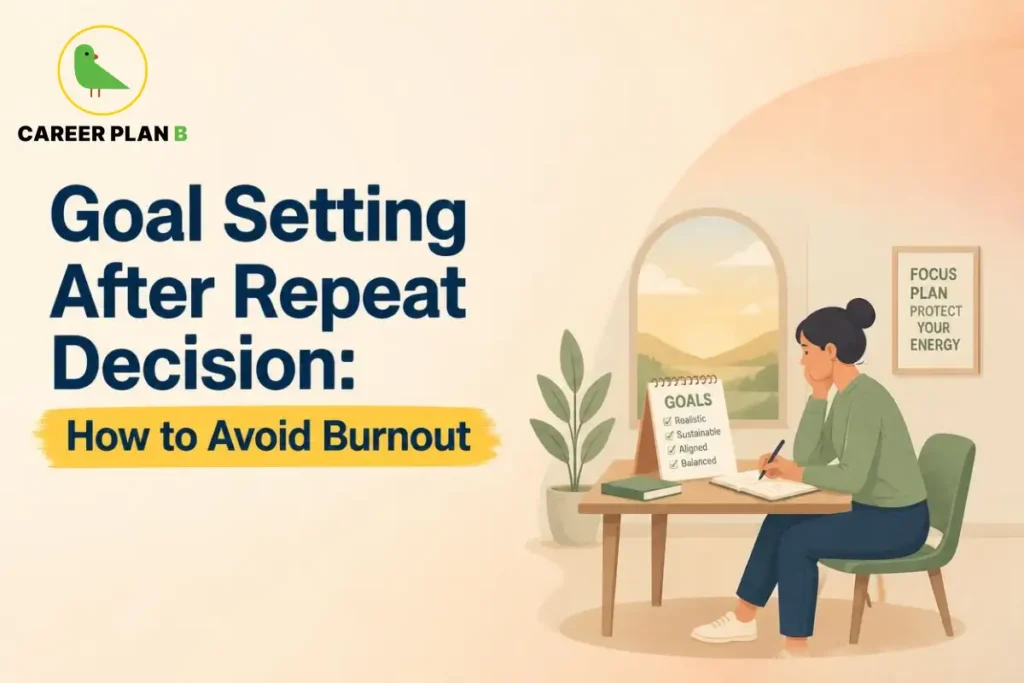
Introduction
I still remember the exact moment I decided to sit for CUET again. The result was out, the marks were average, and somewhere between disappointment and relief, I made a choice that felt both brave and terrifying — I was going to try one more time in 2027. If you’re reading this after making a similar choice, you already know that feeling. Goal setting after a repeat decision is not just about studying harder; it is about studying smarter, without losing yourself in the process. That single sentence became my biggest worry the night I decided to repeat.
This blog is for every student standing where I once stood unsure, a little tired, but still hopeful. We will talk about why drop years feel different the second time around, how burnout quietly creeps in, and most importantly, how goal setting after repeat decision can actually protect your mental health instead of draining it. Think of this less as advice and more as a conversation between two students who have been through the same storm.
Why a Repeat Attempt Feels Different This Time
The first time you prepare for an exam, there is excitement mixed with nervousness. The second time, after a repeat decision, the emotions are heavier. There is guilt about “wasting a year,” pressure from relatives who keep asking questions, and a quiet fear of failing again.
According to the National Testing Agency, CUET UG 2026 was conducted across 321 examination cities, including 15 international cities, which shows just how massive and competitive this exam truly is. When you are one student among lakhs attempting it again, it is natural to feel both small and determined at the same time.
Repeating isn’t a step backward. It is a second attempt with more clarity, more self-awareness, and ideally, a better plan. That plan starts with honest goal setting, not blind repetition of last year’s routine.
The Hidden Risk — Burnout During a Drop Year
Here’s something nobody warns you about: a drop year can be more exhausting than a regular academic year. Why? Because there is no fixed timetable, no classmates moving at the same pace, and no one checking if you studied today. Freedom can quietly turn into pressure.
What Burnout Actually Looks Like for Repeat Students
Burnout rarely arrives with a warning sign. It builds slowly, and most students don’t notice it until they are deep inside it. Some common signs include:
- Feeling tired even after resting properly
- Losing interest in subjects you once enjoyed
- Studying for hours but retaining very little
- Constant comparison with peers who got into college
- Irritability or sudden mood swings without a clear reason
Is More Study Hours Always Better?
We grow up believing that more hours equal more success. But ask any topper who has repeated an exam, and they will tell you something different — consistency beats intensity. Studying for six focused hours often produces better results than ten distracted ones.
Think of your mind like a phone battery. If you keep using it without charging, it eventually shuts down, no matter how urgent the task is. Rest is not laziness; it is maintenance.
Goal Setting After Repeat Decision — Where to Start
This is the heart of the matter. Most students who repeat an exam set one giant goal: “Score higher than last time.” While the intention is right, the goal itself is too vague to act on daily.
Setting Realistic, Time-Bound Goals
Instead of one big goal, break it into smaller, measurable ones. For example:
- Complete one subject’s syllabus in the first two months
- Attempt one full-length mock test every week starting month three
- Identify and improve your three weakest topics every month
- Revise the entire syllabus twice before the exam, not just once
These goals are specific, trackable, and far less overwhelming than a single distant target.
Breaking the Year Into Phases
A drop year feels less scary when divided into clear phases. Here is a simple structure many repeat students follow:
| Phase | Duration | Primary Focus | Strategic Milestones & Action Plan |
|---|---|---|---|
| Foundation | Months 1–3 | Concept building, filling knowledge gaps | Master line-by-line NCERT Class 12 domain concepts; create Anki flashcards for high-yield formulas and vocabulary baselines. |
| Practice | Months 4–6 | Subject-wise practice, previous year papers | Solve NTA PYQs chapter-by-chapter; execute daily timed section-solving drills for General Test and Language modules. |
| Mock Test | Months 7–9 | Full-length mocks, time management | Simulate computer-based test (CBT) environments; audit error logs to eliminate negative marking penalty trends. |
| Final Revision | Last 2 months | Quick revision, weak area polishing | Consolidate active recall notes; finalize CSAS/university target lists and align subject mapping combinations. |
Having visible phases gives structure to days that would otherwise blur into one another.
Building a Sustainable Daily Routine
Goal setting after a repeat decision only works if your daily routine supports it. A goal without a routine is just a wish.
Balancing Study With Rest
Imagine training for a marathon. Nobody runs 26 miles on day one. Runners build stamina gradually, with rest days built into the schedule. Your CUET 2027 preparation should follow the same logic.
A few practical habits that help maintain this balance:
- Fix a daily study window instead of studying “whenever you feel like it”
- Take a 10-minute break after every 50 minutes of focused study
- Keep one half-day every week completely free from books
- Sleep for 7 to 8 hours; sacrificing sleep rarely improves scores
- Step outside for at least 20 minutes daily, even just for a walk
These habits sound simple, but they are often the first things students skip and the first things that need protecting.
Have Any Doubts?
Tracking Progress Without Self-Punishment
Using Small Wins to Stay Motivated
One mistake many repeat students make is judging themselves only by the final result, ignoring the small improvements happening along the way. Did you finish a chapter you were avoiding? Did your mock score improve by even five marks? These are wins worth noticing.
Keep a simple progress journal. Write down one thing you did well each week, even on tough weeks. Over months, this journal becomes proof of how far you’ve actually come — something pure numbers often fail to show.
When to Seek Outside Support
Self-motivation has limits, and that’s completely normal. Sometimes the most productive step isn’t another study hour, but an honest conversation with someone who understands the academic system and can help you see your situation more clearly. Mentorship during a drop year isn’t a sign of weakness; it is a smart, supported way to move forward.
How Career Plan B Helps
Career Plan B supports students navigating a repeat attempt through Personalized Career Counselling that addresses both academic and emotional challenges. Through Psycheintel and Career Assessment Tests, students gain clarity on strengths and study patterns. With Admission and Academic Profile Guidance and structured Career Roadmapping, your drop year becomes purposeful rather than uncertain.
Get In Touch With Us
Frequently Asked Questions
1. Is it normal to feel demotivated during a drop year?
Yes, completely. Most students experience dips in motivation at some point during a repeat attempt. What matters is having small systems in place, like weekly goals, so motivation doesn’t have to carry the entire weight alone.
2. How many hours should I study daily during CUET 2027 preparation?
There is no universal number. Focused, distraction-free hours matter far more than total hours. Many successful repeat students study 6 to 8 quality hours rather than forcing 12 unfocused ones.
3. What if my goals feel too ambitious after a few weeks?
Revisit and adjust them. Goal setting after a repeat decision should be flexible, not rigid. A goal that no longer fits your pace can be modified without guilt.
4. How do I handle comparison with friends who got into college this year?
Limit how much you check their updates if it affects your mindset. Remind yourself that your timeline is different, not worse. Many successful professionals have repeated an exam at some point.
5. Should I take a break from social media during this year?
Not necessarily a complete break, but setting boundaries helps. Consider fixed time slots for social media instead of unlimited access throughout the day.
Conclusion
A drop year is not a punishment; it is a second chance built on the lessons of the first attempt. The students who thrive during this year aren’t necessarily the ones who study the most hours, but the ones who set realistic goals, protect their mental health, and track small progress along the way.
If you are standing at the start of your CUET 2027 journey right now, take a breath. You don’t need to have everything figured out today. One clear goal, one honest routine, and one supportive conversation at a time — that’s truly enough to begin.