 Team Career Plan B · October 15, 2026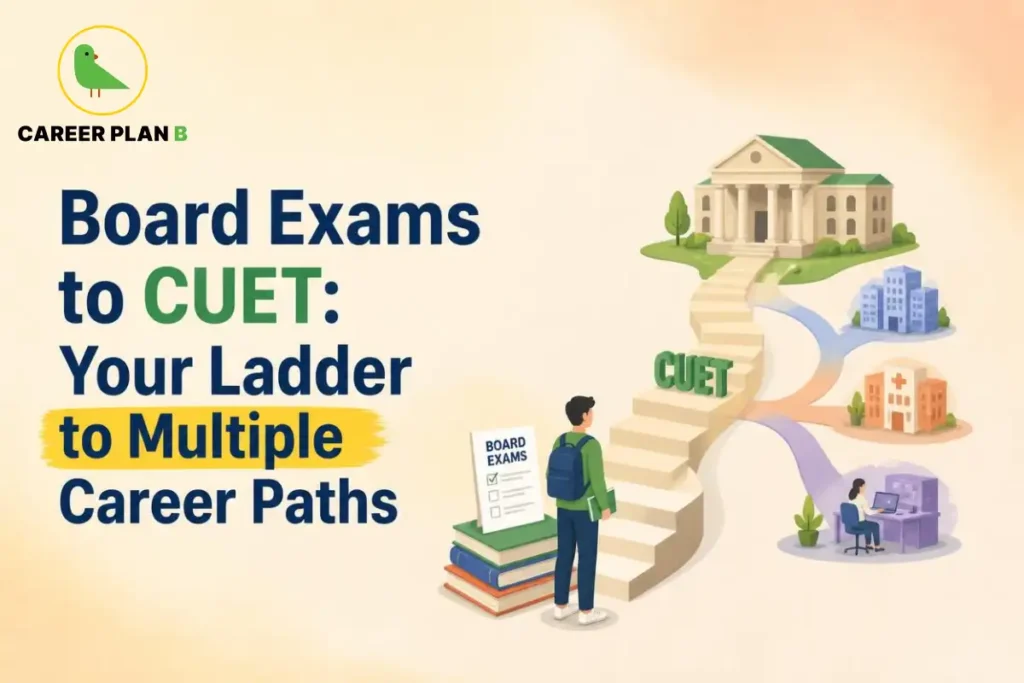
Introduction
Every year, millions of students sit with their board exam admit cards in hand, hearts racing, wondering — “What happens after this?” The pressure of boards feels enormous, almost like the entire future is sitting on those answer sheets. But here is something most students are not told early enough: board exams are not the finish line. They are just the first step on a much bigger ladder. The real climb begins when you move from board exams to CUET.
The Common University Entrance Test has quietly changed the way India thinks about undergraduate admissions. Suddenly, a student from a small town in Rajasthan and a student from a metro city school are standing on the same platform, competing on the same question paper. That is the power of this one exam. The journey from board exams to CUET is not just about switching from one test to another, it is about understanding that your career path is wider than you ever imagined. This blog is going to walk you through exactly that.
What Exactly Is CUET and Why Does It Matter Now?
Let’s be honest. A few years ago, if you scored 95% in your boards, you felt unstoppable. Delhi University cutoffs were the ultimate benchmark. But then came a shift — a big one.
The National Testing Agency (NTA) introduced CUET as a standardized entrance test for admissions into central universities across India. From 2022 onwards, scores from this single exam started determining seats in some of the most prestigious undergraduate programmes in the country. We are talking about universities like Delhi University, Jawaharlal Nehru University, Banaras Hindu University, University of Hyderabad, and many more.
According to the National Testing Agency, CUET is now the gateway to over 250 universities, including all 45 central universities in India. That number keeps growing.
One Exam, Many Doors
Think of CUET as a master key. Earlier, students had to apply to individual colleges, track multiple cutoffs, and hope their board percentage was enough. Now, one well-prepared exam can open doors across streams, subjects, and cities — all at once.
The exam tests you on:
- Section IA and IB — Language papers (13 languages to choose from)
- Section II — Domain-specific subjects (you pick based on your stream)
- Section III — General Test (logical reasoning, current affairs, quantitative aptitude)
You do not have to attempt all sections. You choose what applies to your course and university preferences. That flexibility itself is a game-changer for students planning their CUET 2027 preparation today.
Your Board Marks Still Matter — But Here’s the Twist
Here is where a lot of students get confused. They hear “CUET scores matter now” and immediately think board exams are irrelevant. That is not entirely true.
Most central universities require you to have passed your 12th boards with a minimum percentage — usually 50% for general category students. So boards are your entry ticket. But the actual seat? That goes to the student with the better CUET score, not necessarily the higher board percentage. This is actually great news. It means a student with 78% in boards but an excellent CUET score can secure a seat over someone with 94% who did not prepare for the entrance test. The playing field has genuinely become more level.
Banaras Hindu University’s official admissions page confirms that CUET scores are now the primary criteria for undergraduate admissions, with board marks serving only as eligibility proof. Similar policies exist across most central universities. So the mantra going forward is simple: clear your boards, then conquer CUET.
Which Career Paths Can CUET Actually Unlock?
This is the part students really need to hear. Because the most common assumption is that CUET is only for arts and humanities students, or that it is limited to B.A. programmes. That could not be further from the truth.
The journey from board exams to CUET can lead you into a surprisingly wide range of undergraduate courses — across all three streams.
Science Stream Students
If you are a science student, CUET opens doors to courses like:
- B.Sc. Physics, Chemistry, Biology, Mathematics
- B.Sc. Computer Science
- B.Sc. Biotechnology
- Integrated M.Sc. programmes
- B.Sc. Agriculture and allied sciences
Universities like the University of Delhi and University of Hyderabad offer strong science undergraduate programmes where CUET scores are the deciding factor.
Commerce Stream Students
Commerce students often feel their options are limited to B.Com and CA. CUET expands that thinking considerably:
- B.Com (Hons.)
- BBA / Bachelor of Business Administration
- B.Com with specialisations in Taxation, Finance, Accounting
- Economics (Hons.)
- Statistics (Hons.)
Jamia Millia Islamia’s official website lists several commerce and management programmes accessible through CUET scores.
Arts and Humanities Stream Students
Arts students arguably have the most to gain from CUET. The range of career options after 12th through this route is extraordinary:
- B.A. in English, History, Political Science, Sociology, Psychology
- B.A. in Mass Communication and Journalism
- B.A. in Social Work
- B.A. in Economics
- Integrated programmes in Law, Education, and more
A Quick Look: Stream, Courses, and Where You Can Go
| Stream | Popular CUET Courses | Top Central Universities |
|---|---|---|
| Science | B.Sc. Physics, Biotech, CS | DU, Hyderabad University, JNU |
| Commerce | B.Com Hons., BBA, Economics | DU, Jamia, BHU |
| Arts/Humanities | B.A. English, Psychology, Journalism | JNU, AMU, EFLU, DU |
| All Streams | General Test based courses | Multiple central universities |
How to Start CUET 2027 Preparation Right After Boards
If you are reading this as a student currently in Class 11 or just finished Class 12 boards, the best time to start thinking about CUET 2027 preparation is right now. Not after results. Not after summer vacation. Here is a realistic and simple roadmap:
Step 1 — Know your subject choices (April to May): Look at the courses you want to apply for and identify which domain subjects CUET requires. Do not pick randomly. Match it to your goal.
Step 2 — Understand the exam pattern (May): Visit the NTA CUET official website and go through the official syllabus and past year question papers. The pattern follows your NCERT syllabus closely — which is actually reassuring.
Step 3 — Build a study schedule (June to August): Give yourself at least three months of focused preparation. Section II (domain subjects) needs the most attention. Section III (General Test) can be prepared in parallel with daily reading and practice.
Step 4 — Mock tests and revision (September onwards): Attempt full-length mock tests regularly. Track your weak areas. Revise, not just re-read.
Step 5 — University and course research (Ongoing): Keep a running list of universities, courses, and their specific CUET subject requirements. Different universities may ask for different subject combinations. Central University of Rajasthan’s admissions portal is a good example of how individual universities list their CUET requirements separately.
One honest truth: most students who struggle with CUET do not fail because of lack of intelligence. They fail because of lack of direction. They studied hard but studied the wrong things, or applied to courses without understanding the eligibility properly.
For Personalized Guidance
Are You Making These Common Mistakes Without Even Realising It?
This is where a lot of well-meaning students go wrong. Let’s call them out clearly.
Mistake 1: Waiting for board results to start CUET preparation: Board results come out in May. CUET is typically held between May and June. That gap is razor thin. Students who wait lose crucial weeks.
Mistake 2: Ignoring the General Test section: Many students from science or commerce backgrounds skip Section III thinking it does not apply to them. But several courses, especially interdisciplinary ones require the General Test score. Check the university requirements carefully.
Mistake 3: Applying to too many courses without a plan: CUET allows you to choose multiple subjects and courses. Some students apply to 10 different programmes in panic mode without thinking about which ones align with their actual interests or stream selection after boards. This leads to confusion during counselling.
Mistake 4: Relying only on coaching notes instead of NCERT: The CUET syllabus is largely NCERT-based. Students who go back to their 11th and 12th NCERT textbooks and understand concepts thoroughly tend to perform better than those chasing shortcuts.
Mistake 5: Not researching universities early enough: Each university has its own CUET subject combinations and cutoffs. A student who wants to pursue B.A. Psychology at Delhi University needs to know which CUET subjects DU requires for that specific programme.
How Career Plan B Helps
Career Plan B helps students bridge the gap between Board exams and CUET preparation by providing clarity, structure, and personalized guidance at every stage of the journey:
- Personalized Career Counselling: Helps students understand their strengths, interests, academic goals, and future aspirations so they can make informed decisions about streams, courses, and universities.
- Psycheintel & Career Assessment Tests: Provides data-backed insights into aptitude, personality traits, interests, and learning styles, helping students identify academic and career paths that genuinely suit them.
- Stream, Course & University Alignment: Supports students in choosing academic pathways that match both their abilities and long-term ambitions rather than relying on trends or assumptions.
- Admission & Academic Profile Guidance: Helps students strengthen their academic profile, understand admission requirements, and prepare strategically for future opportunities.
- Career Roadmapping: Creates a structured, step-by-step plan that connects Board preparation, CUET 2027 goals, university admissions, and future career aspirations into one clear direction.
- End-to-End Guidance: Assists students throughout the process so every decision is thoughtful, informed, and aligned with their personal goals.
For Latest Information
Frequently Asked Questions
Q1. Is CUET compulsory for all central university admissions?
For most undergraduate programmes in central universities, yes. Since 2022, CUET scores have replaced direct board-based cutoffs for admission into all 45 central universities. However, a few deemed and private universities may still follow their own criteria. Always check the official university website for the latest admission policy.
Q2. Can a student from any stream appear for CUET?
Absolutely. CUET is open to students from Science, Commerce, and Arts streams. You choose the domain subjects relevant to your course of interest. There is no restriction based on which stream you studied in Class 12.
Q3. How many attempts does a student get for CUET?
As of now, there is no restriction on the number of attempts for CUET. You can appear every year as long as you meet the eligibility criteria. Students who are not satisfied with their score can reattempt the following year.
Q4. Does the CUET score expire after one year?
Yes, currently CUET scores are valid only for the academic year in which the exam is taken. They cannot be carried forward to the next year’s admissions cycle.
Q5. What if I want to apply to both CUET-based universities and non-CUET colleges?
You can do both simultaneously. CUET does not prevent you from applying to private colleges, state universities, or institutions with their own entrance exams. Many students keep both options open as a smart backup strategy.
Conclusion
The road from board exams to CUET is not as intimidating as it looks from the outside. Yes, it is a new system. Yes, it adds one more exam to your already full plate. But it also gives you something that the old cutoff system never really had a fair chance, regardless of which school you studied in or which city you come from. That matters more than most people acknowledge.
If you are a student standing at this crossroads right now, remember this: the students who do well are not always the ones who studied the most. They are the ones who planned the smartest. Start early, choose your subjects wisely, understand your university options, and do not be afraid to ask for help when the path gets unclear. Your board exams brought you this far now let CUET take you further.


