Team Career Plan B · November 4, 2026
Introduction
Nobody tells you about the 7 AM site meetings. Nobody mentions the mud on your boots by 8, the contractor arguments by 10, or the quiet pride you feel at 5 PM when you look at a column that wasn’t there yesterday.
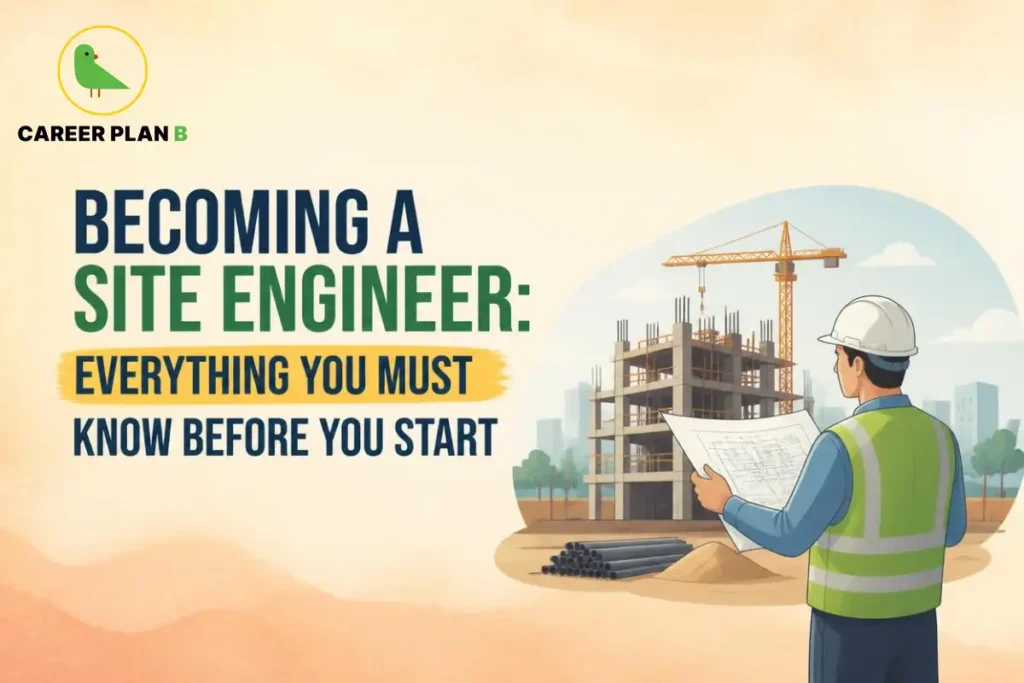
Becoming a site engineer is one of the most hands-on, high-responsibility career choices a civil engineering graduate can make and also one of the least understood. Engineering colleges teach you structural mechanics, fluid dynamics, and reinforced concrete design. What they rarely teach you is what actually happens on a construction site from Monday to Saturday.
This blog is that missing lesson. Whether you are a final-year civil engineering student, a fresher evaluating your first job offer, or someone curious about whether site engineering is the right path here is everything you genuinely need to know before you step onto that site.
What Does a Site Engineer Actually Do?
The textbook answer is a site engineer supervises construction activities on-site. The real answer is considerably more layered.
Key Site Engineer Roles and Responsibilities
On any given day, a site engineer is likely to be:
- Supervising construction activities ensuring work is carried out as per approved drawings and specifications
- Quality control and testing checking concrete mix ratios, rebar placement, compaction, and material quality
- Reading and interpreting drawings, translating design documents into on-ground instructions for labour and contractors
- Coordinating with contractors and subcontractors managing timelines, resolving on-site clashes, and keeping work moving
- Maintaining site records: daily progress reports, material consumption logs, inspection reports, and safety checklists
- Liaising with consultants and clients communicating site progress, flagging issues, and seeking design clarifications
The site engineer roles and responsibilities go far beyond supervision. You are essentially the bridge between the design team’s drawings and the labourers building from them, and that bridge needs to be exceptionally solid.
Site Engineer vs Design Engineer: Which Path Is Right for You?
One of the first choices a civil engineering graduate faces is the site engineer vs design engineer question. Both are valid, rewarding paths, but they suit very different personalities.
| Aspect | Site Engineer | Design Engineer |
|---|---|---|
| Work Environment | Outdoors, construction site | Office, design studio |
| Daily Work | Supervision, coordination, QC | Calculations, modelling, drawings |
| Physical Demand | High | Low |
| People Interaction | High (labour, contractors, clients) | Moderate (team, consultants) |
| Learning Curve | Steep and fast | Gradual and deep |
| Salary Growth | Experience-driven | Specialisation-driven |
If you enjoy being outdoors, thrive under pressure, and want to see the direct results of your decisions in concrete and steel, becoming a site engineer is likely your calling. If you prefer analytical depth, software tools, and structured office work, design engineering may suit you better.
Skills Required for a Site Engineer Beyond the Textbook
The skills required for a site engineer fall into three categories, and only one of them is taught in college.
Technical Skills
- AutoCAD and drawing interpretation essential for reading structural, architectural, and MEP drawings on site
- Construction materials knowledge: understanding grades of concrete, steel specifications, brick masonry, and waterproofing systems
- MS Project or Primavera for basic scheduling and progress tracking
- Knowledge of IS codes particularly IS 456, IS 1786, and IS 2911 for reinforced concrete and foundation work
Soft Skills
- Leadership under pressure: you will manage teams of 20 to 200 people; authority and calm matter equally
- Communication: You need to explain technical requirements to non-technical labour and report progress clearly to senior management
- Problem-solving site problems do not wait for meetings; quick, practical decisions are a daily requirement
On-Ground Practical Skills
- Supervising bar bending schedules and reinforcement placement
- Conducting slump tests, cube tests, and other quality checks
- Managing subcontractor work sequences
- Identifying and flagging safety hazards before they become incidents
For official skill standards and competency frameworks for construction professionals in India, refer to the National Career Service Portal.
Site Engineer Salary in India What Can You Realistically Expect?
Understanding site engineer salary in India helps set realistic expectations before your first job offer arrives.
Salary by Experience Level
| Experience Level | Salary Range (Per Annum) |
|---|---|
| Fresher (0–2 years) | ₹2.5 LPA – ₹5 LPA |
| Mid-Level (3–6 years) | ₹5.5 LPA – ₹12 LPA |
| Senior (7–12 years) | ₹12 LPA – ₹22 LPA |
| Project Engineer / Manager (12+ yrs) | ₹22 LPA – ₹40 LPA+ |
Sector-Wise Differences
- Government roles (CPWD, PWD, Railways): Structured pay scales, allowances, and long-term job security. CPWD Junior Engineer pay starts at approximately ₹35,400 per month as per the 7th Pay Commission.
- Private construction firms: Higher starting packages but more demanding hours and project-based employment.
- MNCs and international contractors (L&T, Shapoorji, Tata Projects): Competitive salaries with structured growth and international project exposure.
For official government pay scales and engineering cadre structures, refer to the 7th Central Pay Commission guidelines via the Ministry of Finance.
For global civil engineering salary benchmarks, refer to the U.S. Bureau of Labour Statistics
The Ground Realities Nobody Tells You About
This is the section most career blogs skip. Before becoming a site engineer, here is what you should genuinely be prepared for:
- Long and irregular hours: Site schedules are driven by project deadlines, weather, and contractor availability, not a 9-to-5 clock. Six-day work weeks are common on active projects.
- Physical demand: You will spend hours walking across sites, climbing scaffolding, standing in sun and rain, and inspecting work at height. Physical fitness is a quiet requirement.
- Labour management: Communicating with and managing daily wage workers, masons, and contractors requires patience, authority, and cultural awareness, especially on large multi-state projects.
- Documentation pressure: Every concrete pour, inspection, and material delivery needs to be recorded. Poor documentation is a career risk.
- The learning curve is steep, and that is the point: in your first two years as a site engineer, you will learn more practically than in your entire four-year degree combined. It is demanding precisely because it is valuable.
The construction site engineer career is not glamorous in the traditional sense, but for those who love building, it is deeply fulfilling.
For Personalized Guidance
Construction Site Engineer Career Growth: Where Can You Go?
The civil engineering career after B.Tech through the site engineering route has a clear and well-defined growth ladder:
Junior Site Engineer → Site Engineer → Senior Site Engineer → Project Engineer → Project Manager → Construction Director
Beyond the linear path, experienced site engineers often branch into:
- Planning and scheduling transitioning into project controls using Primavera or MS Project
- Quantity surveying and estimation moving into commercial management of projects
- Construction consultancy advising clients and developers independently
- Government services qualifying through GATE for PSU roles in RITES, NBCC, WAPCOS, or NHAI
Higher studies worth considering for career acceleration:
- M.Tech in Construction Management or Structural Engineering
- PMP (Project Management Professional) certification
- MBA in Infrastructure or Construction Management
For government engineering recruitment and official job profiles across PSUs,
How to Prepare Before Your First Site Job
The best time to prepare for becoming a site engineer is before you graduate, not after. Here is a practical checklist:
- Do at least one construction site internship: Even 4–6 weeks on an active site teaches you more than a semester of theory.
- Learn AutoCAD and at least one project management tool: These are Day 1 expectations at most firms.
- Study relevant IS codes: IS 456 (Plain and Reinforced Concrete), IS 1786 (Steel for Reinforcement), and IS 875 (Loads on Structures) are your on-site reference points.
- Invest in safety knowledge: OSHA and NBC (National Building Code) awareness signals professional maturity from day one.
- On Day 1, carry a notebook, a measuring tape, a torch, a hard hat, safety shoes, and the humility to ask questions.
How Career Plan B Helps
Becoming a site engineer is just one of many directions a civil engineering graduate can take, and choosing the right one early saves years of course correction. Career Plan B helps civil engineering students and freshers through personalised career counselling, Psycheintel career assessment tests, academic profile guidance, and career roadmapping so you understand whether site engineering, design, government services, or higher studies is the right next step for your specific strengths and goals.
Get In Touch With Us
Frequently Asked Questions (FAQs)
Q1. What qualifications do I need to become a site engineer in India?
A B.Tech or B.E. in Civil Engineering is the standard qualification. Some firms also hire diploma holders for junior site roles. Additional certifications in AutoCAD, project management, or safety management improve employability significantly.
Q2. Is site engineering a good career choice in India?
Yes. With India’s massive infrastructure investment pipeline and booming real estate sector, the demand for competent site engineers is strong and consistent. The construction site engineer career offers rapid practical learning and clear growth pathways.
Q3. What is the starting salary for a site engineer in India?
Freshers typically earn between ₹2.5 LPA and ₹5 LPA depending on the employer, project type, and location. Government junior engineer roles start at approximately ₹35,400 per month under the 7th Pay Commission.
Q4. Is site engineering physically demanding?
Yes. Site engineers spend significant time outdoors, on scaffolding, and across large construction sites in varying weather conditions. Physical fitness and stamina are practical requirements of the role.
Q5. How is a site engineer different from a project manager?
A site engineer focuses on day-to-day technical supervision and quality control on site. A project manager oversees the entire project budget, timelines, client management, and multi-team coordination. Site engineering is typically the foundation from which project managers grow.
Conclusion
Becoming a site engineer is choosing a career that is challenging, physical, constantly evolving, and deeply satisfying for those who love to build. It is not the easiest path, but it is one of the most real. Every structure you supervise will stand long after you have moved on to your next project.
Go in with your eyes open, knowing the salary realities, the skill gaps to close, the physical demands, and the growth that waits on the other side of those early years. The best site engineers are not just technically sharp. They are prepared, adaptable, and relentlessly curious.
The site is waiting. Make sure you are ready for it.