Team6 · November 4, 2026
Introduction
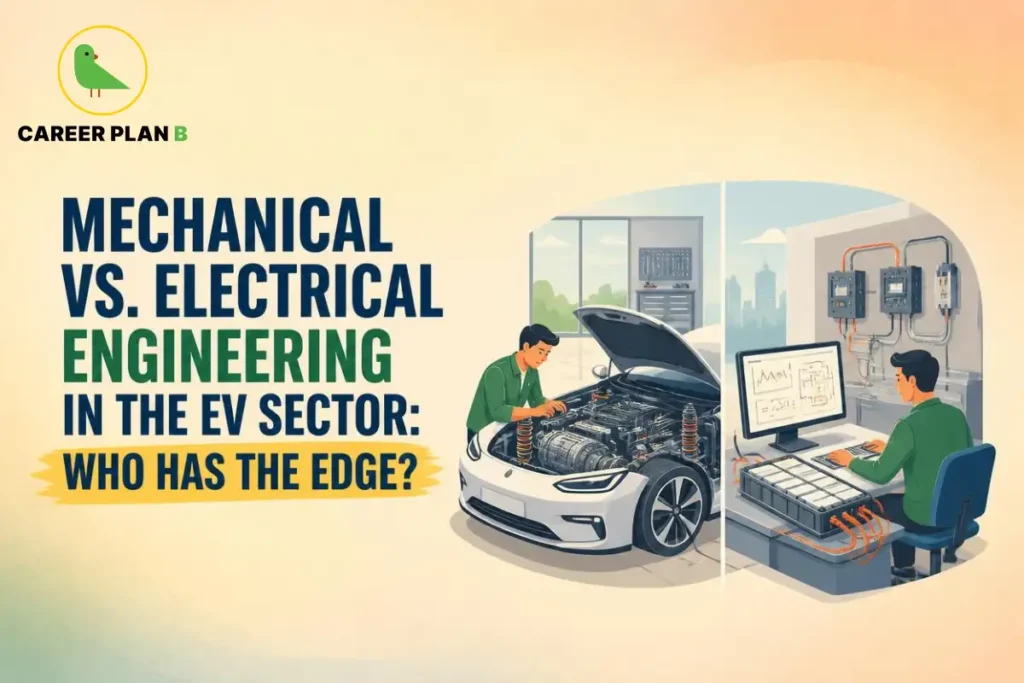
Walk into any engineering college today, and you will hear the same debate playing out in classrooms, hostels, and placement cells: mechanical or electrical for the EV sector? It is one of the most genuinely important career questions of this decade, and the answer is far more nuanced than most people realise.
Mechanical vs electrical engineering in the EV sector is not a winner-takes-all competition. It is a question of which domain fits your strengths, which roles excite you, and where India’s rapidly growing electric vehicle industry needs talent most urgently right now.
India’s EV market is on a steep upward curve. The government has committed over ₹10,000 crore under the FAME II scheme to accelerate electric vehicle adoption and manufacturing, as outlined by the Ministry of Heavy Industries. EV sales in India crossed 1.5 million units in FY2023–24, and with the National Electric Mobility Mission Plan pushing hard toward electrification of public transport and personal vehicles alike, the demand for skilled EV engineers from both mechanical and electrical backgrounds is growing faster than most other engineering domains.
This blog breaks down exactly what each branch contributes to the EV sector, where the jobs are, what the salaries look like, and how to decide which path makes more sense for your specific profile and goals.
How the EV Sector Actually Works And Why Both Branches Matter
To understand the mechanical vs. electrical engineering in the EV sector debate clearly, you first need to understand how an electric vehicle actually comes together as a product.
An EV is not simply a car with a battery instead of a fuel tank. It is a deeply integrated system where mechanical and electrical engineering work in constant interdependence:
- The battery pack needs a mechanically engineered structural enclosure and an electrically engineered Battery Management System
- The electric motor requires electrical design for its windings and control electronics and mechanical design for its housing, shaft, and bearings
- The chassis and body are purely mechanical, but they must accommodate electrical wiring harnesses, charging ports, and battery modules
- The thermal management system is mechanically designed but thermally affects battery and electronics performance
- The charging infrastructure is primarily electrical but requires mechanical installation and housing design
Neither branch owns the EV sector entirely. Both are essential, but they contribute in very different ways to very different problems.
What Mechanical Engineers Do in the EV Sector
Mechanical engineer roles in electric vehicles are broader and more varied than most students expect. Here is where mechanical engineers genuinely lead in EV development:
Chassis and Structural Design
EV platforms have fundamentally different architecture from conventional vehicles; the absence of an engine bay and transmission tunnel opens up the floor for battery integration. Mechanical engineers design the structural frame, crash management systems, and body-in-white components that keep the vehicle safe and rigid. Tools like CATIA, HyperMesh, and ANSYS are standard in this role.
Thermal Management Systems
Lithium-ion battery cells operate optimally within a narrow temperature window, typically between 15°C and 35°C. Outside this range, performance drops and degradation accelerates. Mechanical engineers design the cooling circuits, heat exchangers, cold plates, and thermal interface materials that keep batteries and power electronics within safe operating temperatures. This is one of the most critical and in-demand electric vehicle design and development jobs for mechanical engineers today.
Battery Pack Mechanical Enclosure
The battery pack casing must be lightweight yet structurally robust enough to survive crash loads, road vibrations, and thermal cycling over a 10-year vehicle life. Mechanical engineers design these enclosures using lightweight materials engineering principles, working with aluminium alloys, advanced high-strength steel, and composite materials to meet weight and safety targets simultaneously.
Lightweighting and Materials Engineering
Every kilogram saved in an EV directly translates to extended driving range. Mechanical engineers specialising in lightweighting work on material substitution, topology-optimised structural designs, and manufacturing process selection to reduce vehicle weight without compromising safety or durability.
Key employers for mechanical engineer roles in electric vehicles in India include Tata Motors, Mahindra Electric, Ola Electric, Bajaj Auto, TVS Motor Company, and global EV engineering centres like the Mercedes-Benz R&D India and Stellantis technical centres.
What Electrical Engineers Do in the EV Sector
Electrical engineering jobs in the EV industry are arguably the fastest-growing segment of EV hiring right now, driven by the electronics intensity of modern electric powertrains. Here is where electrical engineers lead:
Battery Management System (BMS) Engineering
The BMS is the brain of the battery pack. It monitors cell voltages, temperatures, and state of charge in real time, balances cells during charging, and protects the pack from overcharging or thermal runaway. Electrical engineers design and program BMS hardware and firmware, making this one of the most technically demanding and well-compensated roles in the entire EV ecosystem.
Motor and Powertrain Electronics
Electric motors in EVs are driven by sophisticated power electronics that control speed, torque, and energy regeneration during braking. Electrical engineers design motor controllers, develop control algorithms, and validate powertrain performance across driving cycles. Knowledge of MATLAB, Simulink, and embedded C is essential for this role.
Power Electronics and Inverter Design
Power electronics and EV engineering are one of the most critical intersections in the entire field. The inverter converts DC power from the battery into AC power for the motor, and its efficiency directly determines the vehicle’s range and performance. Electrical engineers designing inverters work with IGBTs, SiC MOSFETs, gate drivers, and thermal management of power modules. This is a highly specialised, high-value skill set.
EV Charging Infrastructure Engineering
India’s EV charging network is expanding rapidly under government initiatives. The Ministry of Power has issued guidelines for EV charging infrastructure that are driving large-scale deployment of public and private charging stations across the country. Electrical engineers design AC and DC fast-charging systems, grid integration solutions, and smart charging protocols, creating a large and growing segment of electrical engineer jobs in the EV industry.
Key employers for electrical engineering roles in the EV sector include Tata Power, Ather Energy, ChargeZone, Delta Electronics, Exicom, and the EV divisions of Maruti Suzuki, Hero MotoCorp, and Hyundai India.
Head-to-Head Comparison: Mechanical vs Electrical in EV
Here is a straightforward comparison to help you understand where each branch stands in the EV sector:
Roles:
- Mechanical: Chassis design, thermal management, enclosure engineering, lightweighting, NVH
- Electrical: BMS, motor control, power electronics, inverter design, charging systems
Primary Tools:
- Mechanical: CATIA, SolidWorks, ANSYS, HyperMesh, MATLAB Thermal
- Electrical: MATLAB/Simulink, Altium Designer, CAN bus tools, SPICE, embedded C/C++
Entry-Level Salary Range:
- Mechanical: ₹4–7 LPA
- Electrical: ₹4.5–8 LPA
Mid-level Salary Range:
- Mechanical: ₹8–15 LPA
- Electrical: ₹9–18 LPA
Demand Growth:
- Mechanical: Strong and steady, driven by new platform development
- Electrical: Very high and accelerating, driven by electronics intensity of EVs
Natural Advantage:
- Mechanical: Vehicle architecture, safety systems, materials and manufacturing
- Electrical: Powertrain intelligence, energy efficiency, charging and grid integration
It is worth noting that the roles with the highest demand and compensation in the EV sector increasingly sit at the intersection of both branches, making mechatronics and systems engineering profiles are particularly valuable for the best engineering branch for EV careers conversation.
Which Branch Has More EV Jobs in India Right Now?
Both branches are hiring actively, but the composition is shifting. Based on current hiring trends across EV OEMs, startups, and Tier 1 suppliers in India, electrical and electronics engineering profiles are seeing slightly faster demand growth, primarily because:
- EV powertrains are fundamentally electronics-intensive
- BMS, motor control, and power electronics talent is in shorter supply relative to demand
- Software-hardware integration roles which lean electrical are multiplying rapidly
However, mechanical engineers remain indispensable for vehicle platform development, manufacturing scale-up, and thermal systems, all of which are at peak activity as Indian OEMs launch new EV platforms.
The government’s PLI scheme for automobiles and auto components and the PLI for advanced chemistry cells are driving domestic manufacturing investment that creates both mechanical and electrical engineering roles in equal measure across the supply chain.
The National EV Policy and the MoRTH guidelines for electric vehicle standards are also expanding the regulatory and testing ecosystem, creating additional roles in compliance, validation, and homologation engineering for both branches.
Have Any Doubts?
Should You Specialise or Stay Broad?
The honest answer is to specialise deeply in your core branch first, then build cross-disciplinary awareness deliberately.
A mechanical engineer who understands battery thermal behaviour and BMS fundamentals is far more valuable to an EV employer than one who only knows structural design. An electrical engineer who understands vehicle dynamics and chassis constraints designs better motor control systems than one who works in isolation.
For students seriously considering the future of EV jobs for engineers in India, the following paths add significant value:
- M.Tech in Electric Vehicle Technology or Power Electronics offered by IITs, NITs, and VIT, among others
- Certification in EV systems from SAE India which offers EV-specific technical programmes
- NPTEL courses in battery technology, power electronics, or vehicle dynamics
- Mechatronics upskilling: understanding both mechanical and electrical systems makes you a stronger candidate for system-level EV roles
How Career Plan B Helps
Choosing between a mechanical or electrical engineering path in the EV sector is not just about which branch has more jobs; it is about where your specific aptitude, strengths, and interests align with the available opportunities. Career Plan B offers PsycheIntel aptitude assessments that help engineering students identify whether their profile is better suited to mechanical design and thermal roles or electrical and power electronics domains within the EV industry. Through personalised career counselling and structured EV career roadmapping, Career Plan B guides you from your current position, whether a student or a working professional, toward the specific roles, tools, and companies that match your individual goals in India’s fast-growing EV sector.
For Latest Information
Frequently Asked Questions (FAQs)
Q1. Is mechanical or electrical engineering better for an EV career in India?
Both branches have strong and growing roles in the EV sector; they simply contribute to different systems. Electrical engineers lead in BMS, power electronics, and motor control, while mechanical engineers lead in chassis design, thermal management, and battery enclosures. The better branch depends entirely on your individual aptitude and interests.
Q2. What is the salary of a mechanical engineer in the EV sector in India?
Entry-level mechanical engineers in EV roles typically earn ₹4–7 LPA, with mid-level professionals earning ₹8–15 LPA. Senior design and thermal management specialists at leading OEMs and Tier 1 suppliers can earn ₹15–28 LPA.
Q3. What is the salary of an electrical engineer in the EV industry in India?
Entry-level electrical engineers in EV roles earn ₹4.5–8 LPA, with BMS and power electronics specialists commanding a premium. Mid-level professionals earn ₹9–18 LPA, and senior powertrain electronics engineers at top companies can earn ₹20–35 LPA.
Q4. Can a mechanical engineer switch to electrical roles in the EV sector?
Direct switching between core domains is uncommon, but mechanical engineers can expand into thermal-electrical interface roles, battery pack systems engineering, and EV integration testing, all of which require understanding of both disciplines. Targeted upskilling, through certifications and PG programmes, makes this transition more achievable.
Q5. Which skills should I develop as a fresher to enter the EV sector?
For mechanical engineers: CATIA or SolidWorks, ANSYS thermal and structural simulation, and knowledge of battery thermal management fundamentals. For electrical engineers: MATLAB/Simulink, power electronics basics, BMS architecture understanding, and embedded C programming. Both branches benefit from familiarity with CAN bus communication and EV system architecture.
Conclusion
The mechanical vs. electrical engineering in the EV sector debate does not have a single winner, and that is actually good news for engineers from both backgrounds. India’s EV industry is large enough, complex enough, and growing fast enough to need both branches at full capacity simultaneously.
What matters is not which branch you are from; it is how deeply you develop your skills, how well you understand the EV system as a whole, and how clearly you can articulate your value to an employer building the next generation of electric vehicles.
If you want personalised guidance on how your specific engineering profile fits into India’s EV sector, whether you are a mechanical or electrical engineering student or a professional exploring a transition, Career Plan B offers aptitude assessments, career counselling, and a roadmap built around your strengths and goals.
The EV sector is the defining engineering frontier of this decade. The question is not mechanical or electrical; the question is whether you are ready.