Team6 · November 4, 2026
Introduction
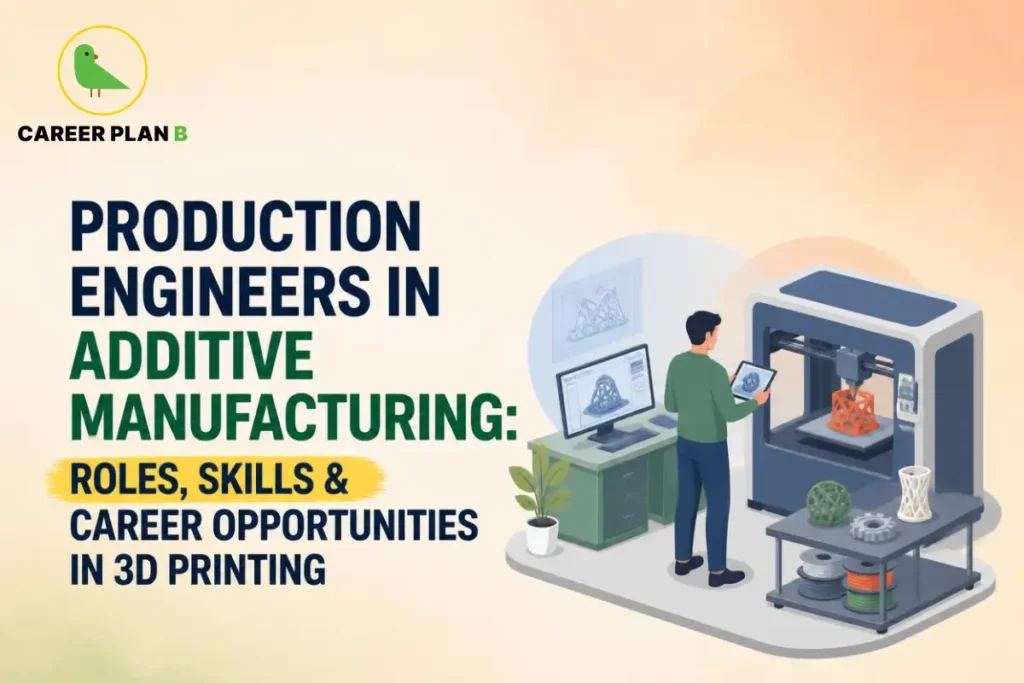
The factory of the future does not just stamp, cut, or weld. It prints. Consider a jet engine fuel nozzle. Earlier, manufacturers needed 20 separately welded components to produce it. Today, additive manufacturing can print it as one lighter and stronger part. Similarly, manufacturers can produce customised knee implants overnight. Rocket manufacturers can also produce combustion chambers in days instead of months.
These are real manufacturing applications, not just experiments. Production engineers in additive manufacturing help make these breakthroughs possible.
The global additive manufacturing market is projected to exceed USD 76 billion by 2030, with a CAGR of over 20%. India also recognises this technology as a strategic priority. NITI Aayog has released a National Strategy for Additive Manufacturing to guide its adoption. (Source: NITI Aayog)
Consequently, production engineers have exciting career opportunities across aerospace, defence, healthcare, automotive, and consumer goods. This blog explores the available roles, essential skills, certifications, and India’s growing additive manufacturing ecosystem.
What Is Additive Manufacturing and Why Does It Matter?
Traditional manufacturing removes material from a block through cutting, drilling, milling, and turning. Additive manufacturing follows the opposite approach. It builds components layer by layer using a digital design file.
Why Is Additive Manufacturing Important?
This technology offers several advantages:
- Design freedom: Engineers can create complex shapes and lightweight components.
- Material efficiency: It can reduce material waste compared with traditional manufacturing.
- Supply chain compression: On-demand printing reduces inventory and production lead times.
- Mass customisation: Manufacturers can produce different parts without expensive retooling.
- Distributed manufacturing: Companies can produce components closer to where they are needed.
Key Additive Manufacturing Technologies
Different printing methods support different materials and applications:
- FDM (Fused Deposition Modelling): Used for plastic prototypes and functional parts.
- SLA (Stereolithography): Produces detailed resin prototypes and dental applications.
- SLS (Selective Laser Sintering): Uses nylon and composite powders for functional parts.
- DMLS/SLM: Supports metal printing for aerospace, defence, and medical implants.
- Binder Jetting: Enables metal and ceramic printing for industrial production.
- DED (Directed Energy Deposition): Supports large-scale metal printing and component repair.
India’s defence and space organisations are already adopting these technologies. DRDO uses additive manufacturing for defence components, while ISRO has used 3D-printed parts in launch vehicles and satellite programmes. (Sources: DRDO and ISRO)
What Does a Production Engineer Do in Additive Manufacturing?
Production engineers in additive manufacturing do much more than operate 3D printers. They connect digital designs with physical products and develop efficient manufacturing processes.
Core Responsibilities
Their main responsibilities include:
- Design for Additive Manufacturing (DfAM): Redesigning components for 3D printing, topology optimisation, and lightweight structures.
- Process Parameter Optimisation: Selecting suitable layer thickness, laser power, print speed, and temperature.
- Material Selection and Qualification: Evaluating metals, polymers, composites, and ceramics.
- Quality Assurance and Metrology: Inspecting components through CT scanning, CMM, and non-destructive testing.
- Post-Processing Management: Supervising heat treatment, surface finishing, support removal, and coating.
- Production Workflow Design: Combining additive and conventional manufacturing into efficient production systems.
How Is This Role Different from Traditional Production Engineering?
Traditional production engineers often work with finalised designs. However, additive manufacturing brings design and production closer together.
Production engineers now collaborate with design teams from the beginning. They help improve product performance and manufacturing efficiency. The Society of Manufacturing Engineers (SME) also identifies additive manufacturing as a priority skill area for production engineers. (Source: SME)
Top Career Roles for Production Engineers in Additive Manufacturing
Industrial 3D printing job opportunities in 2026 cover technical, research, quality, and management functions. Production engineers can work in process development, materials research, and product development.
Career Opportunities at a Glance
| Role | Key Skills Required | Top Employers | 2026–2027 Additive Manufacturing Job Market Alignment |
|---|---|---|---|
| AM Process Engineer | DfAM, process optimisation, slicing software | DRDO, HAL, Wipro 3D, Renishaw | Crucial for fine-tuning metal powder bed fusion (PBF) parameters, reducing residual stress, and scaling high-precision aerospace components. |
| 3D Printing Application Engineer | CAD, material selection, application development | Stratasys, EOS, 3D Systems | Bridges client requirements with technical feasibility, managing rapid prototyping and production-grade polymer/metal deployment. |
| Quality and Metrology Engineer | CT scanning, CMM, GD&T | Aerospace OEMs, medical device firms | Ensures structural integrity and internal defect detection for critical flight-worthy and patient-specific medical implants. |
| Materials Engineer for AM | Metallurgy, polymer science, powder characterisation | Tata Advanced Materials, ISRO, BARC | Focuses on powder morphology, feedstock recycling, and qualifying high-entropy alloys and advanced composites for extreme environments. |
| Rapid Prototyping Engineer | FDM, SLA, SLS, functional testing | Automotive OEMs, product design firms | Drives fast iteration cycles for consumer goods and automotive design validation, compressing time-to-market windows. |
| AM Production Manager | Workflow design, capacity planning | Defence PSUs, aerospace suppliers | Oversees industrial-scale additive factories, digital thread management, post-processing automation, and shop-floor efficiency. |
Additive Manufacturing Process Engineer
Process engineers develop, qualify, and improve manufacturing processes. They work with design engineers to implement DfAM principles and establish suitable production parameters.
In India, HAL and DRDO laboratories are developing additive manufacturing capabilities for defence and aerospace applications. (Source: HAL)
3D Printing Application and Design Engineer
Application engineers help customers identify suitable uses for additive manufacturing. They redesign components, select materials, and validate printed products against functional requirements.
This role requires CAD knowledge and an understanding of different printing technologies. Additionally, strong communication skills help engineers convert customer needs into practical designs.
Quality and Metrology Engineer in Additive Manufacturing
Complex internal structures and lattice designs require advanced inspection methods. Therefore, quality engineers use industrial CT scanning, coordinate measuring machines, and surface roughness analysis.
They develop inspection plans and verify that printed components meet industry standards. This work is especially important in aerospace, healthcare, and defence.
Materials Engineer for Additive Manufacturing
Materials engineers study metal powders, polymer filaments, and other printing materials. They also examine how printing parameters affect microstructure and mechanical properties.
BARC and several IIT research groups conduct materials research for nuclear, aerospace, and biomedical applications. (Source: BARC)
Rapid Prototyping and Product Development Engineer
Rapid prototyping helps companies shorten product development cycles. Engineers use 3D printing to create prototypes for design validation, functional testing, and customer feedback.
For example, Tata Motors, Mahindra, and Maruti Suzuki use rapid prototyping in vehicle development. Therefore, engineers with product development and additive manufacturing skills can explore opportunities in the automotive industry.
Key Skills Production Engineers Must Build for Additive Manufacturing Careers
A successful career requires design knowledge, materials expertise, process engineering, and software proficiency. The following skills can help you build a competitive profile.
Technical Skills
- CAD and Design for AM: Autodesk Fusion 360, SolidWorks, and CATIA.
- Slicing Software: Materialise Magics, Autodesk Netfabb, Cura, and PreForm.
- Simulation Tools: ANSYS Additive and Simufact Additive.
- Metrology and Inspection: GD&T, CMM operation, and industrial CT scanning.
- Materials Science: Metal powder characterisation, polymer behaviour, and composite properties.
- Post-Processing: Heat treatment, HIP, surface finishing, and coating.
- Process Qualification: DOE, statistical process control, AS9100, and ISO 13485.
Key Certifications
Consider these certifications and training options:
- SME Additive Manufacturing Technologist (AMT): A professional certification administered by the Society of Manufacturing Engineers. (Source: SME)
- NPTEL Additive Manufacturing Courses: Courses from IIT faculty covering 3D printing and manufacturing fundamentals. (Source: NPTEL)
- NITI Aayog and MeitY Programmes: Government-backed training aligned with India’s additive manufacturing strategy. (Source: NITI Aayog)
- Autodesk Certified Professional Fusion 360: Demonstrates CAD and design software proficiency. (Source: Autodesk)
- ASME Additive Manufacturing Courses: Technical training for additive manufacturing professionals. (Source: ASME)
- GATE (Production Engineering / Mechanical Engineering): Supports postgraduate admissions and certain PSU recruitment pathways. (Source: GATE)
Soft Skills
Technical knowledge alone is not enough. Employers also value design thinking, attention to detail, teamwork, and problem-solving.
Strong documentation and reporting skills are equally important. Moreover, adaptability helps engineers keep up with changing technologies and materials.
Have Any Doubts?
India’s Additive Manufacturing Ecosystem and Policy Push
India is encouraging additive manufacturing through policy support, research investment, and industry development. These initiatives are creating new opportunities for production engineers.
NITI Aayog National Strategy for Additive Manufacturing
NITI Aayog’s National Strategy for Additive Manufacturing identifies four priority sectors: defence, aerospace, healthcare, and automotive.
It also highlights the need for a skilled workforce. Consequently, the strategy supports training, research, and industry development. (Source: NITI Aayog)
Defence and Aerospace Leadership
DRDO, ISRO, HAL, and BEL are among India’s active adopters of additive manufacturing. They use the technology for rocket components, aircraft parts, and satellite brackets.
As these organisations expand their capabilities, they create specialised opportunities for production engineers. (Source: DRDO)
PLI Scheme for Advanced Manufacturing
India’s Production Linked Incentive schemes support sectors such as electronics, pharmaceuticals, and automotive manufacturing.
This investment encourages companies to explore advanced manufacturing technologies. As a result, opportunities can emerge both in companies adopting 3D printing and among equipment and material suppliers. (Source: Ministry of Commerce and Industry)
Research and Academic Ecosystem
IITs, NITs, and institutions such as CMTI are strengthening India’s additive manufacturing research capabilities.
These organisations support technical development and produce skilled graduates. They also offer research opportunities for engineers interested in advanced manufacturing. (Source: CMTI)
Smart Manufacturing and Industry 4.0 Integration
Additive manufacturing is becoming an important part of smart factories. Companies are adopting digital twins, connected manufacturing systems, and AI-driven process optimisation.
These technologies connect different stages of production. Therefore, engineers who combine additive manufacturing expertise with digital manufacturing knowledge can explore emerging Industry 4.0 careers.
How Career Plan B Helps
Choosing a career in additive manufacturing involves several decisions. You need to select the right specialisation, develop technical skills, and identify suitable industries.
Career Plan B supports production and mechanical engineering students through personalised career guidance.
Its services include expert career counselling, PsycheIntel-based career assessments, and structured career roadmapping. These services help you identify suitable roles in process engineering, materials, quality, and product development.
Additionally, Career Plan B helps you create a step-by-step action plan. This gives you a clearer direction from your current academic stage to your target career.
For Latest Information
Frequently Asked Questions (FAQs)
Q1. What is the role of production engineers in additive manufacturing?
Production engineers design, optimise, and manage 3D printing processes. Their responsibilities include DfAM, process parameter optimisation, material qualification, and quality control.
They also manage post-processing and integrate additive manufacturing into production workflows. In short, they connect digital designs with physical manufacturing.
Q2. What are the best 3D printing engineering careers in India in 2026?
Some promising roles include AM Process Engineer, Materials Engineer, Quality and Metrology Specialist, and Rapid Prototyping Engineer.
Aerospace and defence organisations such as DRDO, ISRO, and HAL offer specialised opportunities. Meanwhile, automotive companies and medical device manufacturers are also adopting additive manufacturing.
Q3. What educational background is needed for production engineering roles in additive manufacturing?
A degree in Production Engineering, Mechanical Engineering, Materials Science, or Manufacturing Engineering provides a strong foundation.
However, postgraduate specialisation in advanced manufacturing can improve your prospects. You can also strengthen your profile through SME AMT certification and NPTEL courses.
Q4. How is additive manufacturing different from traditional production engineering?
Traditional production engineering focuses on processes such as machining, casting, and forging. Manufacturers usually finalise the design before production begins.
Additive manufacturing changes this approach. Production engineers now participate in design decisions through DfAM and work with a wider range of materials.
Consequently, the role involves greater collaboration between design and manufacturing teams.
Q5. Is additive manufacturing a good long-term career choice for production engineers?
Yes. The global additive manufacturing market is growing rapidly, and India considers it a strategic manufacturing technology.
Domestic adoption across defence, aerospace, healthcare, and automotive is also increasing. Furthermore, Industry 4.0 and smart manufacturing are creating new applications for this technology.
Q6. What industries in India offer the most industrial 3D printing job opportunities?
Aerospace and defence offer specialised opportunities through DRDO, ISRO, HAL, and BEL. Automotive companies provide roles in rapid prototyping and product development.
Medical device manufacturers and advanced electronics firms are also adopting 3D printing. Additionally, CMTI and IIT research laboratories offer academic and R&D opportunities.
Conclusion
Manufacturing is changing layer by layer, and production engineers in additive manufacturing are helping lead this transformation.
Their work supports aerospace, healthcare, defence, and automotive industries. For example, additive manufacturing helps produce rocket components, customised medical implants, and lightweight automotive parts.
India is also encouraging this technology through policy initiatives, defence and space programmes, and research investment. Consequently, the domestic ecosystem is creating new opportunities for skilled engineers.
For production engineers interested in smart manufacturing and Industry 4.0, this field offers an exciting career path. It combines design, materials science, and advanced production techniques.
Moreover, professionals can work across different industries while contributing to innovations that are changing how products are made.