Team Career Plan B · November 4, 2026
Introduction
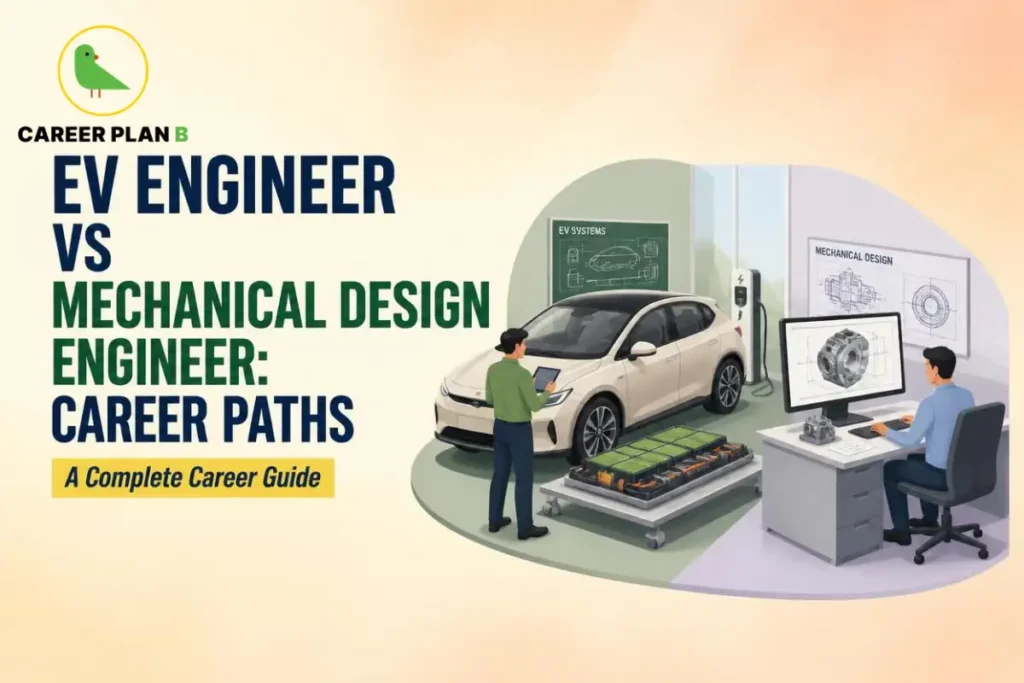
One designs the future of mobility. The other designs the machines that keep almost every industry running. Both fall under “engineering”, but the day-to-day reality of these two roles looks very different. EV engineer vs mechanical design engineer career paths is a comparison many students lump together without realising how distinct these roles actually are. In this blog, we will break down what each role involves, the skills each demands, career scope, salary, and how to decide which path suits you.
Who Is an EV Engineer? What Does the Role Involve?
An EV engineer works specifically on electric vehicle systems. This is a relatively new, highly specialised role that has emerged alongside India’s push toward electric mobility.
Core responsibilities typically include:
- Battery systems and battery management design
- Electric motor and drivetrain engineering
- Power electronics for energy conversion and control
- EV-specific thermal management and safety systems
This role sits at the intersection of automobile, electrical, and electronics engineering, making it one of the more technically diverse specialisations in the current job market.
Who Is a Mechanical Design Engineer? What Does the Role Involve?
A mechanical design engineer focuses on designing physical products and components, using tools like CAD software, applying structural analysis, and factoring in manufacturing constraints from the start.
Unlike EV engineering, this role is not tied to one industry. Mechanical design engineers work across:
- Automotive components (traditional and EV)
- Aerospace and defence equipment
- Consumer goods and appliances
- Heavy machinery and industrial equipment
This is a broader, more established role with decades of industry presence across nearly every manufacturing sector.
Difference Between EV Engineer and Mechanical Design Engineer: Key Distinctions
| Factor | EV Engineer | Mechanical Design Engineer |
|---|---|---|
| Focus area | Electric vehicle systems specifically | Product/component design across industries |
| Industry breadth | Narrow, automotive-focused | Broad, spans multiple sectors |
| Core skillset | Mechanical + electrical + software integration | Primarily mechanical: CAD, materials, manufacturing |
| Field maturity | Newer, rapidly evolving | Established, long-standing discipline |
This table sums up the core difference between an EV engineer and a mechanical design engineer: one is a fast-growing, cross-disciplinary specialisation; the other is a foundational, industry-agnostic design role.
Skills Required for EV Engineers vs Mechanical Design Engineers
The skills required for EV engineers include:
- Battery technology and chemistry fundamentals
- Power electronics and energy conversion systems
- Embedded systems for vehicle control
- Thermal management, since batteries and motors generate significant heat
Mechanical design engineers, by contrast, rely on a more traditional but equally demanding skillset:
- CAD/CAM software proficiency
- Geometric Dimensioning and Tolerancing (GD&T)
- Materials science knowledge
- Understanding of manufacturing processes and constraints
Both roles demand precision, but EV engineering leans toward integrated, multi-disciplinary skills, while mechanical design engineering rewards deep, focused mechanical expertise.
Career Scope Compared: EV Engineering vs Mechanical Design Engineering
The EV engineering career scope is concentrated but fast-growing, spanning EV startups, automakers’ dedicated EV divisions, battery manufacturers, and R&D bodies like the Automotive Research Association of India (ARAI). ARAI, an R&D institute set up by the automotive industry in collaboration with the Government of India under the Ministry of Heavy Industries, runs a dedicated centre of excellence in e-mobility.
The mechanical design engineer career scope is considerably wider, covering automotive (both traditional and EV), aerospace, consumer goods, heavy machinery, and industrial equipment. This breadth gives mechanical design engineers more flexibility to move across industries over the course of their career.
For Personalized Guidance
Which Pays Better? EV Engineer Salary vs Mechanical Design Engineer Salary in India
EV engineer salary in India tends to reflect the field’s high-demand, high-growth status. As a specialised niche actively supported by government incentives like the Production Linked Incentive schemes for automobiles and battery cells under the Ministry of Heavy Industries, EV-focused roles often see faster salary growth for engineers with the right specialised skills. A mechanical design engineer’s salary in India tends to follow a more stable, broad-based trajectory since the role has been established across industries for decades. Growth here is generally steady rather than sharply accelerated, though it comes with the advantage of diverse industry demand.
Neither path is inherently higher-paying across the board. EV engineering currently offers faster growth potential, while mechanical design engineering offers stability with a well-established industry base.
Which Path Should You Choose? Questions to Ask Yourself
Before deciding, ask:
- Are you drawn to emerging technology like electrification, or do you prefer classic mechanical design and manufacturing? This is the central question in choosing your specialisation.
- What is your risk appetite? EV engineering is a fast-evolving niche with strong growth but fewer established norms. Mechanical design engineering is a broad, well-established field with steadier demand.
- Do you want to specialise early or stay flexible across industries? EV engineering rewards early specialisation, while mechanical design engineering keeps your options open across sectors.
There is no single best engineering career path for future growth between these two. The right choice depends on your comfort with a fast-changing niche versus a broad, time-tested field.
How Career Plan B Helps
Still unsure whether EV engineering or mechanical design suits you better? Career Plan B offers personalised career counselling and PsycheIntel psychometric assessments to help you evaluate your genuine aptitude and interest fit between these two paths. Our counsellors guide your course selection and career roadmap so your decision is backed by clarity, not just current industry trends.
Get In Touch With Us
Frequently Asked Questions
Q1. Do I need an electrical engineering background to become an EV engineer?
Not necessarily a full electrical engineering degree, but a strong working understanding of power electronics, batteries, and embedded systems is essential for EV-focused roles.
Q2. Is mechanical design engineering a good career choice with the rise of EVs?
Yes. EVs still require extensive mechanical design work, from chassis and structural components to thermal enclosures, so this role remains highly relevant.
Q3. Can a mechanical design engineer transition into EV engineering?
Yes, with additional specialisation in battery technology, power electronics, or embedded systems, mechanical design engineers can transition into EV-focused roles.
Q4. Which path offers more job security: EV engineering or mechanical design?
Mechanical design engineering offers broader, more established job security across industries, while EV engineering offers strong growth potential tied to a specific, expanding sector.
Q5. What qualifications are needed to specialise in EV engineering?
A B.Tech in Automobile, Mechanical, or Electrical Engineering, combined with additional coursework or certifications in battery technology, power electronics, or embedded systems, strengthens your EV engineering candidacy.
Q6. Which career path has more growth in the next decade?
EV engineering is likely to see faster percentage growth given India’s strong policy push toward electric mobility, while mechanical design engineering will continue to see steady, broad-based demand across industries.
Conclusion
Choosing between EV engineering and mechanical design engineering comes down to your appetite for a fast-evolving, specialised niche versus a broad, time-tested discipline. Both offer genuine career potential, just through very different paths.
If you are still weighing this decision, talk to a Career Plan B counsellor for a personalised assessment. The right path is not the one generating the most buzz right now. It is the one that matches how you genuinely want to spend your working days.