Team Career Plan B · November 4, 2026
Introduction
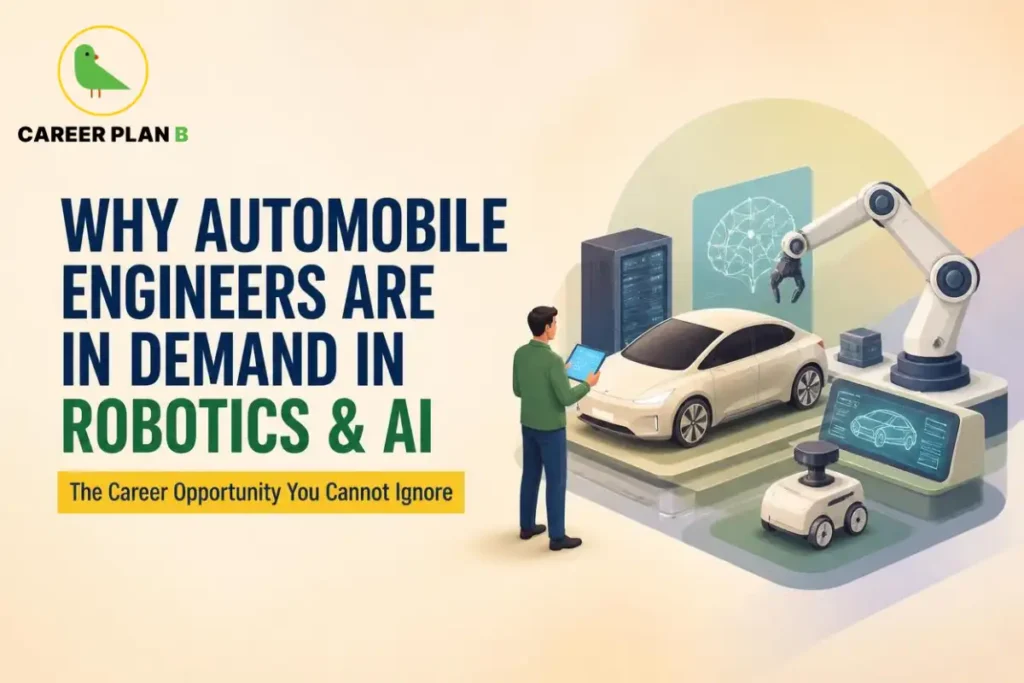
The same engineer who once focused on engines and chassis is now being recruited to build robots and help train autonomous systems. It sounds like an unusual leap, but it isn’t one at all once you understand how these fields actually overlap. Why automobile engineers are in demand in robotics & AI comes down to a simple truth: modern vehicles are becoming robotic systems in their own right. In this blog, we will explore why this crossover is happening, which skills make automobile engineers valuable in this space, the roles available, and where this career shift is headed.
Why Is There a Crossover Between Automobile Engineering and Robotics/AI?
This crossover is not a coincidence. It is being driven by a genuine convergence of technologies:
- Autonomous vehicles are essentially robots that navigate real-world environments, relying on sensors, actuators, and control systems
- Smart manufacturing increasingly uses robotics for vehicle assembly and quality control
- AI-driven design and simulation are becoming standard tools in modern vehicle development
Vehicles today are not just mechanical machines. They are systems built on sensors, actuators, and control loops, which happens to be the exact foundation robotics and AI careers are built on too.
What Skills Make Automobile Engineers Valuable in Robotics and AI?
Automobile engineers in robotics bring a specific set of advantages that many pure software or robotics graduates lack:
- Deep understanding of mechanical systems combined with control systems knowledge
- Practical familiarity with sensors and actuators, gained through vehicle systems work
- Exposure to embedded systems, especially in modern EV and smart vehicle roles
- Strong systems thinking, essential for integrating hardware and software components
- Rigorous testing and validation experience, critical in safety-focused robotics applications
This combination of hardware fluency and systems-level thinking is exactly what robotics and AI-driven engineering roles need.
Role of Automobile Engineers in AI: Where Do They Fit In?
The role of automobile engineers in AI is most visible in a few key areas:
- Autonomous vehicle technology working on perception systems, sensor fusion (combining data from cameras, radar, and lidar), and real-world testing and validation of AI-driven driving models
- AI-driven design and simulation using machine learning tools to speed up vehicle design, testing, and performance optimisation
Automobile engineers are often the ones who understand how AI models need to interact with real, physical vehicle systems, a bridge that pure AI specialists frequently lack.
Robotics Career Opportunities in India for Automobile Engineers
Robotics career opportunities in India for automobile engineers span several growing areas:
- Industrial automation and manufacturing robotics, particularly in automotive production lines
- Autonomous vehicle and drone companies, an expanding segment in India’s private tech sector
- Testing and certification of Advanced Driver-Assistance Systems (ADAS) and autonomous features, an area actively supported by the Automotive Research Association of India (ARAI), an R&D institute set up by the automotive industry in collaboration with the Government of India.
On the defence side, DRDO‘s Centre for Artificial Intelligence and Robotics (CAIR), based in Bengaluru, works on advanced robotics and AI systems, offering another avenue for engineers with hardware-software integration skills.
For Personalized Guidance
Skills Needed for Robotics and AI Careers: What Should Automobile Engineers Add?
To move confidently into robotics and AI roles, automobile engineers typically need to build on their existing foundation with:
- Programming basics, particularly Python, which is widely used in robotics and AI development
- Machine learning fundamentals, especially concepts relevant to perception and decision-making systems
- Robotics-specific coursework, covering kinematics, control theory, and robot operating systems
- Sensor fusion knowledge, critical for combining data from multiple sensor types into reliable real-world decisions
These skills needed for robotics and AI careers complement, rather than replace, the mechanical and systems knowledge automobile engineers already bring.
Future of Automobile Engineering: Why This Crossover Will Only Grow
Where is this heading? A few clear signals point toward deeper integration:
- Software-defined vehicles, where much of a car’s functionality is controlled through software, are becoming the industry standard
- Increasing vehicle autonomy, moving gradually from driver-assistance features toward more advanced automation
- Smart factories, where robotics and AI are reshaping how vehicles themselves get built
The future of automobile engineering is not a departure from robotics and AI. It is an increasing convergence with them, making this crossover a long-term trend rather than a passing phase.
How Career Plan B Helps
Curious whether a robotics or AI-focused path fits your automobile engineering interests? Career Plan B offers personalised career counselling and PsycheIntel psychometric assessments to help you evaluate your aptitude for this evolving crossover field. Our counsellors guide your course selection and career roadmap so you can build the right skills for where this industry is genuinely headed.
Get In Touch With Us
Frequently Asked Questions
Q1. Do automobile engineers need to learn coding for robotics and AI roles?
Yes, at least foundational programming, especially Python, is important for working with AI models, robotics control systems, and simulation tools.
Q2. Is working in autonomous vehicles considered a robotics career?
Yes. Autonomous vehicles rely heavily on robotics principles, including sensors, actuators, and control systems, making this a genuine robotics-adjacent career path.
Q3. Can automobile engineers switch fully into AI-focused roles?
With additional training in machine learning and programming, automobile engineers can transition into AI-focused roles, particularly those involving real-world hardware integration.
Q4. What additional certifications help automobile engineers enter robotics?
Certifications or coursework in robotics, machine learning, Python programming, and sensor fusion are particularly valuable for this transition.
Q5. Is this crossover only relevant to autonomous vehicles or broader too?
It’s broader. Smart manufacturing, industrial automation, and AI-driven design also offer strong opportunities for automobile engineers beyond just autonomous vehicles.
Q6. Will automobile engineering remain relevant as AI and robotics grow?
Yes. As vehicles become more automated and software-driven, the mechanical and systems expertise automobile engineers bring becomes more valuable, not less.
Conclusion
Automobile engineers are increasingly in demand across robotics and AI because their skill set, systems thinking, hardware familiarity, and rigorous testing experience translate directly into these fields. This is not a departure from automotive engineering. It is where the field is naturally heading.
If you are curious about building a career at this intersection, talk to a Career Plan B counsellor for a personalised assessment. The future of mobility is increasingly robotic and intelligent, and automobile engineers are well-positioned to help build it.