Team Career Plan B · November 5, 2026
Introduction
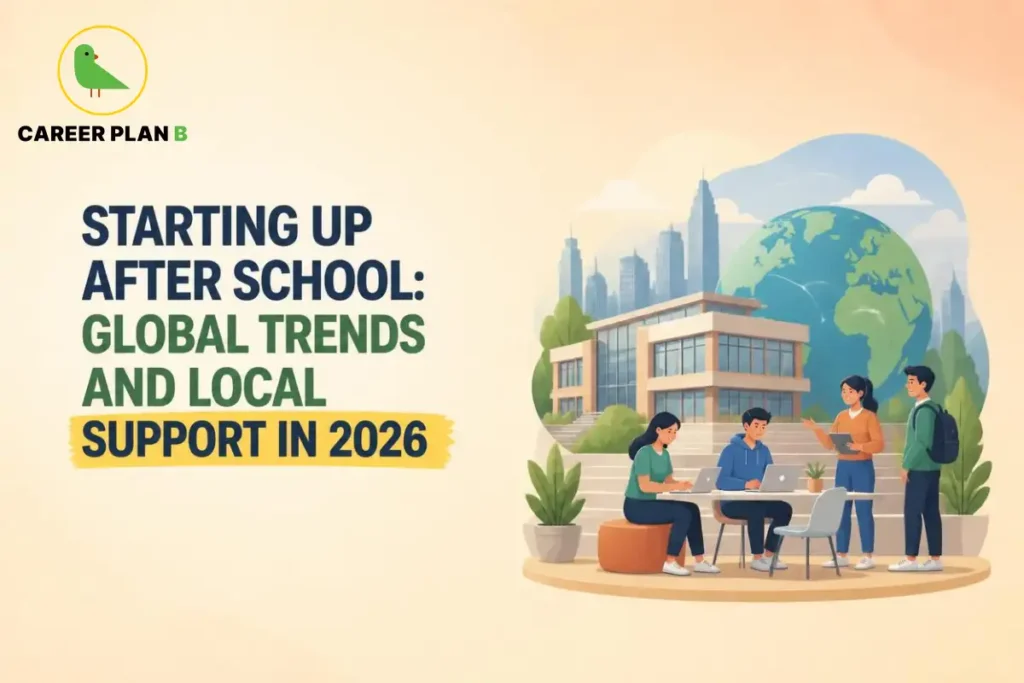
Not every student walks out of school with a college brochure in hand — some walk out with a business plan instead. Starting a business after school is no longer the unconventional path it once was; it’s becoming a genuine, well-supported career route, backed by accelerators, government schemes, and mentorship networks built specifically for young founders.
This guide looks at what starting a business after school actually looks like in 2026 — the global trends shaping student entrepreneurship, the support systems available locally, and how to decide if this path is right for you. Whether you’re a student with an idea, a working professional considering a pivot, or a parent trying to understand this world, here’s a clear-eyed look at it.
Why Are So Many Students Choosing to Start Up Instead of Settling Down?
Here’s a question worth sitting with: what if the safest career move today isn’t a stable job, but building something of your own early, while the stakes are still low? A growing number of students clearly think so.
Youth entrepreneurship has moved well beyond a niche interest. Programs like NFTE have provided entrepreneurship education for youth in underserved communities since 1987, and alongside global partners, its comprehensive entrepreneurial education has now reached more than a million learners. That kind of scale signals something important — student entrepreneurship isn’t a passing trend, it’s becoming embedded in how young people are educated.
What’s Driving This Shift Globally?
A few forces are converging at once. Employers increasingly value the skills that entrepreneurship teaches — the vast majority of employers say the workforce needs the kind of entrepreneurial skills that structured youth programs build, from problem-solving to resilience under uncertainty.
At the same time, the barriers to actually starting something have dropped. Free or heavily discounted tools now support first-time founders directly — cloud credits, design software, and developer resources are increasingly available to student entrepreneurs at no or low cost, making the earliest, most expensive stage of building a company far more accessible than it used to be.
Global Youth Startup Trends Shaping 2026
Let’s look at what’s actually changing in the global student entrepreneurship landscape this year.
1. Structured Programs Are Replacing Guesswork
Where students once had to figure things out alone, structured pathways now exist at nearly every stage. Organisations like LaunchX, founded at MIT, now offer a year-round lineup of hands-on startup and innovation experiences for high school students, allowing them to progress from short bootcamps to immersive, in-person accelerators.
2. Universities Are Backing Student Founders With Real Capital
It’s not just extracurricular anymore — universities are putting money behind it. Programs like the Startup Founders Award at UT Dallas were created specifically to help students move from “I have an idea” to “I’m building a real venture,” pairing funding with structured mentorship and weekly accountability workshops.
3. Student-Focused Venture Capital Is Growing
A notable shift in 2026 is how seriously investors are taking student founders. Firms like Pear VC report that a substantial share of their portfolio companies are founded by students, while student-led funds such as Rough Draft Ventures continue investing directly in early-stage student-led teams.
4. Global Innovation Rankings Are Increasingly Volatile
Where a young founder is based now matters more than ever. Monthly tracking through indices like the Draper Innovation Index Global shows real movement — nations that lower barriers to entry and improve economic freedom can rapidly climb the rankings, while regions affected by instability can drop just as quickly. For student entrepreneurs, this underlines why local ecosystem support matters as much as the idea itself.
5. AI Skills Are Becoming a Baseline Expectation
Universities are now actively pushing students to build AI fluency before launching ventures, treating it as a foundational skill alongside traditional business basics like finance and marketing — not an optional add-on.
For Personalized Guidance
Local Support: How India Is Backing Young Entrepreneurs
While global trends set the tone, local support is what actually gets a student’s idea off the ground. India’s ecosystem has expanded significantly for young and student founders specifically.
Startup India Scheme
Launched in 2016, the Startup India Scheme is the flagship government initiative promoting entrepreneurship, and by the end of FY 2025–26, over 2.23 lakh startups had been officially recognised under it, up from fewer than 500 when the scheme began. It offers tax exemptions, simplified compliance, intellectual property support, and access to funding — and importantly, first-time entrepreneurs and college students with innovative ideas are explicitly encouraged to register.
Startup India Seed Fund Scheme (SISFS)
For very early-stage founders without personal capital, this is often the first real financial lifeline. The scheme provides early-stage capital for proof of concept, prototype development, and market entry, delivered through approved incubators as a mix of grants and convertible debt.
State-Level Student Schemes
Several states have built dedicated programs just for students still in school or college. Gujarat’s Student Startup and Innovation Policy (SSIP 2.0) is built entirely around helping students turn ideas into real startups while still studying, offering grants of up to ₹2.5 lakh for testing and prototyping — funding that removes the single biggest barrier for a student with a strong idea but no personal capital.
Sector-Specific Support
Founders working in specialised fields have targeted options too. For example, the SPARSH programme, run by BIRAC, focuses specifically on startups in healthcare, biotechnology, and medical innovation, offering both funding and technical mentorship for founders working in highly technical domains.
Quick Comparison Table
| Program | Type | Best For | Support Offered |
|---|---|---|---|
| Startup India | National flagship scheme | Recognised startups, first-time founders | Tax exemptions, IPR support, compliance ease |
| SISFS | National seed funding | Early-stage, DPIIT-recognised startups | Up to ₹70 lakh (grant + debt) |
| SSIP 2.0 (Gujarat) | State student scheme | Students still studying | Up to ₹2.5 lakh grant for prototyping |
| SPARSH (BIRAC) | Sector-specific | Healthcare & biotech founders | Funding + technical mentorship |
| LaunchX / NFTE (Global) | Youth accelerator programs | High school & college students | Bootcamps, mentorship, pitch training |
Is Starting Up After School Right for You?
With so much support now available, how do you know if this path actually suits you? A few honest questions can help:
- Do you have an idea you’d pursue even without guaranteed success? Founders who stick with it long-term are usually solving a problem they genuinely care about, not chasing a trend.
- Are you comfortable with financial and emotional uncertainty? Even with strong support programs, early-stage entrepreneurship rarely offers a stable income right away.
- Have you validated your idea, even informally? Talking to potential customers, testing a rough prototype, or joining a student accelerator can clarify whether an idea has real traction.
- Would a structured program or degree pathway serve you better first? For some students, a business or entrepreneurship-focused degree alongside early venture-building offers the best of both worlds.
There’s no single right answer — only the option that matches your risk appetite, resources, and conviction in the idea.
Must read :- Business Careers That Don’t Require an MBA
How Career Plan B Helps
Deciding whether to start a business after school — or to pursue a degree first and build toward entrepreneurship later — isn’t a decision to make on excitement alone.This is where Career Plan B can help by offering:
- Personalised Career Counselling: Provides expert guidance based on individual interests, skills, and career goals — helping you weigh entrepreneurship against other academic or career paths.
- Psychometric & Career Assessment Tests: Identifies strengths, personality traits, and suitable career opportunities, so you know whether you’re genuinely wired for the uncertainty of founding a business.
- Career Roadmapping: Creates a clear step-by-step plan to achieve academic and professional goals, including how to combine coursework, accelerators, and funding schemes strategically.
- Admission & Academic Profile Guidance: Helps in selecting the right courses and colleges and improving academic profiles, including entrepreneurship-focused programs for students who want structured business education alongside their venture.
Get In Touch With Us
Frequently Asked Questions
Q1. Can I really start a business right after school, without a degree?
Yes. Many schemes, including India’s Startup India and SISFS, are open to first-time entrepreneurs and students, and don’t require a completed degree — though building basic business and financial literacy alongside your venture is strongly advisable.
Q2. What is the biggest support students overlook when starting up?
Awareness itself. Many government-backed funding schemes and grants go unused simply because student founders don’t know these programs exist or assume they’re not eligible.
Q3. Do I need a registered company to access government startup schemes in India?
For most schemes like SISFS, yes — your startup typically needs to be DPIIT-recognised and incorporated within a specific timeframe. However, state-level student schemes like SSIP 2.0 support founders even before formal incorporation, at the prototyping stage.
Q4. Are global accelerator programs only for students in the US or Europe?
No. Many programs, including LaunchX and various VC-backed initiatives, accept applications from students worldwide, and Indian student founders can apply alongside domestic schemes.
Q5. How important is an idea versus timing when starting a business after school?
Both matter, but validated demand usually outweighs a “perfect” idea. Testing your concept with real users early, even informally, tends to matter more than waiting for a fully refined plan.
Q6. Should I choose a business degree or jump straight into building a startup?
It depends on your risk comfort and the complexity of your idea. Some founders benefit from structured business education first, while others learn faster by building and course-correcting in real time — a career counsellor can help assess which route suits your situation.
Conclusion
Starting a business after school in 2026 looks nothing like it did even a decade ago — global accelerators, student-focused venture capital, and robust local schemes like Startup India and SISFS have made this path more supported, and more realistic, than ever before. The opportunity is real, but so is the uncertainty that comes with any entrepreneurial journey.
What matters most is entering this path with clarity about your own risk appetite, resources, and genuine conviction in your idea — not just the appeal of “being your own boss.” With the right guidance, students, professionals, and parents can approach this decision with confidence rather than blind optimism. Curious whether entrepreneurship is the right next step for you? Talk to a Career Plan B counsellor today and build a clear, well-informed plan for what comes next.