Piyush · July 27, 2026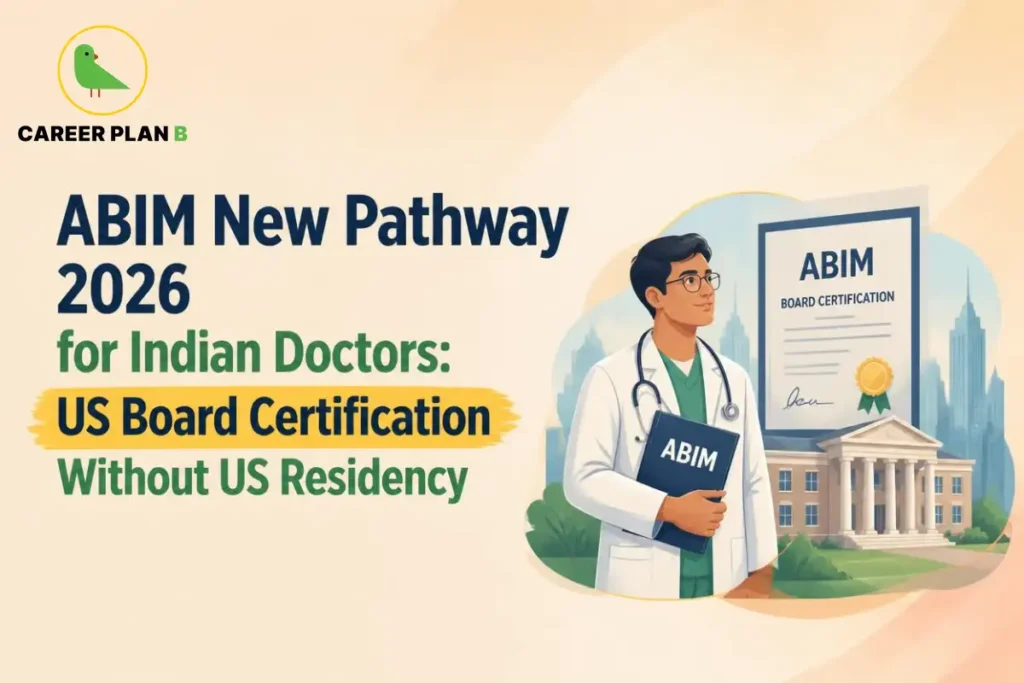
Introduction
Indian doctors trained abroad have traditionally faced a major barrier to US board certification: repeating an internal medicine residency. The ABIM New Pathway (Pilot Pathway E) changes this by allowing eligible international medical graduates to pursue board certification without completing a second residency in the US or Canada. This blog explains the eligibility requirements, process, and what this pathway means for Indian doctors pursuing medical careers in the US.
What Is the ABIM New Pathway for Indian Doctors?
The American Board of Internal Medicine has introduced a pilot programme specifically designed for international medical graduates who completed their residency abroad. According to the official ABIM Special Consideration page, this initiative is called Pilot Pathway E, a competency-based medical education pilot. It targets physicians who completed an internal medicine residency outside the United States or Canada, followed by an ACGME-accredited fellowship inside the US. Therefore, this pathway does not eliminate residency training; instead, it removes the requirement to repeat that residency specifically within the US system.
Who Qualifies for the ABIM Certification Pathway?
Eligibility under this pathway rests on several specific conditions, verified directly through ABIM’s official documentation. Candidates must have completed at least three years of verified internal medicine training abroad. Moreover, they must have been accepted into an ACGME-accredited fellowship either as an “exceptionally qualified candidate” or as a graduate of an ACGME-International residency programme. Additionally, applicants need a valid Educational Commission for Foreign Medical Graduates (ECFMG) certificate and must satisfy ABIM’s licensure requirements at the time of their exam. For the full, official eligibility criteria, refer to the ABIM Pilot Pathway E requirements page.
For Personalized Guidance
How Does the ABIM Pathway Process Actually Work?
Once accepted into this pathway, candidates must first complete their ACGME-accredited fellowship successfully. During this fellowship, their subspecialty training is attested to for each year through ABIM’s FasTrack Clinical Competence Evaluation System. Consequently, this attestation confirms that a candidate has met the practical, competency-based standards ABIM expects, even without a US-based internal medicine residency behind them.
Registering for the Internal Medicine Certification Exam
After fellowship completion and FasTrack attestation, candidates become eligible to register for ABIM’s Internal Medicine Certification Examination through their ABIM Physician Portal. Importantly, candidates must pass this internal medicine exam first before they can sit for any subspeciality certification exam. Therefore, this pathway follows a sequential structure: internal medicine certification comes first, and subspeciality certification follows.
Why This ABIM Pathway Matters for Indian Doctors Specifically
India sends a significant number of internal medicine graduates into US fellowship training every year, and many of these doctors have historically struggled to gain board certification despite strong clinical backgrounds. ABIM has identified at least 4,000 physicians across internal medicine subspecialties who could potentially benefit from this new route. For Indian doctors specifically, this pathway finally closes a long-standing gap between the years of high-quality training they receive in India and the board credentials required for competitive US employment. Furthermore, board certification directly affects hiring decisions, since most US hospitals and physician groups treat it as a critical hiring benchmark.
Key Eligibility Requirements to Remember
Before applying, Indian doctors should carefully review each requirement, since missing even one condition can delay the process considerably.
- Completion of three or more years of verified internal medicine training outside the US or Canada
- Acceptance into an ACGME-accredited fellowship as an exceptionally qualified candidate, or as a graduate of an ACGME-International programme
- Satisfactory completion of subspecialty fellowship training, attested through FasTrack
- Fellowship training that started on or after July 1, 2016
- A valid, unrestricted ECFMG certificate
- Fulfilment of ABIM’s standard licensure requirements at exam time
Important Limitations Doctors Should Understand
While this pathway removes a major barrier, it does not offer an unconditional shortcut. Successful completion of the pathway does not guarantee ABIM certification; each application still undergoes individual review. Additionally, this remains a pilot programme, currently expected to run for five years, after which ABIM will evaluate whether to make it permanent based on participant outcomes. Therefore, doctors considering this route should also confirm individual state licensing requirements, since board certification alone does not guarantee unrestricted practice rights everywhere.
How Career Plan B Helps
Career Plan B helps Indian doctors understand and plan their journey through the ABIM New Pathway with the right guidance. We offer
- Personalised Career Counselling: Helps doctors evaluate their eligibility and choose the right US medical career pathway.
- Psychometric & Career Assessment Tests: Help identify suitable career directions based on skills and goals.
- Career Roadmapping: Helps plan fellowship applications, ABIM certification steps, and career progression.
- Admission & Academic Profile Guidance: Helps strengthen profiles and navigate international medical certification requirements.
Get In Touch With Us
Frequently Asked Questions
- Can Indian doctors get ABIM certification without US residency?
No. Candidates must still complete an internal medicine residency abroad, followed by an ACGME-accredited fellowship in the US. What this pathway removes is the requirement to repeat that residency specifically within the US or Canada.
- How many years of training abroad are required for eligibility?
Candidates need at least three years of verified graduate medical education training in internal medicine completed outside the US or Canada.
- Can a candidate go directly for a subspeciality exam under this pathway?
No. Candidates must first pass the ABIM Internal Medicine Certification Examination before becoming eligible for any subspeciality certification exam.
- Is this pathway a permanent ABIM policy?
Not yet. It currently operates as a pilot programme expected to run for five years, after which ABIM will assess whether to make it permanent.
- What certificate is mandatory for applying under this pathway?
A valid Educational Commission for Foreign Medical Graduates (ECFMG) certificate is required, alongside fulfilment of ABIM’s standard licensure requirements.
- Where can I check the complete, official eligibility criteria?
Refer directly to the official ABIM Special Consideration page, which lists every pathway and its specific requirements.
Conclusion
The ABIM New Pathway represents a genuinely meaningful shift for Indian doctors who have long trained abroad without a clear route to US board certification. By removing the requirement to repeat an internal medicine residency within the US, this pilot programme opens real opportunities for physicians who already hold strong clinical training from India. However, eligibility remains carefully structured, and doctors should review each requirement closely before applying. Since this remains a pilot initiative, staying updated through official ABIM channels is essential as the programme evolves over its five-year run.
And if the process feels complex to navigate alone, Career Plan B can help Indian doctors map out each step with guidance built around their specific training background and career goals.
For Personalized Guidance