Careerplanb · October 4, 2025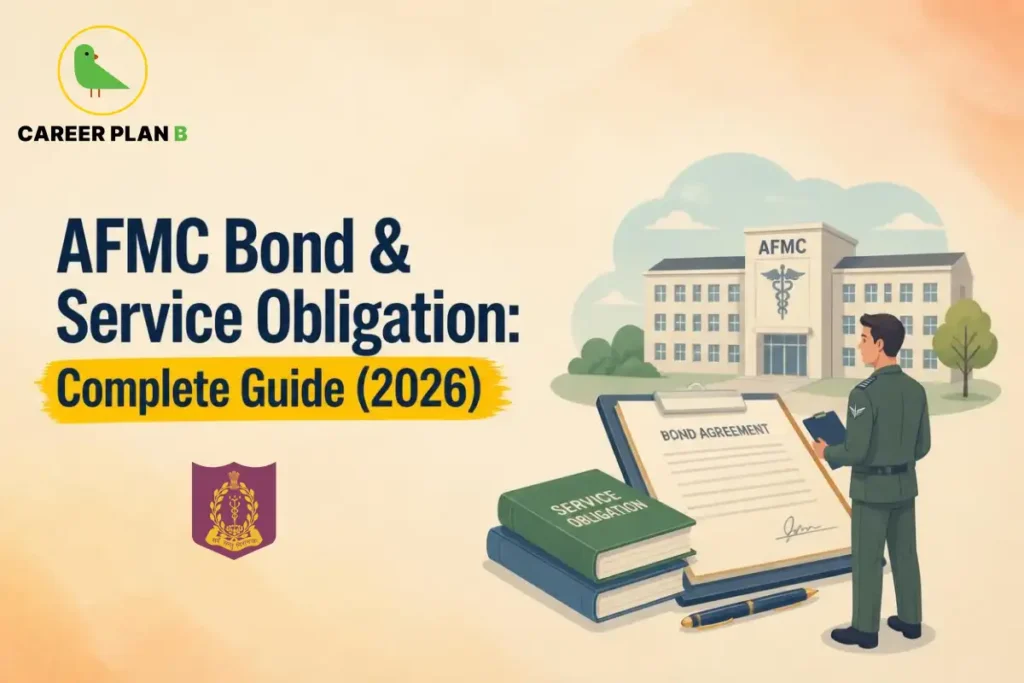
Introduction
Getting into Armed Forces Medical College comes with a genuinely unique catch. Most other medical colleges don’t have this: the AFMC bond. Unlike a typical state government service bond, this one ties you to a specific career path in the Armed Forces, not just a geographic posting.
Therefore, this guide breaks down everything about the AFMC bond. It covers how long the service obligation runs, what happens if you break it, how MBBS and PG bonds differ, and what your life actually looks like once you sign it.
What Is the AFMC Bond?
Armed forces medical college bond is a legal agreement signed by candidates and their parents or guardians at admission. This bond legally commits you to serve as a commissioned medical officer in the Armed Forces Medical Services (AFMS) for a fixed period after your MBBS and internship.
State government MBBS bonds typically require rural service within civilian healthcare. The afmc service bond, however, ties you specifically to a military career, complete with officer rank, uniform, and postings across the Army, Navy, or Air Force. This binding legal agreement isn’t optional, and AFMC operates as a fully government-funded institution under the Ministry of Defence.
AFMC Bond Duration and Service Obligation
Afmc bond duration currently stands at a minimum of 7 years of compulsory service after your MBBS internship, under Short Service Commission (SSC). Afmc mbbs bond years work like this: you complete MBBS and internship first, then begin your 7-year service liability as a commissioned Medical Officer.
Afmc bond service obligation doesn’t automatically end at 7 years either. At that point, based on merit-cum-option and vacancy availability, officers can choose between two paths. They can continue on a Permanent Commission, serving until the standard date of superannuation, or complete their SSC term and pursue other options, including PG study or civilian practice.
AFMC Bond Amount: How Much Is at Stake
Afmc bond amount has risen steadily in recent years. Candidates admitted for the 2025-26 session signed a bond agreement of ₹69 lakh, up from ₹67 lakh the previous year and ₹65 lakh two years before that. For 2026, the official AFMC brochure lists a further increase to ₹71 lakh.
This escalation pattern isn’t a one-time hike. Consequently, future candidates should expect the figure to rise again, reflecting increasing training and operational costs borne by the Armed Forces.
Here’s a quick look at how the bond amount has moved over recent admission cycles:
| Admission Session | Bond Amount |
|---|---|
| 2023-24 | ₹65 lakh |
| 2024-25 | ₹67 lakh |
| 2025-26 | ₹69 lakh |
| 2026 | ₹71 lakh |
AFMC Bond Penalty: What Triggers It
Afmc bond penalty applies at multiple exit points, not just at the end of training. Here’s when the full bond amount becomes payable:
| Trigger | Penalty |
|---|---|
| Leaving AFMC after Day 7 of admission | Full bond amount |
| Withdrawing during the MBBS course (after Day 7) | Full bond amount |
| Completing MBBS but failing to join AFMS | Full bond amount |
| Joining AFMS but leaving before completing the 7-year service | Pro-rated penalty, plus recovery of training costs |
Importantly, the first 7 days after admission serve as a penalty-free withdrawal window. If AFMC isn’t the right fit, you can exit within that first week without owing the bond amount. Beyond that window, however, the penalty applies in full, regardless of whether you voluntarily quit or simply choose not to continue with armed forces medical duties. One exception exists for candidates declared Non-Service Liable (NSL) due to medical unfitness for commission. They face a different, weekly training-cost-based liability instead.
AFMC Bond Conditions: What Else You’re Agreeing To
Afmc bond conditions extend beyond just the financial penalty and service years. AFMC operates under military-style discipline throughout the MBBS course. Additionally, candidates must remain unmarried during their training period, as part of the college’s conduct rules.
Afmc bond rules also mean you’re treated as a cadet and future commissioned officer from day one, not simply a medical student. In exchange for this discipline, education comes fully subsidized. You also receive a stipend during your studies, along with a guaranteed officer-rank position immediately upon completing your service liability.
AFMC PG Bond: How It Differs from MBBS
Afmc pg bond terms work differently from the MBBS-level bond above. Under the Short Service Commission structure, officers generally become eligible for regular postgraduate degrees only after completing their 7-year service liability. However, DNB courses offer an earlier route; officers can pursue these after just four years of service.
This distinction matters significantly for long-term career planning. Moreover, the timing of PG training can affect your overall career progression within the Armed Forces Medical Services. Therefore, understanding this service commitment before choosing AFMC remains essential.
For students planning PG immediately after MBBS, AFMC requires more patience than a civilian medical college. A civilian route generally allows eligible graduates to pursue NEET PG soon after internship. AFMC officers, in contrast, must consider their service obligations before selecting a preferred PG pathway.
Additionally, candidates should check the latest AFMC service regulations before deciding. Rules for PG eligibility, service duration, and training pathways can change between admission cycles. Therefore, current official terms should always take priority over older information.
What Is the Difference Between Short Service and Permanent Commission at AFMC?
This distinction comes down to duration and long-term career structure. Short Service Commission (SSC) carries a fixed 7-year service obligation, with a bond penalty of several lakhs if broken before completion. Permanent Commission (PC), by contrast, means committing to serve until the standard date of superannuation, essentially a full military medical career rather than a fixed term.
The choice between SSC and PC isn’t typically made at admission. Instead, it’s determined later, based on merit-cum-option at the final MBBS examination and vacancies available at that time.
AFMC Eligibility Criteria
AFMC admission eligibility starts with qualifying NEET UG, since it’s compulsory for shortlisting. Beyond that, candidates need a minimum 60 percent aggregate in Physics, Chemistry, and Biology. Additionally, they need at least 50 percent in English and 50 percent in each individual science subject at the higher secondary level.
Candidates must also fall between 17 and 24 years of age at admission and remain unmarried, consistent with the bond conditions covering the training period. AFMC Pune currently offers 145 MBBS seats, including 115 seats for boys and 30 for girls, along with a limited number of reserved and foreign-sponsored seats.
Have Any Doubts?
Is AFMC Bond Applicable to Both MBBS and PG Students?
This remains a common point of confusion. The primary 7-year service bond applies specifically at the MBBS level, signed at admission. PG opportunities at AFMC come later, generally after completing this service liability, or after 4 years for DNB, rather than carrying a separate, independent bond of their own.
Read more:-Scholarship for Medical Students in India: Medical PG, NEET PG & Financial Aid Guide
What Happens If a Candidate Breaks the AFMC Service Bond?
The consequences depend on when a candidate leaves the programme or service. If someone leaves after the initial 7-day window but before completing MBBS, or completes MBBS but chooses not to join AFMS, the full bond penalty of ₹71 lakh applies for the 2026 cycle.
Consequences become more significant once a candidate has already joined AFMS. Leaving before completing the required 7-year service can trigger recovery of the applicable bond amount, potentially calculated based on the remaining service period. The candidate may also need to repay associated training or other costs, depending on applicable terms.
Because AFMC bond conditions can change between admission cycles, candidates should carefully read the latest AFMC admission brochure and bond undertaking before accepting a seat. Therefore, always confirm the exact financial liability from official documents applicable to your specific batch.
How Career Plan B Helps
Understanding AFMC’s genuine long-term commitment before you sign ranks among the most important decisions in a medical career. Career Plan B helps you weigh it clearly against other options.
- Personalized Career Counselling: Guidance on whether AFMC’s military service structure genuinely fits your long-term career goals.
- Psychometric & Career Assessment Tests: Helps identify whether a defence medical career or civilian practice path suits you better.
- Career Roadmapping: A plan that accounts for the 7-year service bond and delayed PG timeline if you choose AFMC.
- Admission & Academic Profile Guidance: Support in understanding AFMC’s selection process, documentation, and bond terms before you commit.
Get In Touch With Us
Frequently Asked Questions
Q1. What is the bond duration and service obligation at AFMC Pune?
The current service obligation runs a minimum of 7 years in AFMS after completing MBBS and internship, under Short Service Commission.
Q2. How much is the penalty for leaving AFMC before completing service?
For 2026, the bond penalty stands at ₹71 lakh. This applies if you leave after the initial 7-day window, don’t join AFMS after MBBS, or otherwise fail to complete your service liability.
Q3. What is the difference between Short Service and Permanent Commission at AFMC?
Short Service Commission requires a fixed 7-year term. Permanent Commission, however, requires serving until the standard date of superannuation, essentially a full-length military medical career.
Q4. Is the AFMC bond applicable to both MBBS and PG students?
The primary bond applies at MBBS admission. PG opportunities typically come after completing the 7-year service obligation, or after 4 years specifically for DNB courses, rather than involving a separate PG-specific bond.
Q5. What are the eligibility criteria for AFMC admission?
Candidates need a qualifying NEET UG score, a minimum 60 percent aggregate in PCB, 50 percent in English and each science subject, and must be between 17 and 24 years old and unmarried at admission.
Conclusion
The AFMC bond represents a genuinely different commitment compared to civilian medical college bonds. It ties you to a 7-year military medical career with a steep financial penalty if broken. With the bond amount now at ₹71 lakh for 2026 and rising each cycle, understanding this obligation fully before you apply remains essential.
Therefore, if you’re weighing AFMC against civilian medical college options, reach out to Career Plan B’s counsellors for personalized guidance.