Team Career Plan B · August 10, 2026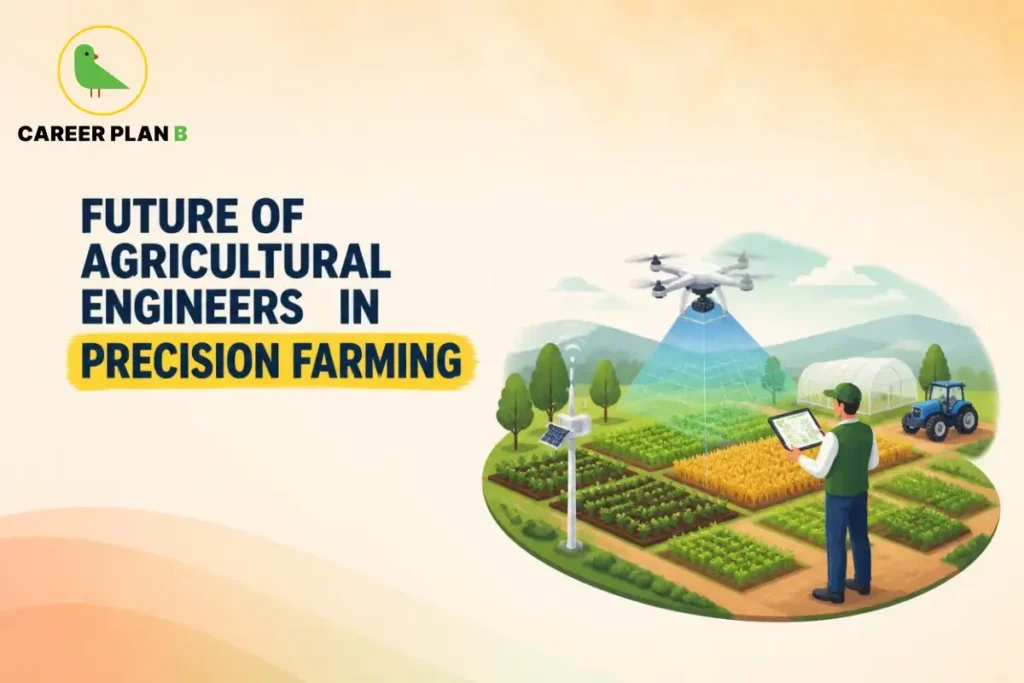
Introduction
India’s farms are quietly transforming through sensors, drones, and data-driven decision-making, and agricultural engineers sit right at the centre of this shift. Understanding the future of agricultural engineers in precision farming starts with recognizing just how much dedicated government infrastructure now supports this transition.
The Government of India has established 22 precision farming development centres across the country’s agro-climatic zones, located within state and central agricultural universities, ICAR institutes, and IITs. These centres aim to develop and disseminate regionally tailored precision farming technologies, from micro irrigation to hi-tech cultivation methods. Let’s break down exactly what this means for engineers entering the field.
Why Precision Farming Has Become a Genuine National Priority
Precision farming isn’t a niche experiment anymore in India; it’s backed by dedicated infrastructure spanning nearly every agro-climatic zone in the country. Consequently, precision farming careers India offers now benefit from a genuinely mature support ecosystem rather than scattered pilot projects.
How Precision Farming Development Centres Are Shaping Careers
These specialized centres represent one of the most concrete examples of government investment translating directly into technical career opportunities.
A Network Spanning the Entire Country
The Precision Farming Development Centres network, working under the National Committee on Precision Agriculture and Horticulture, focuses on micro-irrigation and hi-tech agriculture, including vertical farming, hydroponics, aeroponics, and protected cultivation. This kind of precision agriculture engineering work spans 22 states, from Punjab and Haryana to Kerala and Assam, giving engineers genuinely widespread geographic opportunity rather than concentration in just one or two hubs.
Micro Irrigation and Protected Cultivation: Where the Real Work Happens
Within these PFDCs, engineers focus on genuinely specific, technically demanding sub-specializations that didn’t exist as distinct career paths a generation ago.
The Technical Core of Precision Farming
ICAR-IARI’s Agricultural Engineering Division specifically conducts research on precision equipment across farm machinery and power, precision farming, post-harvest engineering, and protected cultivation. These micro-irrigation engineering jobs require engineers to design systems that deliver water with genuine precision, reducing waste while improving crop yield, a genuinely technical challenge blending mechanical design with agricultural science.
How AgriStack and Digital Infrastructure Are Expanding This Field
Precision farming increasingly connects to India’s broader digital agriculture push, creating new hybrid roles that blend traditional engineering with data systems work.
Data-Driven Agriculture at Scale
India’s Digital Agriculture Mission builds AgriStack, a farmer-centric digital infrastructure incorporating soil fertility mapping across 142 million hectares of farmland. This kind of large-scale data infrastructure directly supports smart agriculture careers India increasingly needs, since precision farming ultimately depends on accurate, granular data about soil, weather, and crop conditions at scale.
The Rise of Precision Agriculture Startups
Beyond government research institutes, private innovation is now actively building on this public infrastructure to create genuinely new commercial opportunities.
Incubation Support for the Next Generation
ICAR-IARI recently launched its “SHITIJ 2.0” Incubation Programme specifically for startups working in plant health and precision agriculture. This reflects a broader pattern: precision agriculture startups India hosts increasingly benefit from direct institutional backing, rather than operating purely on private venture funding alone. For engineers with entrepreneurial ambitions, this kind of structured incubation support genuinely lowers the barrier to building something of their own.
Have Any Doubts?
What Skills Will Engineers Need Going Forward?
Meeting this shift requires agricultural engineers to build on traditional mechanical and irrigation training with genuinely new technical capabilities.
| Traditional Skill | Precision Farming Skill | Why It Matters |
|---|---|---|
| Manual Irrigation Design | Micro irrigation and sensor-based systems | Reduces water waste, improves precision |
| Basic Farm Machinery | IoT-enabled equipment and drones | Enables real-time monitoring and automation |
| Field-Based Data Collection | AgriStack and digital soil mapping | Supports large-scale, data-driven decisions |
| Standalone Research | Startup incubation and commercialization | Opens entrepreneurial career pathways |
Strong agricultural engineering technology skills increasingly blend traditional mechanical and irrigation expertise with comfort around sensors, data systems, and even startup commercialization, reflecting how genuinely interdisciplinary this field has become.
How Career Plan B Helps
Career Plan B helps students and aspiring professionals make informed career decisions by understanding their interests, skills, and opportunities in emerging fields like precision farming, smart agriculture, and agricultural technology.
Personalized Career Counselling: Provides expert guidance to help students explore careers in precision agriculture, agricultural technology, micro irrigation, and AgriTech startups based on their interests and long-term goals.
Psychometric & Career Assessment Tests: Identify students’ strengths, technical aptitude, and career preferences to determine suitable opportunities in areas like smart farming systems, agricultural automation, IoT-based farming, and research.
Career Roadmapping: Creates a structured career plan covering the right education pathway, skill development, internships, technology training, and growth opportunities in precision farming and agricultural engineering.
Admission & Academic Profile Guidance: Helps students select suitable colleges, courses, and specialization options while improving their academic profile for careers in ICAR institutes, AgriTech companies, government projects, and precision agriculture startups.
Get In Touch With Us
Frequently Asked Questions
- What exactly are precision farming development centres?
They’re government-established research and demonstration centres located across India’s agroclimatic zones, focused on technologies like micro irrigation and high-tech cultivation.
- Do I need a computer science background to work in precision farming?
Not necessarily, though comfort with sensors, basic data analysis, and digital tools increasingly complements traditional agricultural engineering training.
- Can agricultural engineers start their own precision farming startup?
Yes, and institutional support genuinely exists, including ICAR-IARI’s dedicated incubation programmes for plant health and precision agriculture startups.
- Which states in India have the strongest precision farming infrastructure?
The PFDC network spans states including Punjab, Haryana, Tamil Nadu, Karnataka, and Kerala, among many others, offering geographically widespread opportunity.
- Is precision farming considered a stable long-term career path?
Yes. It benefits from sustained government infrastructure investment combined with growing private-sector interest, supporting genuine long-term demand.
Conclusion
The future of agricultural engineers in precision farming looks promising. India already has a nationwide network of Precision Farming Development Centres. Digital infrastructure through AgriStack is also expanding, while startup incubation support continues to grow.
These developments are creating technically advanced opportunities for agricultural engineers. The field is especially suited to engineers who can combine traditional agricultural knowledge with modern sensors, automation, and data-driven technologies.
If this evolving and high-impact specialisation interests you, Career Plan B can help you plan a realistic path forward. Infrastructure, funding, and incubation support are expanding across the sector. This creates long-term opportunities for engineers who want to help modernise the way India farms.