Team Career Plan B · August 10, 2026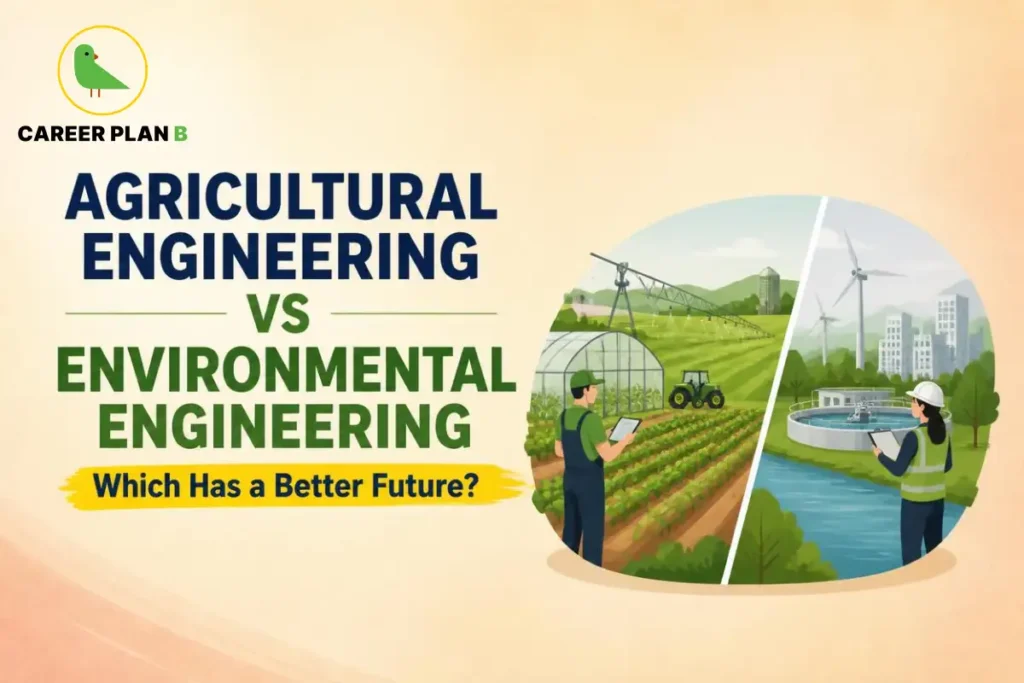
Introduction
India faces two enormous, interconnected challenges at once: feeding a growing population and managing a worsening environmental crisis. Comparing agricultural engineering vs environmental engineering, which has a better future, requires understanding how each field connects to these very different, but equally pressing, national priorities.
The Ministry of Agriculture and Farmers Welfare received ₹14,052.9 crore for 2026-27, while the Ministry of Environment, Forest and Climate Change received a net allocation of ₹3,759.46 crore for the same period, including ₹1,091 crore specifically for pollution control. Both figures tell genuinely different stories about where these fields stand today.
Why This Comparison Matters More Than Ever
Both fields sit at the intersection of technology and India’s biggest national challenges, yet they receive genuinely different levels of government investment and public attention. Understanding this engineering branch’s future scope question requires looking honestly at both the funding and the career pathways each field actually offers.
What Does a Career in Agricultural Engineering Actually Involve?
Agricultural engineering focuses on the machinery, irrigation systems, and technology that keep India’s farms productive and increasingly efficient.
Government Backing and Growth Areas
The Indian Council of Agricultural Research coordinates R&D specifically around mechanization, irrigation, and post-harvest technology. Genuine agricultural engineering careers India offers increasingly extend into precision farming, drone deployment, and agri-tech startups, reflecting a field that’s modernizing quickly alongside sustained government mechanization spending. This growing emphasis on sustainable farming technology also connects agricultural engineering directly to broader environmental goals, since efficient irrigation and reduced chemical runoff both matter for long-term ecological health.
What Does a Career in Environmental Engineering Actually Involve?
Environmental engineering, by contrast, focuses directly on pollution control, water management, and regulatory compliance across industries.
Government Backing and Growth Areas
The Ministry of Environment, Forests and Climate Change oversees implementation of laws like the Air (Prevention and Control of Pollution) Act and the Water (Prevention and Control of Pollution) Act, while supporting state pollution control boards with technical and financial assistance. Genuine pollution control engineering jobs exist across central and state pollution control boards, alongside private industry compliance roles. Environmental engineering government jobs in India also connect to global commitments, since the ministry plays a key role in implementing India’s obligations under international agreements like the Paris Agreement.
Comparing Government Investment and Career Scope
Looking at both fields side by side highlights genuinely different scales of investment and career structure.
| Factor | Agricultural Engineering | Environmental Engineering |
|---|---|---|
| Government Budget (2026-27) | ₹14,05,290 crore (Ministry of Agriculture) | ₹3,759.46 crore net (MoEFCC) |
| Core Focus | Mechanization, irrigation, farm technology | Pollution control, regulatory compliance |
| Key Growth Area | Precision farming, agri-tech, drones | Industry compliance, climate policy implementation |
| US Median Wage (Global Benchmark) | $84,630 (Agricultural Engineers, BLS) | $104,170 (Environmental Engineers, BLS) |
This table draws from the Ministry of Agriculture and Farmers Welfare and Ministry of Environment, Forest and Climate Change budget data, alongside U.S. Bureau of Labour Statistics figures used purely as an international benchmark, since India doesn’t publish equivalent standardized occupational wage data for either field.
Which Field Genuinely Offers More Career Opportunity?
Agricultural engineering benefits from significantly larger direct government investment, reflecting the sheer scale of India’s farming economy and the priority placed on food security. Environmental engineering, while receiving comparatively smaller direct ministry funding, benefits from cross-cutting demand, since environmental compliance requirements touch nearly every industrial sector, not just one ministry’s budget. This means agri-tech vs environmental career comparisons don’t reduce to a single funding number; environmental engineers often find opportunities through private industry compliance roles that exist entirely outside government budgets.
Have Any Doubts?
Which Path Actually Makes Sense for You?
If you’re drawn to farm technology, mechanization, and a field backed by substantial, sustained government investment, agricultural engineering offers a genuinely strong, expanding niche. If you’re more interested in pollution control, regulatory work, and cross-industry environmental compliance, environmental engineering offers broader private-sector opportunities that aren’t limited to government budgets alone.
How Career Plan B Helps
Career Plan B helps students make informed career decisions by understanding their interests, strengths, and future opportunities in fields like agricultural technology, sustainability, and environmental protection.
Personalized Career Counselling: Provides expert guidance to help students compare agricultural engineering and environmental engineering based on career opportunities, industries, government initiatives, and personal goals.
Psychometric & Career Assessment Tests: Identify students’ skills, interests, and aptitude to understand whether they are better suited for areas like sustainable farming technology, agri-tech innovation, pollution control, or environmental solutions.
Career Roadmapping: Creates a structured career plan covering the right degree selection, skill development, internships, competitive exams, and long-term growth opportunities in agricultural or environmental engineering.
Admission & Academic Profile Guidance: Helps students choose suitable colleges, courses, and academic pathways while improving their academic profile for careers in research institutes, government organizations, agri-tech companies, and environmental industries.
Get In Touch With Us
Frequently Asked Questions
- Which field receives more government funding in India, agriculture or environment?
Agriculture receives significantly more direct government funding, reflecting the scale and priority of India’s farming economy.
- Does environmental engineering offer opportunities beyond government jobs?
Yes, extensively. Private industry compliance roles, consulting, and corporate sustainability teams all hire environmental engineers well beyond government budgets.
- Is agricultural engineering more relevant with the rise of agri-tech?
Yes. Growing government mechanization schemes combined with private agritech investment are expanding this field’s relevance significantly.
- Which field has a more secure long-term future in India?
Both remain genuinely important: agricultural engineering is tied to food security priorities, and environmental engineering is tied to compliance requirements across nearly every industry.
- Can environmental engineers work on agricultural sustainability projects?
Yes, and it’s a growing overlap area, since sustainable irrigation and reduced agricultural runoff connect both fields directly.
Conclusion
Weighing agricultural engineering vs environmental engineering, which has a better future, ultimately comes down to how you value scale versus reach. Agricultural engineering benefits from substantial direct government investment tied to food security, while environmental engineering benefits from cross-industry demand that extends well beyond any single ministry’s budget.
If you’re still deciding which path fits your interests and strengths, Career Plan B can help you explore both directions and build a realistic plan to get there. Whichever you choose, both fields address genuinely urgent national priorities.