Team Career Plan B · August 10, 2026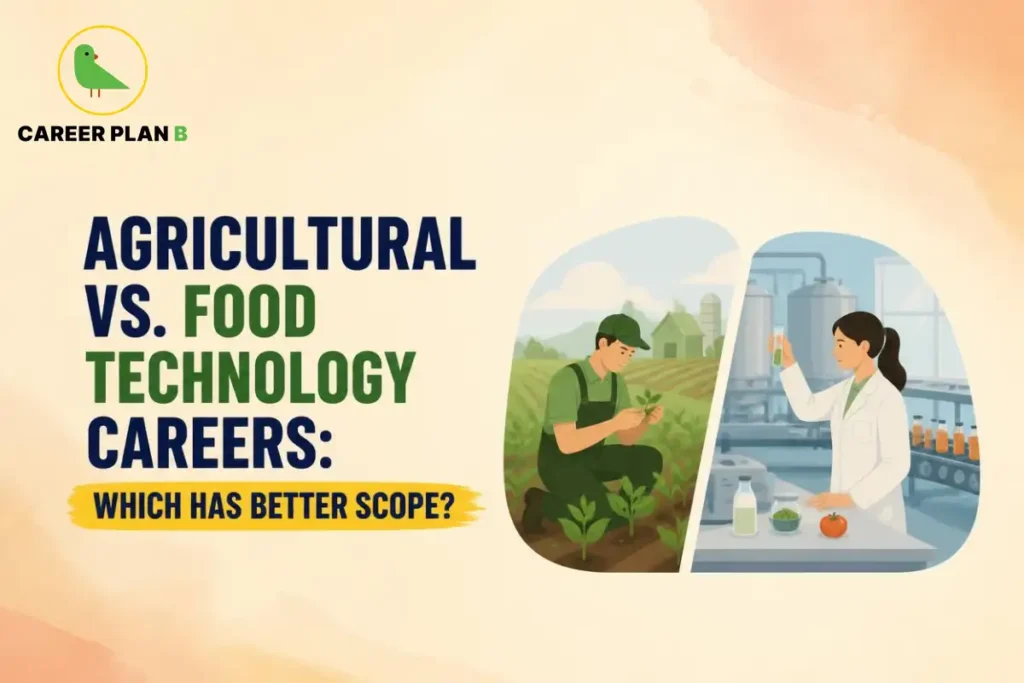
Introduction
India’s farm-to-plate journey involves two genuinely distinct engineering disciplines: growing and handling raw produce, and transforming it into packaged, market-ready food products. Comparing agricultural vs food technology careers, which has better scope? It requires understanding how differently these two fields have been backed by recent government investment.
The Production Linked Incentive Scheme for the Food Processing Industry, launched with a ₹10,900 crore outlay, has already generated approximately 3.39 lakh direct and indirect jobs, surpassing its original employment target of 2.5 lakh persons. Meanwhile, the Ministry of Agriculture and Farmers Welfare received ₹14,052.9 crore for 2026-27, covering the much broader farm production ecosystem. Both fields matter genuinely, just through different parts of the food supply chain.
Why This Comparison Matters for Engineering and Science Students
Both fields connect directly to food, yet they represent genuinely different stages of the same journey: agricultural engineering focuses on production, while food technology focuses on processing and value addition. This agri and food sector comparison helps clarify which stage of that journey actually interests you more.
What Does a Career in Food Technology Actually Look Like?
Food technology in India has recently benefited from substantial, targeted government investment aimed specifically at boosting processing and value addition.
A Sector Riding Real Policy Momentum
The Ministry of Food Processing Industries’ PLI scheme has already approved 165 applications across 274 project locations, with incentives worth around ₹2,000 crore already disbursed as of February 2026. Food technology careers India offers increasingly span ready-to-eat foods, processed fruits and vegetables, marine products, and even millet-based innovation, reflecting the scheme’s genuinely broad product focus. This kind of momentum makes food processing industry jobs a genuinely active, government-backed hiring category right now.
What Does a Career in Agricultural Engineering Actually Look Like?
Agricultural engineering, by contrast, focuses on the earlier stage of the food journey: growing, harvesting, and initial handling of raw agricultural produce.
A Broader, Production-Focused Field
The Indian Council of Agricultural Research coordinates research specifically around mechanization, irrigation, and post-harvest technology. Agricultural engineering careers India offers connect directly to a much larger institutional and budgetary ecosystem than food technology’s more targeted scheme-based approach, reflecting the sheer scale of India’s farming economy compared to its processing sector.
Have Any Doubts?
Comparing Government Investment and Employment Impact
Looking at both fields side by side highlights genuinely different scales and structures of government backing.
| Factor | Agricultural Engineering | Food Technology |
|---|---|---|
| Key Government Body | Ministry of Agriculture and Farmers Welfare | Ministry of Food Processing Industries |
| Ministry Budget | ₹14,05,290 crore (2026–27) | ₹4,364.22 crore (2025–26) |
| Flagship Programme | Mechanization, Irrigation, Post-Harvest Technology | PLI Scheme for Food Processing (₹10,900 crore) |
| Employment Impact | Broad, Spans the Entire Farming Economy | Approximately 3.39 Lakh Jobs Generated Under the PLI Scheme |
This table draws from the Ministry of Agriculture and Farmers Welfare and the Ministry of Food Processing Industries. Notably, the PLI scheme has already surpassed its own employment target, a genuinely strong signal for PLI scheme food processing careers specifically.
Have Any Doubts?
Where Farm Technology Engineering Fits Into This Picture
Understanding the connection between these two fields helps clarify why they’re often compared rather than seen as entirely separate.
Farm technology engineering work, particularly around post-harvest handling and storage, directly feeds into the food processing sector’s raw material supply. Engineers working on post-harvest technology essentially bridge these two career paths, since better harvest handling directly improves what food processing companies have available to work with.
Which Field Genuinely Offers Better Scope?
Agricultural engineering offers dramatically more institutional scale, reflecting its role across the entire, massive farming economy. Food technology, while smaller in overall government budget, currently benefits from concentrated, high-visibility policy momentum through the PLI scheme. which has already exceeded its own job creation targets. This makes food science careers India offers particularly compelling right now for students seeking a fast-moving, currently well-funded specialization, even though the field remains smaller in absolute scale than agricultural engineering.
How Career Plan B Helps
Career Plan B helps students understand the difference between agricultural engineering and food technology careers by evaluating their interests, strengths, and future goals in the food and agriculture ecosystem.
Personalized Career Counselling: Helps students explore whether they are better suited for agricultural engineering, food processing, food technology, agri-tech, or value-added industries based on their career goals and interests.
Psychometric & Career Assessment Tests: Helps identify students’ aptitude, technical interests, and preferred work areas to guide them toward suitable career paths in farm technology, food science, processing, research, or entrepreneurship.
Career Roadmapping: Creates a structured career plan covering degree selection, specialization choices, skill development, internships, certifications, competitive exam preparation, and long-term growth opportunities in agriculture and food industries.
Admission & Academic Profile Guidance: Supports students in selecting suitable colleges, courses, and academic pathways while improving their profile for opportunities in ICAR institutes, food processing companies, agri-tech organizations, government departments, and higher education programmes.
Get In Touch With Us
Frequently Asked Questions
- Which field has more government investment, agriculture or food technology?
Agricultural engineering benefits from a dramatically larger overall ministry budget, given its role across India’s entire farming economy.
- Has the PLI scheme for food processing actually created real jobs?
Yes, genuinely. It has generated approximately 3.39 lakh direct and indirect jobs, surpassing its original 2.5 lakh target.
- Do agricultural engineering and food technology careers overlap?
Yes, particularly in post-harvest handling and storage, where agricultural production directly feeds into food processing supply chains.
- Which field offers faster-growing opportunities right now?
Food technology currently shows strong, concentrated momentum through the PLI scheme, though agricultural engineering offers a broader overall scale.
- Is food technology considered a specialization within agricultural engineering?
They’re closely related but distinct; food technology focuses on processing and value addition, while agricultural engineering focuses on production and farm systems.
Have Any Doubts?
Conclusion
Weighing agricultural vs. food technology careers, which has better scope, ultimately comes down to scale versus current momentum. Agricultural engineering offers vastly broader institutional backing tied to India’s entire farming economy, while food technology currently rides genuinely strong, targeted policy momentum through the PLI scheme’s proven job creation results.
If you’re still deciding which path fits your interests and strengths, Career Plan B can help you explore both directions and build a realistic plan to get there. Whichever you choose, both fields remain genuinely important links in India’s food value chain.