Team6 · July 21, 2026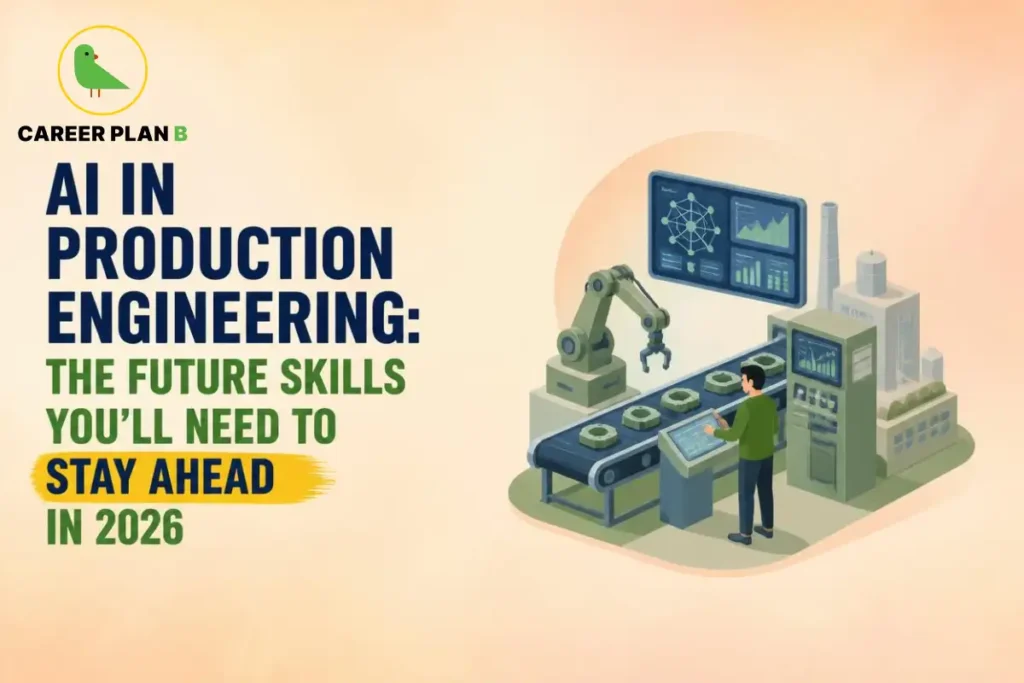
Introduction
India’s AI market is expected to grow at 25-35 per cent through 2027, and NASSCOM estimates the country will need over 1.25 million AI professionals by then. This rapid expansion places genuine urgency behind understanding AI in Production Engineering: Future Skills Needed, since manufacturing is one of the sectors this AI wave is reshaping most directly. Most production engineering students still picture AI as something confined to software companies and data science teams, far removed from factory floors. However, AI is quietly transforming how production lines get monitored, how quality gets checked, and how manufacturing decisions get made, right down to the shop floor. This blog explains exactly what’s changing, the specific skills this shift creates demand for, and what it means for your production engineering career.
Why AI Is Becoming Central to Modern Production Engineering Careers
India’s Broader AI Skilling Push and What It Means for Engineers
India’s government has taken this transformation seriously at a national level. Through the IndiaAI Mission, run under the Ministry of Electronics and Information Technology, the government is establishing data and AI labs in Tier 2 and Tier 3 cities and funding research through the IndiaAI Innovation Centre. Additionally, the Ministry of Skill Development and Entrepreneurship has launched initiatives like Skilling for AI Readiness, specifically designed to embed AI capabilities across vocational training and workforce development. This isn’t a narrow, software-only initiative; it explicitly targets sectors including manufacturing, alongside agriculture, healthcare, and governance.
How Manufacturing Specifically Is Being Reshaped by AI
Within manufacturing, this shift builds directly on India’s earlier Industry 4.0 push through initiatives like SAMARTH Udyog Bharat 4.0, run by the Ministry of Heavy Industries. That programme already established Centres of Excellence to help manufacturers adopt connected, data-driven production systems. AI represents the natural next layer on top of that foundation, since the sensor data these smart factories generate become genuinely useful only when AI models can analyze it and make predictions from it in real time.
How Is AI Actually Changing the Day-to-Day Role of a Production Engineer?
Is this really changing daily work, or is it simply new software layered onto old processes? The shift runs deeper than that. Traditionally, production engineers monitored machines manually, reacted to problems after they occurred, and relied heavily on experience-based judgment calls. With AI tools now analyzing sensor data continuously, however, engineers increasingly work with systems that flag problems before they happen and recommend specific corrective actions. Consequently, the role is shifting from reactive troubleshooting toward interpreting AI-generated insights and deciding how to act on them, a meaningfully different skill set than what traditional production engineering training emphasized.
Core Areas Where AI Is Transforming Production Engineering Work
Predictive Maintenance Powered by Machine Learning
One of the clearest applications involves predictive maintenance, where machine learning models analyze vibration, temperature, and performance data to predict equipment failures before they happen. Rather than following fixed maintenance schedules, production engineers can now rely on AI models that flag specific machines needing attention, based on actual wear patterns rather than generic timelines. This shift alone significantly reduces unplanned downtime, which historically cost manufacturers enormous amounts in lost production time.
AI-Driven Quality Control and Computer Vision Systems
Quality control has also transformed considerably through computer vision systems that can spot defects far more consistently than manual visual inspection. These systems use trained AI models to scan products at high speed, flagging even minor inconsistencies that a human inspector might miss during a long shift. Production engineers now need to understand how to configure, calibrate, and troubleshoot these vision systems, rather than relying purely on manual inspection protocols.
AI-Assisted Production Planning and Demand Forecasting
Beyond the factory floor itself, AI is increasingly used for production planning, helping engineers forecast demand more accurately and optimize scheduling across multiple production lines. This means production engineers now collaborate more closely with data teams, since planning decisions increasingly draw on AI-generated forecasts rather than purely historical patterns. Therefore, understanding the basics of how these forecasting models work has become genuinely useful, even for engineers who aren’t building the models themselves.
The Future Skills Production Engineers Will Need to Stay Relevant
Technical Skills: Machine Learning Basics, Data Analytics, and IIoT
Staying relevant in this shifting landscape requires more than traditional mechanical or industrial engineering knowledge alone. Basic familiarity with machine learning concepts, comfort interpreting data analytics dashboards, and working knowledge of Industrial Internet of Things platforms are quickly becoming genuine differentiators for AI skills for engineers entering this space. You don’t necessarily need to build AI models from scratch, but understanding how they work, what data they need, and how to interpret their outputs matters enormously for working effectively alongside them.
The Growing Talent Gap and Why Upskilling Matters Now
Given India’s need for over 1.25 million AI professionals by 2027, according to NASSCOM’s projections, a genuine talent gap already exists across sectors, including manufacturing. This gap represents a real opportunity for production engineers willing to build these skills early, since companies actively investing in AI in manufacturing India initiatives need engineers who can bridge traditional manufacturing knowledge with AI literacy, a combination that remains genuinely scarce right now.
Have Any Doubts?
Career Roles and Growth Path in AI-Driven Manufacturing
| Career Stage | Typical Role | What You’ll Do |
|---|---|---|
| Entry-Level | Junior Production Engineer (AI-Integrated Lines) | Monitor AI dashboards, support predictive maintenance |
| Mid-Level | Smart Manufacturing Engineer | Configure AI quality systems, coordinate forecasting |
| Senior-Level | AI-Manufacturing Integration Lead | Oversee factory-wide AI strategy and training |
Given the scale of investment behind India’s AI skilling push and the persistent talent gap NASSCOM has identified, professionals who combine production engineering scope with genuine AI literacy are well positioned for strong, sustained demand across AI manufacturing jobs in India.
How Career Plan B Helps
Career Plan B helps students and professionals make informed career decisions by providing personalized guidance, skill assessments, and structured career planning for emerging fields like AI-driven manufacturing and production engineering.
Personalized Career Counselling: Provides expert guidance based on individual interests, technical skills, and career goals and helps students understand how AI integration can shape their production engineering careers.
Psychometric & Career Assessment Tests: Identify strengths, personality traits, learning preferences, and suitable career opportunities in areas such as smart manufacturing, AI-enabled production systems, and Industry 4.0 roles.
Career Roadmapping: Creates a clear step-by-step plan covering required skills, certifications, learning pathways, and career milestones to help students prepare for future AI-driven manufacturing opportunities.
Admission & Academic Profile Guidance: Helps students select the right engineering courses, specializations, and academic pathways while improving their profile for advanced production engineering and AI manufacturing career opportunities.
Get In Touch With Us
Frequently Asked Questions
1. Will AI replace production engineers, or just change the job?
It’s changing the job rather than replacing it, shifting engineers from manual monitoring toward interpreting AI-generated insights and managing automated systems.
2. What AI skills should a production engineer learn first?
Basic machine learning concepts, data analytics interpretation, and familiarity with IIoT platforms offer the most practical starting point for this transition.
3. Is India investing seriously in AI skilling for manufacturing?
Yes, through initiatives like the IndiaAI Mission and SAMARTH Udyog Bharat 4.0, both of which specifically target workforce readiness across manufacturing sectors.
4. Do I need a coding background to work with AI in manufacturing?
Not necessarily advanced coding, though basic data literacy and comfort with analytics tools significantly strengthen a production engineer’s profile in this space.
5. Which industries are adopting AI in production the fastest?
Automotive and electronics manufacturing currently lead AI adoption in India, driven by precision requirements and high-volume production needs.
Conclusion
Understanding AI in Production Engineering: Future Skills Needed makes it clear that this career is evolving into something considerably more data-driven than its traditional form, without becoming any less valuable or relevant. As India’s AI skilling initiatives continue expanding through programmes like the IndiaAI Mission, production engineers who build genuine AI literacy alongside their core manufacturing knowledge are positioned for strong, long-term career growth. This shift represents a real opportunity for engineering students who want to future-proof their production engineering career rather than watch their traditional skill set gradually become less central to how factories actually operate.
If you’d like help figuring out how to build the right AI-related skills for this evolving direction, a conversation with a Career Plan B counsellor can help you plan the right path forward.