Team Career Plan B · August 10, 2026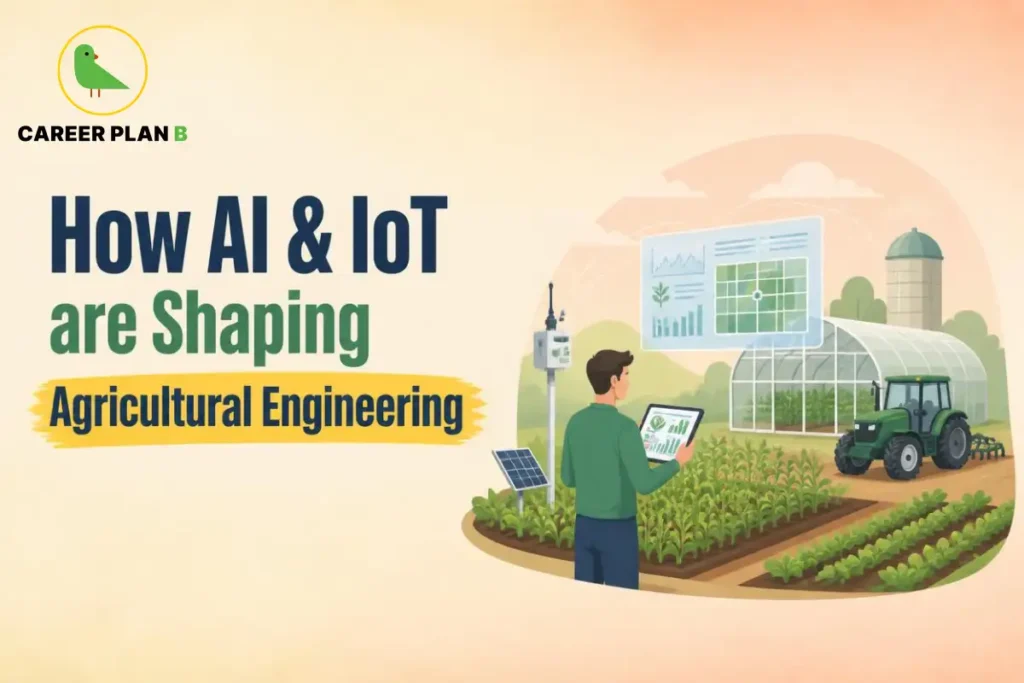
Introduction
India’s agricultural sector is quietly becoming one of the country’s most active testing grounds for artificial intelligence and connected devices. Understanding how AI & IoT are shaping agricultural engineering starts with looking at real, already-deployed government initiatives, not just future possibilities.
According to the Ministry of Agriculture and Farmers’ Welfare, the Indian Council of Agricultural Research has already developed an IoT-based irrigation system and tested it in the field for selected crops. Meanwhile, the government has deployed Kisan e-Mitra, an AI-powered chatbot supporting farmers in multiple regional languages. Let’s break down exactly what these technologies mean for agricultural engineers entering the field today.
Why This Shift Is Happening Right Now
Government agencies have moved well beyond pilot projects into genuinely deployed, farmer-facing AI and IoT systems. This makes AI in Indian agriculture a current, active career area rather than a distant future trend, giving engineers real, already-functioning systems to build careers around today.
Kisan e-Mitra: AI Meeting Farmers Where They Are
One of the clearest examples of AI actually reaching Indian farmers at scale comes through a voice-enabled chatbot handling millions of queries.
A Genuinely Large-Scale Deployment
Kisan e-Mitra technology, launched in September 2023, uses natural language processing to understand farmer queries across 11 major Indian languages, including Hindi, Bengali, Telugu, and Tamil. According to government data, the chatbot addresses over 8,000 farmer queries daily and has responded to more than 93 lakh queries as of December 2025. This isn’t a small experiment; it represents genuine infrastructure-scale AI deployment that engineers help build, maintain, and expand.
IoT-Based Irrigation: Where Hardware Meets Data
Beyond chatbots, agricultural engineers are directly involved in building the physical sensor networks that make precision irrigation possible.
Bringing Sensors to the Field
ICAR has developed and field-tested an IoT-based irrigation system for selected crops, directly connecting agricultural engineering expertise to sensor and connectivity technology. These IoT irrigation systems India deploys require engineers who understand both traditional irrigation design and how sensors, connectivity, and automated controls work together to reduce water waste while improving crop outcomes.
The National Pest Surveillance System: AI Protecting Crops
Beyond irrigation, AI is also being deployed to solve one of farming’s oldest problems: detecting crop threats before they cause serious damage.
Detecting Problems Before They Spread
The National Pest Surveillance System, launched in 2024, uses artificial intelligence and machine learning to enable early detection of pest infestations and crop diseases. This system reflects a genuinely important shift in agricultural engineering’s role, from designing physical equipment toward building the data and detection systems that protect crops proactively rather than reactively.
What Skills Will Engineers Need for This AI-Driven Future?
Meeting this shift requires agricultural engineers to build genuinely new technical capabilities on top of traditional training.
| Traditional Skill | AI/IoT-Era Skill | Where It’s Already Deployed |
|---|---|---|
| Manual Irrigation Scheduling | IoT Sensor-Based Irrigation Control | ICAR’s Field-Tested IoT Irrigation System |
| Field-Based Pest Inspection | AI-Driven Pest Detection and Surveillance | National Pest Surveillance System |
| In-Person Farmer Support | Multilingual AI Chatbot Systems | Kisan e-Mitra |
| Manual Data Collection | Digital Infrastructure and Soil Mapping | AgriStack, Digital Agriculture Mission |
Strong agricultural engineer AI skills increasingly blend traditional mechanical and irrigation expertise with comfort around sensors, natural language processing systems, and machine learning fundamentals, reflecting how genuinely interdisciplinary this field has become in just a few short years.
Have Any Doubts?
Career Opportunities in This Emerging Space
This technological shift is directly creating new categories of IoT agricultural engineering jobs that didn’t exist as distinct roles until very recently.
Engineers working on these systems find opportunities within ICAR’s research network, private technology partners supporting government platforms like Kisan e-Mitra, and a growing base of agri-tech companies building similar sensor and AI-driven tools independently. This diversification means genuinely broad career options for engineers comfortable working at the intersection of agriculture and emerging technology.
How Career Plan B Helps
Career Plan B helps students understand how emerging technologies like AI, IoT, and smart farming are reshaping agricultural engineering careers and what skills they need to build for the future.
Personalized Career Counselling: Helps students explore whether AI-driven agriculture, IoT-based farming solutions, research roles, or agri-tech careers align with their interests and long-term goals.
Psychometric & Career Assessment Tests: Identifies students’ strengths, technical interests, and aptitude to determine suitable career directions in areas such as precision farming, agricultural technology, data-driven farming, and innovation.
Career Roadmapping: Creates a structured career plan covering relevant skills like IoT systems, sensors, AI fundamentals, programming basics, internships, certifications, and higher education pathways for technology-focused agricultural engineering roles.
Admission & Academic Profile Guidance: Supports students in choosing the right agricultural engineering colleges, specialization areas, and academic opportunities while preparing them for careers in ICAR research, government technology projects, and private agri-tech companies.
Get In Touch With Us
Frequently Asked Questions
- Is Kisan e-Mitra actually being used by farmers, or is it still experimental?
It’s genuinely in active use, having responded to over 93 lakh farmer queries as of December 2025 across 11 regional languages.
- Has India actually deployed IoT-based irrigation systems, or is this still research?
ICAR has developed and field-tested an IoT-based irrigation system for selected crops, representing real, deployed technology rather than purely theoretical research.
- What does the National Pest Surveillance System actually do?
It uses AI and machine learning to enable early detection of pest infestations and crop diseases, helping farmers intervene before problems spread.
- Do agricultural engineers need programming skills for these AI/IoT roles?
Increasingly, yes. Basic familiarity with sensors, data systems, and machine learning fundamentals is becoming valuable alongside traditional engineering training.
- Are these AI and IoT initiatives creating genuine new job opportunities?
Yes. They’re creating distinct new categories of work spanning government research, private technology partnerships, and independent agri-tech companies.
Conclusion
Understanding how AI & IoT are shaping agricultural engineering in India comes down to recognizing that this isn’t a future trend; it’s already happening through deployed systems like Kisan e-Mitra, ICAR’s IoT irrigation technology, and the National Pest Surveillance System. Agricultural engineers today genuinely need to blend traditional expertise with comfort around sensors, data, and AI fundamentals.
If this evolving, technology-driven field sounds like where you want to build your career, Career Plan B can help you map out a realistic path forward. With government and private innovation both expanding rapidly, there’s genuine, lasting opportunity for engineers ready to help shape how India farms.