Team Career Plan B · October 8, 2026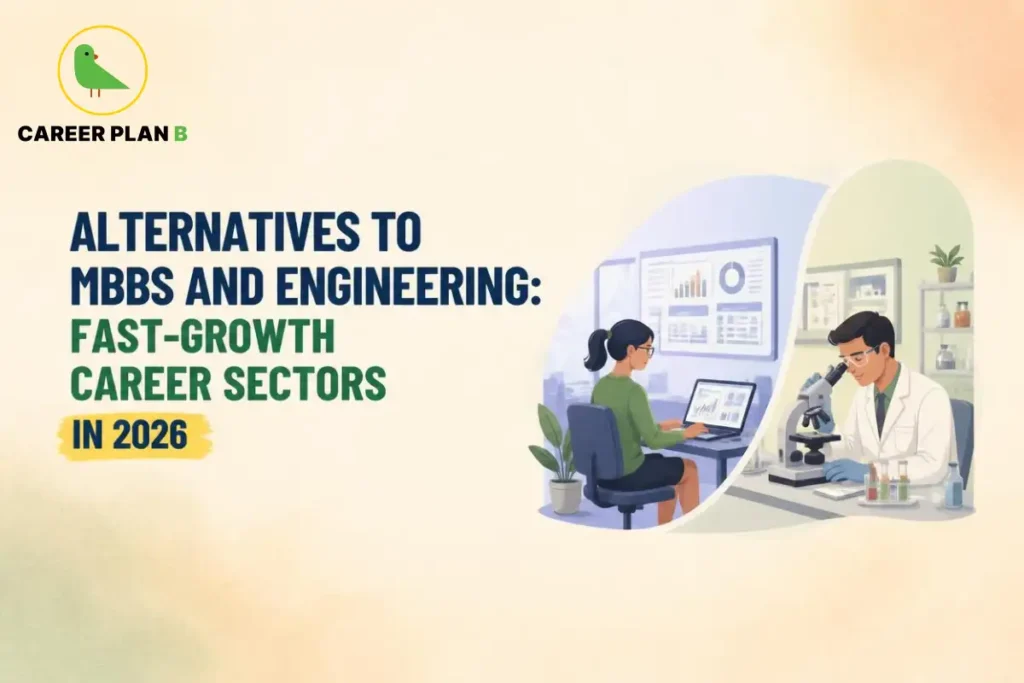
Introduction
“Beta, become a doctor or an engineer.” If you’ve heard this at every family gathering, you’re far from the only one. For decades, MBBS and engineering were treated as the only two “safe” destinations after Class 12 in India. But that thinking is quietly becoming outdated.
Alternatives to MBBS and Engineering aren’t a consolation prize anymore — they’re often the smarter, faster-growing path. From animation and design to renewable energy and semiconductors, entire sectors are expanding rapidly, backed by real government investment and policy support. And the best part? Many of these fields don’t require the intense, single-track exam pressure that medicine and engineering demand.
This blog walks you through genuine, fast-growing sectors in India for 2026, what makes them worth considering, and how students and parents can evaluate these paths with confidence rather than confusion. Let’s get into it.
Fast-Growth Career Sectors to Watch in 2026
Before jumping into specific careers, it helps to understand which sectors the Indian government itself is actively investing in. According to the Union Budget 2026-27, several sectors have been flagged for major skilling and capacity-building pushes:
- AVGC (Animation, Visual Effects, Gaming, and Comics) – The media and entertainment sector is projected to grow at nearly 7% annually, and the AVGC sector alone is expected to need close to 2 million professionals by 2030. To support this, the government is setting up AVGC Content Creator Labs in 15,000 secondary schools and 500 colleges.
- Design – A new National Institute of Design is being set up in eastern India to meet growing demand for design professionals across industries.
- Tourism and Hospitality – The travel and tourism sector supported an estimated 8.46 crore direct and indirect jobs, contributing over 13% of total employment in the country. A new National Institute of Hospitality is also being established.
- Semiconductors, AI, and Cybersecurity – The Ministry of Skill Development and Entrepreneurship has developed over 600 new job roles in semiconductors, AI, cybersecurity, and renewable energy, training more than 4.3 lakh youth in these emerging areas.
These aren’t speculative trends — they’re backed by budget allocations and active skilling missions. That’s what makes these Fast-Growth Career Sectors genuinely different from a passing fad.
Read more :- Medical Courses Without NEET After 12th
Best Career Options After 12th (Beyond MBBS and Engineering)
If you’re wondering what this looks like as a career choice, here are some Best Career Options After 12th worth researching seriously:
- Animation, VFX & Game Design – A creative-technical field with growing institutional support and industry demand, as outlined above.
- Design (Product, UX/UI, Fashion, Communication) – Covers physical products and digital interfaces. Institutes like NID offer structured, portfolio-based programmes.
- Hospitality & Tourism Management – A sector with a major employment contribution and renewed government focus on skilling.
- Renewable Energy & Green Jobs – India continues to expand solar, wind, and clean mobility infrastructure. This is increasing demand for technical and vocational roles.
- Semiconductor & Electronics Manufacturing – A newly prioritized sector under India’s semiconductor mission, with hundreds of new job roles being defined.
- Skilled Trades via ITIs – Industrial Training Institutes have expanded significantly. The number grew from around 9,977 institutes to over 14,682 nationally. They offer practical, job-ready training in emerging technical fields.
Each path has its own entry route. Some use specialized entrance exams, while others rely on skill certification or portfolio-based admission. None require the MBBS or engineering route to build a solid, growing career.
High-Demand Careers Without MBBS or Engineering
It’s worth addressing the elephant in the room directly: can you build a stable, well-paying career without becoming a doctor or engineer? Increasingly, yes. Here’s why these High-Demand Careers Without MBBS or Engineering are gaining real traction:
- Government-backed skilling infrastructure – Programmes like PMKVY 4.0 had trained over 28.17 lakh candidates across 36 sectors by June 2026. The programme also introduced 68 customised courses and 189 future-skill job roles.
- New-age job roles being formally recognized – Sectors like AI, cybersecurity, and green jobs now have defined job roles and training pathways. Many of these roles did not exist a decade ago.
- Reduced dependency on a single high-stakes exam – Many of these fields use skill certification, portfolio review, or aptitude-based entry. They don’t always depend on one make-or-break test.
That said, it’s important to be honest with yourself and your family. These fields require their own form of discipline. You may need to build a portfolio, clear a design aptitude test, or complete structured skill certification. They’re alternatives, not shortcuts.
Emerging Career Options 2026
Looking ahead, a few Emerging Career Options 2026 deserve particular attention because of how directly they’re tied to national policy priorities:
| Sector | Government Signal | Why It’s Growing |
|---|---|---|
| AVGC | AVGC Labs in 15,000 schools, 500 colleges | Nearly 2 million professionals needed by 2030 |
| Semiconductors | 600+ new job roles under MSDE | India’s semiconductor ecosystem workforce strategy |
| Renewable Energy & Green Jobs | National skilling missions | Focus on AI, cybersecurity, renewable energy, mobility |
| Design | New NID campus planned | Rising cross-industry demand for design professionals |
| Hospitality | New National Institute of Hospitality | Tourism sector supports 13.3% of total employment |
What’s notable here is that these aren’t isolated private-sector trends — they’re sectors the government itself has chosen to invest skilling infrastructure into, which is a meaningfully different signal than a marketing claim from a training company.
For Personalized Guidance
Alternative Career Paths After 12th: How to Choose Wisely
With so many options, how do you actually pick an Alternative Career Path After 12th without feeling overwhelmed? A few grounded steps:
- Match the sector to your genuine interest, not just the trend. A fast-growing sector still requires years of sustained effort — pick something you can stay motivated in.
- Research the actual entry pathway. Some fields need entrance exams, others need portfolios, and some need skill certifications. Know this before you commit a year of preparation.
- Talk to people actually working in the field. Trends look great on paper; real working conditions and day-to-day work matter more.
- Avoid unverified salary or ranking claims. Be cautious of numbers from training companies or aggregator sites promising guaranteed outcomes — verify placement and career data directly with institutes wherever possible.
- Keep your options layered, not locked. Many of these fields allow you to start with a shorter certification and scale up to a full degree later, reducing the pressure of a single irreversible decision at 18.
How Career Plan B Helps
Choosing a path beyond MBBS and engineering can feel uncertain without the right guidance — Career Plan B helps students and parents make this decision with clarity, not guesswork.
- Personalized Career Counselling: We help you explore fast-growing sectors that genuinely match your interests and strengths, not just what’s trending.
- Psychometric & Career Assessment Tests: Our assessments reveal whether you’re better suited to creative, technical, or service-driven emerging fields.
- Career Roadmapping: We build a realistic, step-by-step plan for entry into sectors like design, AVGC, or green energy — including the right courses and certifications.
- Admission & Academic Profile Guidance: We guide you on building a strong profile for portfolio-based or skill-certification pathways, so you’re not limited to the traditional exam-only route.
Get In Touch With Us
Frequently Asked Questions
Q1. Are there real career options in India besides MBBS and engineering?
Yes. Sectors like design, AVGC, hospitality, renewable energy, and semiconductor manufacturing are receiving active government investment and skilling support, making them genuine, growing alternatives.
Q2. Is the AVGC sector actually in demand in India?
Yes. The government’s Budget 2026-27 documentation notes the AVGC sector is projected to require nearly 2 million professionals by 2030, backed by new Content Creator Labs in thousands of schools and colleges.
Q3. Do these alternative careers require entrance exams like MBBS or engineering?
Some do — for example, top design institutes require entrance and portfolio review. Others rely more on skill certification. It depends entirely on the specific field and institute.
Q4. Can I switch into a fast-growing sector later if I start with a traditional degree?
Many of these sectors offer certification and diploma-level entry points, which can complement or follow an existing degree, though starting early generally gives a stronger foundation.
Q5. How do I know if a “high-demand” career claim is reliable?
Look for backing from official sources like government ministries, budget documents, or recognized skill councils, rather than relying solely on private training companies’ marketing claims.
Conclusion
MBBS and engineering will always have their place, but they’re no longer the only “serious” options after Class 12. Sectors like AVGC, design, hospitality, renewable energy, and semiconductors are backed by real government investment, expanding institutional capacity, and genuine long-term demand.
The key is choosing a path based on your interests and verified information, not pressure or assumptions. If you’re a student or parent trying to explore what’s actually available beyond the traditional two tracks, Career Plan B is here to help you map out a career path that’s both exciting and grounded in reality.