Team Career Plan B · August 13, 2026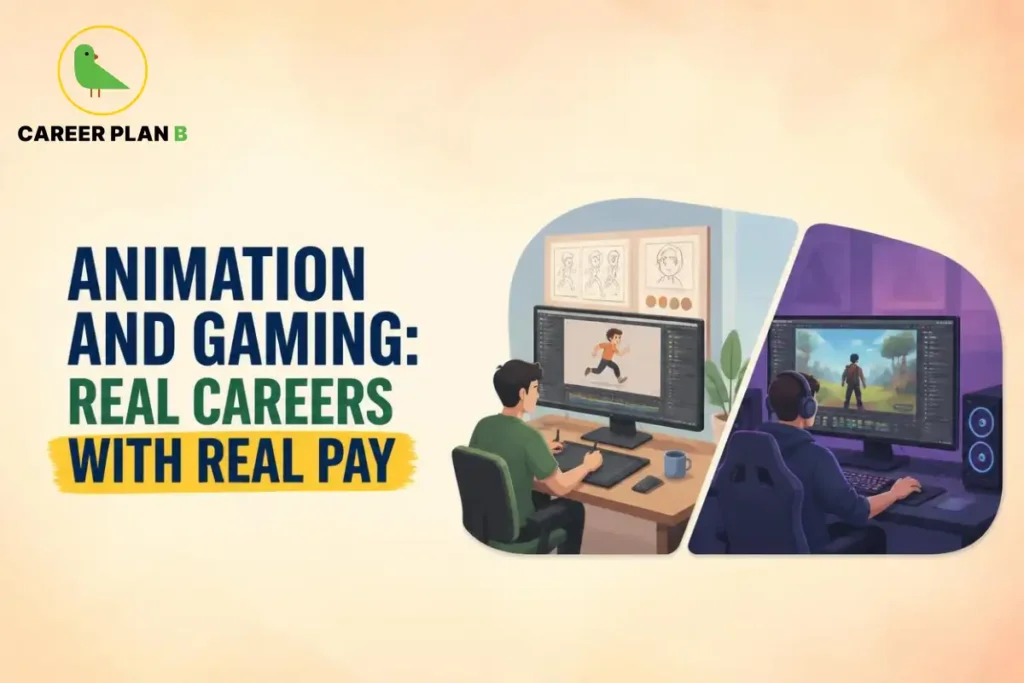
Introduction
Animation and gaming used to sound like a risky choice in India. That’s changed. Government policy, real studios, and global outsourcing have turned it into a documented, growing job market. This guide covers animation and gaming as real careers, with real pay, not just creative passion projects.
Why Animation and Gaming Are Becoming Serious Career Options
The sector now has an official name: AVGC-XR, short for Animation, Visual Effects, Gaming, Comics, and Extended Reality. India’s media and entertainment market is projected to cross USD 100 billion by 2030, based on government estimates. The AVGC Promotion Task Force was set up by the Ministry of Information and Broadcasting in 2022. It projects the sector could create around 20 lakh direct and indirect jobs over the next decade.
This isn’t just a projection on paper. The Union Cabinet has already approved a National Centre of Excellence for the sector. It’s called the Indian Institute of Creative Technologies (IICT), located in Mumbai. The government has backed it with over ₹391 crore in one-time funding, modelling it on the IIT and IIM system.
The Real Career Paths Inside Animation and Gaming
“Animation and gaming” isn’t one job. It covers a wide set of distinct roles, each needing different skills.
On the animation and VFX side:
- 2D/3D Animator — brings characters and scenes to life, frame by frame or through rigged models.
- VFX Artist — creates visual effects for film, TV, and advertising.
- Motion Designer — builds animated graphics for branding, UI, and marketing content.
- Technical Artist — bridges the gap between artists and engineers, optimising assets for production.
On the gaming side:
- Game Designer — designs mechanics, levels, and player experience.
- Game Developer — builds the actual game using engines like Unity or Unreal Engine.
- UI/UX Designer for games — designs how players interact with the game itself.
- XR Developer — builds AR and VR experiences, a fast-growing niche within AVGC-XR.
What These Careers Actually Pay
Salary data for this sector isn’t published by a single official source. Most figures come from job platforms like Glassdoor, AmbitionBox, and PayScale, based on real listings rather than government surveys.
With that caveat, senior roles reportedly pay well. Lead Game Designer, Senior Technical Artist, and Senior UI/UX Designer roles range from ₹25 to ₹45 LPA, based on 2025-26 platform data. Entry-level roles pay considerably less, as in any creative field. Pay also varies by city, studio size, and whether the client is domestic or international.
Treat any specific number as a starting reference, not a guarantee. Verify current listings before making a decision based on salary alone.
Skills That Actually Get You Hired
Portfolios matter more than degrees in this industry. Studios hire based on demonstrated work, not just a certificate.
- Software fluency: Unity and Unreal Engine for games, Blender and Maya for 3D art, After Effects and Cinema 4D for motion design.
- A strong, focused portfolio: three to five excellent pieces beat twenty mediocre ones, in almost every hiring conversation.
- Working knowledge of AI-assisted tools: tools like Runway and Stable Diffusion are increasingly part of real production pipelines, not a threat to avoid.
- Collaboration skills: most roles sit inside a pipeline with writers, engineers, and other artists, not in isolation.
Where to Study: Official and Industry-Backed Options
The Indian Institute of Creative Technologies opened its first batch in August 2025, in Mumbai. It runs courses across Gaming, Post-Production, Animation, Comics, and XR, developed with industry partners like Google, Adobe, and NVIDIA.
State governments are also building out AVGC-XR infrastructure. Maharashtra approved a ₹3,268 crore AVGC-XR policy. Tamil Nadu launched its own AVGC-XR Policy 2026, targeting 200 new startups and roughly two lakh jobs by 2030. Karnataka has run a dedicated AVGC-XR policy since 2024.
Beyond these, private institutes and university-run programmes remain common entry points. This holds especially for students not near a major AVGC-XR hub.
Is AI a Threat to This Industry?
It’s a fair question, given how fast AI image and video tools have improved. Some routine tasks are genuinely changing. Basic rotoscoping, simple asset generation, and rough concept art are increasingly AI-assisted.
But this shifts the job, rather than eliminating it. Studios still need people who can direct, refine, and judge AI output, not just accept it. Treat AI fluency as a skill to build, not a threat to fear. That’s the more useful framing for anyone starting out now.
Have Any Doubts?
Benefits, Challenges, and What the Data Says
The genuine benefit here is real government and state-level investment, not just hype. Cabinet-approved infrastructure, dedicated state policies, and a national training institute all point to sustained backing, not a passing trend.
To be transparent about a limitation: figures like “20 lakh jobs by 2032” come from task force projections. They aren’t a completed count of existing roles. Treat them as a policy target and industry estimate, not a confirmed employment number. Current employment figures also vary by source. Estimates range from roughly 2.6 lakh to 4.5 lakh professionals, depending on the report.
The real challenge is competition and income variability. This remains a portfolio-driven, often freelance-heavy industry. Steady, well-paid roles exist, but they’re earned through demonstrated skill, not guaranteed by a degree alone.
How Career Plan B Helps
Animation and gaming careers span a wide range of specific roles, each needing a different skill set. Career Plan B helps through:
Personalised Career Counselling: narrowing down which specific role, animator, designer, or developer, actually fits your strengths. Psychometric and Career Assessment Tests: checking whether your aptitude leans toward art, technical building, or design. Career Roadmapping: a step-by-step plan covering the right software, portfolio pieces, and institutes for your chosen path. Admission and Academic Profile Guidance: support building a profile that stands out for AVGC-XR programmes.
If you’re weighing animation or gaming as a real career, Career Plan B is a reasonable next stop.
For Latest Information
Frequently Asked Questions
Q1. Is animation and gaming a stable career in India?
It’s a genuinely growing field, backed by government policy and real institutional investment. That said, income can vary a lot, and a strong portfolio matters more than a fixed career ladder.
Q2. Do I need a specific degree to work in gaming or animation?
Not always. Studios generally hire based on portfolio strength and software skills. Structured courses at places like IICT can still speed up skill-building and networking.
Q3. What is AVGC-XR?
It stands for Animation, Visual Effects, Gaming, Comics, and Extended Reality. It’s the official government term for this sector, used in national policy and job projections.
Q4. Will AI replace animation and gaming jobs?
Unlikely to eliminate them, though it is changing routine tasks like basic rotoscoping. Professionals who can direct and refine AI output are likely to stay in demand.
Q5. What’s the best software to learn first?
It depends on your path. It depends on the path. Common starting points are Unity or Unreal Engine, Blender or Maya, and After Effects.
Conclusion
Animation and gaming careers in India are now supported by far more than individual talent and ambition. The industry has gained strong institutional backing through national policy initiatives, a Cabinet-approved training institute, and growing investments from several state governments. At the same time, expanding demand from gaming studios, animation companies, OTT platforms, advertising agencies, and emerging technologies such as AR and VR is creating a wider range of career opportunities than ever before.
Connect with Career Plan B today to understand your strengths, explore the right learning pathway, and build a personalised roadmap into India’s growing animation and gaming industry.