Team6 · October 6, 2026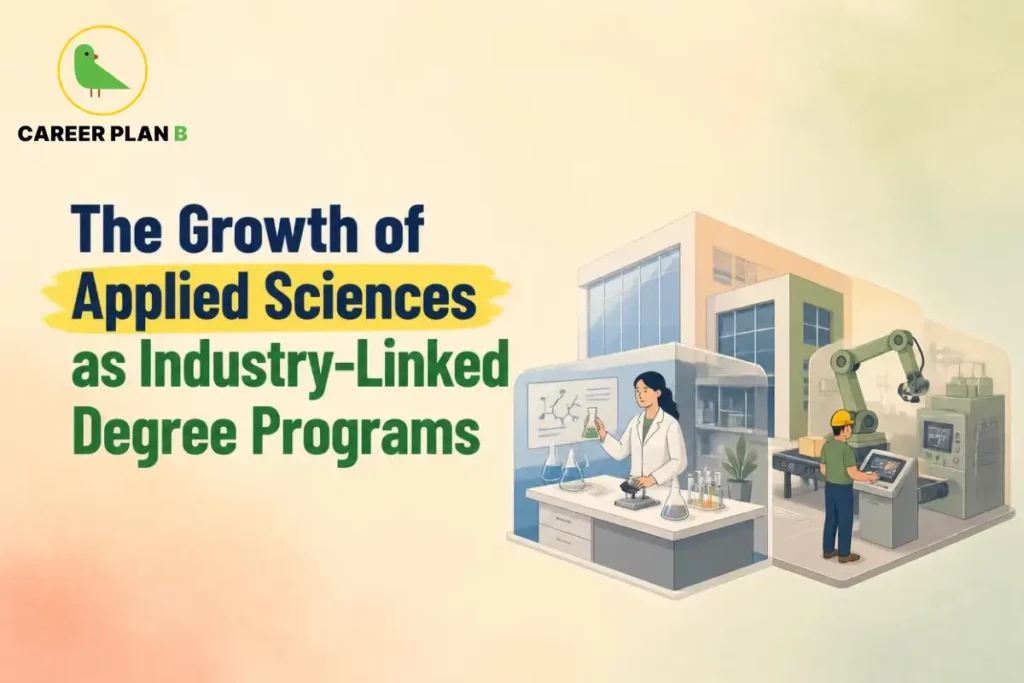
Introduction
For a long time, science degrees in India followed one script: memorize the theory, pass the exam, and figure out the “real job” part later. That script is quietly being rewritten.
Applied sciences courses are gaining ground because they flip this order. They build job-ready skills into the degree itself instead of adding them afterward.
If you’re a student who loves science but has always wondered, “How does this actually turn into a job?” this shift matters to you. Industry-linked degree programs are no longer a niche experiment. They are becoming a structured, government-recognized part of India’s higher education system. These programs aim to close the gap between what you learn and what employers actually need.
This blog explores how applied sciences have evolved into genuinely industry-connected degrees. It also looks at what this approach means in practice and how you can plan your own path into this growing space in 2026.
Applied Sciences Courses: A Different Kind of Science Degree
Applied sciences courses differ from traditional pure science degrees in one key way: they’re built around solving real, practical problems rather than purely theoretical understanding. Where a conventional B.Sc. might focus heavily on foundational theory, applied sciences programs integrate:
- Hands-on lab and field work tied directly to industry practices
- Sector-specific specializations — food technology, industrial chemistry, applied biotechnology, and similar practical disciplines
- Direct curriculum input from industry partners, ensuring what’s taught reflects what’s actually used on the job
- Structured pathways toward employability, not just academic progression
This isn’t a new idea globally, but its formal integration into India’s degree structure — through frameworks like the University Grants Commission’s (UGC) skill-based degree programs — has made applied sciences a much more legitimate, recognized route than it was a decade ago.
Read more:- Career Scope in Applied Economics After BBA: 10 Strategic-Analytical Paths to Success
Industry-Linked Degree Programs: How They Actually Work
The clearest example of Industry-Linked Degree Programs in India is the Bachelor of Vocation (B.Voc.) framework, introduced by the UGC specifically to blend academic education with vocational skill-building. According to UGC’s own guidelines, the goal is to provide a judicious mix of skills relating to a profession alongside general education, ensuring students are genuinely work-ready at multiple points in the program, not just at graduation.
Here’s what makes this framework genuinely industry-linked, not just industry-branded:
- Curriculum built with industry input – UGC guidelines specify that universities and colleges should develop the curriculum in consultation with industry, with industry representatives forming part of the academic bodies overseeing these programs.
- Alignment with National Occupational Standards (NOS) – The skill components of the curriculum are aligned with standards developed by Sector Skill Councils, ensuring what’s taught maps to real, recognized job roles.
- Multiple entry and exit points – Students can exit with a Diploma, Advanced Diploma, or full B.Voc. Degree depending on how far they progress, offering flexibility rather than an all-or-nothing commitment.
- NSQF-aligned skill levels – The program structure is designed so that by the end of each year, students meet defined National Skills Qualifications Framework (NSQF) levels, creating a transparent, standardized progression.
This structure is precisely what separates a genuine industry-linked degree from a marketing label — it’s backed by an actual government framework connecting academic credit to real occupational standards.
Applied Science Careers Opening Up Through This Model
As these programs mature, Applied Science Careers are becoming more diverse and more directly connected to specific industries. Depending on your specialization, this model can lead toward:
| Specialization Area | Career Direction | Starting Salary (2026) | Senior Salary Scope |
|---|---|---|---|
| Food Processing & Food Safety | Quality control, food safety management, production roles | ₹3.5 – ₹6.5 LPA | ₹12.0 – ₹22.0+ LPA |
| Industrial Chemistry | Manufacturing, quality assurance, chemical industry roles | ₹4.0 – ₹7.5 LPA | ₹15.0 – ₹30.0+ LPA |
| Applied Computer Technology | IT support, application development, technical operations | ₹4.5 – ₹8.0 LPA | ₹16.0 – ₹32.0+ LPA |
| Agriculture & Organic Farming | Agri-tech, farm management, sustainable agriculture roles | ₹3.5 – ₹7.0 LPA | ₹14.0 – ₹28.0+ LPA |
| Biotechnology-adjacent applied fields | Lab-based industry roles, quality and research support | ₹4.0 – ₹7.5 LPA | ₹15.0 – ₹28.0+ LPA |
What’s notable is that these aren’t abstract “science degree” outcomes — they’re specific job-role pathways, shaped directly by the Sector Skill Councils and industry partners involved in designing the curriculum.
Applied Sciences After 12th: Getting Started
If you’re wondering how to pursue Applied Sciences After 12th, here’s what the entry point generally looks like:
- Eligibility – Under UGC’s B.Voc. guidelines, the eligibility condition for admission is 10+2 or equivalent, in any stream — meaning you don’t necessarily need a pure Science background to enter many applied science and vocational degree programs.
- Program structure – A typical B.Voc. program runs three years, combining substantial skill training (often the larger share of total credits) with general education components.
- Institution selection – UGC maintains and periodically updates a list of approved institutions offering skill-based courses under NSQF, which is worth checking directly before applying anywhere.
- Specialization choice – With a wide range of sectors covered — from food processing to IT to agriculture — it’s worth matching your specialization to genuine interest, not just perceived demand.
Because eligibility is broader than many traditional science degrees, this path can be a genuine option even for students who didn’t take Science in Class 12 but are drawn to a specific applied, hands-on field.
Have Any Doubts?
Skill-Based Science Courses: Why the Structure Matters
The design of Skill-Based Science Courses under this framework is deliberate, and understanding it helps you evaluate any program properly:
- Skill-heavy credit weighting – A significant portion of total credits in these programs is dedicated to skill development rather than pure theory, a structural difference from conventional degrees.
- Stackable, flexible progression – Because of the multiple exit-point design, you’re not locked into a full three-year commitment before gaining a recognized qualification.
- Continuous curriculum updates – UGC guidelines call for periodic monitoring and updating of curriculum in consultation with industries and Sector Skill Councils, keeping content aligned with real-world changes rather than static for years.
This structure directly addresses one of the most common complaints about traditional degrees: that by the time you graduate, what you learned is already outdated. Skill-based, industry-linked programs are specifically designed to stay current.
Applied Sciences Admission 2026: What to Check
If you’re considering Applied Sciences Admission 2026, verify these points before committing:
- Confirm UGC approval for the specific program and institution — not just the university’s general reputation, since skill-based course approval is program-specific.
- Ask about the industry partners involved in curriculum design — genuine industry linkage should be visible in specifics, not just claimed generally.
- Understand the exit-point structure — know exactly what qualification you’d hold if you exit after one, two, or three years.
- Check placement and industry partnership specifics — ask for concrete examples of industry collaboration rather than accepting vague claims.
- Match the specialization to genuine interest — the strength of this model is real-world relevance, but it only pays off if you’re genuinely engaged with the specific applied field you choose.
How Career Plan B Helps
Choosing an applied science, industry-linked degree involves more moving parts than a traditional degree decision — Career Plan B helps you navigate it with clarity.
- Personalized Career Counselling: We help you identify which applied science specialization genuinely matches your interests and strengths.
- Psychometric & Career Assessment Tests: Our assessments reveal whether a skill-heavy, hands-on learning structure suits your learning style.
- Career Roadmapping: We map out a clear plan, including how multiple exit points in programs like B.Voc. can work to your advantage.
- Admission & Academic Profile Guidance: We help you verify UGC approval and genuine industry linkage before you commit to a specific program.
Get In Touch With Us
Frequently Asked Questions
1. What makes applied sciences different from traditional science degrees?
Applied sciences integrate hands-on, industry-relevant skill training directly into the curriculum, alongside academic study, rather than focusing primarily on theoretical knowledge.
2. Do I need a Science background in Class 12 to pursue an applied science degree?
Not always. Under UGC’s B.Voc. framework, eligibility is 10+2 or equivalent in any stream, making many applied and vocational science programs accessible beyond a pure Science background.
3. What is the Bachelor of Vocation (B.Voc.) degree?
It’s a UGC-introduced undergraduate degree that blends skill development (a significant share of total credits) with general education, aligned with the National Skills Qualifications Framework and developed in consultation with industry.
4. Can I exit a B.Voc. program early with a valid qualification?
Yes. The program is designed with multiple entry and exit points, allowing students to receive a Diploma or Advanced Diploma if they exit before completing the full three-year degree.
5. How do I verify if an applied science or B.Voc. program is genuinely UGC-recognized?
Check the UGC’s official list of approved institutions offering skill-based courses under NSQF directly, rather than relying on an institution’s own marketing claims.
Conclusion
Applied sciences are moving from the margins of higher education into a structured, government-backed pathway. These programs connect academic learning directly to employable skills.
For students who want their degree to lead clearly to real career outcomes, this shift is worth taking seriously.
If you’re wondering whether an applied science or industry-linked degree program could be the right fit for you, Career Plan B is here to help you explore your options with real clarity, not just curiosity.