Team Career Plan B · July 16, 2026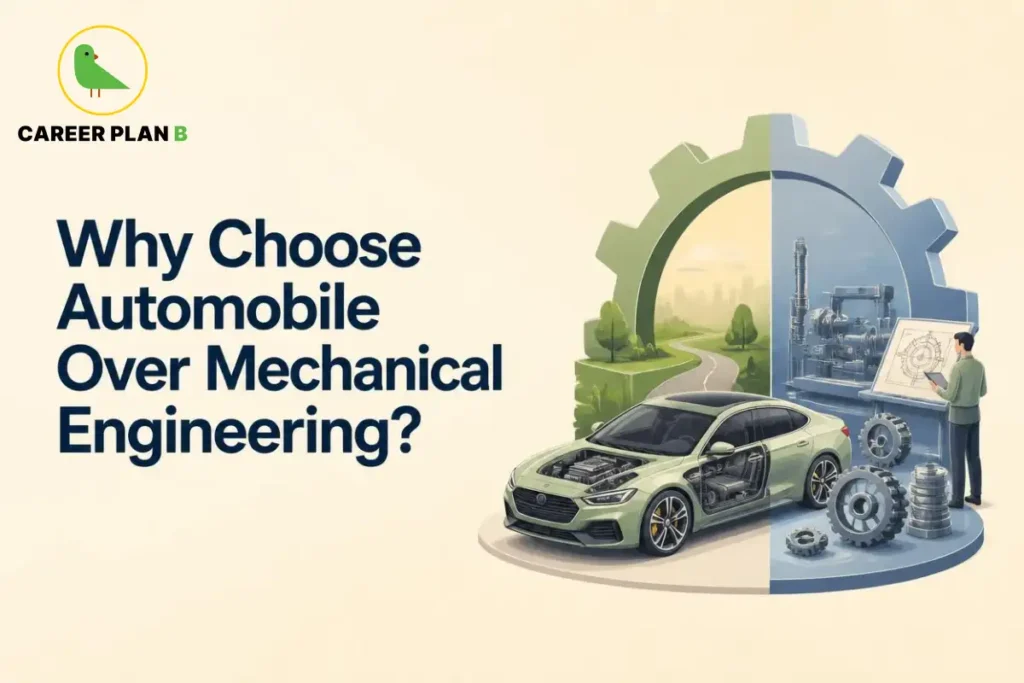
Introduction
Picking an engineering branch after Class 12 or JEE can feel like a high-stakes guessing game. Two of the most common and most confused choices are automobile and mechanical engineering. If you’ve been wondering why to choose automobile over mechanical engineering, you’re not alone; thousands of students face this exact dilemma every admission season. Both branches share a common engineering foundation, but they lead to very different day-to-day work and industries. In this blog, we’ll break down the real differences, compare career scope and salary trends, look at how the EV boom is reshaping opportunities, and help you figure out which path suits you better.
Automobile Engineering vs. Mechanical Engineering: What’s the Real Difference?
Mechanical engineering is a broad discipline covering everything from thermodynamics and manufacturing to robotics and energy systems. It’s the “parent” branch, applicable across industries like power plants, aerospace, consumer goods, and heavy machinery. Automobile engineerings, on the other hand, is a specialized offshoot focused entirely on vehicles: their design, manufacturing, performance, and maintenance. Think engines, transmissions, vehicle dynamics, and increasingly, electric drivetrains. The difference between automobile and mechanical engineering essentially comes down to breadth versus depth: mechanical gives you a wider toolkit, while automobile gives you specialized, industry-ready expertise from day one.
Career Scope: Where Each Branch Leads
Mechanical Engineering Career Paths
Mechanical engineers find roles across manufacturing plants, power and energy companies, HVAC systems, aerospace, defense, and general core industries. It’s a flexible degree that keeps multiple doors open.
Automobile Engineering Career Paths
Automobile engineers typically head straight into vehicle manufacturers, auto component suppliers, EV startups, R&D centres, and even motorsport engineering teams. This gives you deep, hands-on exposure to one industry rather than broad, generalized exposure.
| Factor | Mechanical Engineering | Automobile Engineering |
|---|---|---|
| Scope | Broad, multi-industry | Focused on vehicle industry |
| Specialization | General | Deep, industry-specific |
| Entry-level flexibility | High | Moderate |
| Industry demand today | Steady | Rising sharply (EV boom) |
The Electric Vehicle Boom and What It Means for Automobile Engineers
India’s electric vehicle push has changed the game for automobile graduates. Government incentive schemes under the Ministry of Heavy Industries have accelerated EV adoption and manufacturing across the country, creating fresh automobile engineer job opportunities in battery systems, EV powertrains, and charging infrastructure. This shift is one of the biggest reasons automobile engineering has gained ground recently; it sits right at the centre of one of India’s fastest-growing manufacturing sectors, giving graduates a front-row seat to genuinely new technology rather than legacy systems alone.
Salary Comparison: Automobile vs Mechanical Engineering
Salary trends vary widely depending on company, specialization, and city, but here’s a general comparison to set expectations:
| Career Stage | Mechanical Engineering | Automobile Engineering |
|---|---|---|
| Entry-level | Moderate, industry-dependent | Moderate to slightly higher in EV/auto hubs |
| Mid-career | Steady growth across sectors | Faster growth in specialized EV/R&D roles |
Keep in mind: mechanical engineering vs. automobile engineering salary comparisons are heavily influenced by which specific industry and company you join. A mechanical engineer in aerospace R&D may out-earn an automobile engineer in a smaller manufacturing unit, and vice versa. Specialization and skill, not just the degree name, ultimately drive pay.
Skills Required for Automobile Engineers
If you’re leaning toward automobile engineering, start building these:
- Automotive design and CAD/CAE tools for vehicle modeling and simulation
- IC engine and EV powertrain knowledge: understanding both legacy and future systems
- Vehicle dynamics: how vehicles handle, brake, and perform under real conditions
- Battery and EV systems literacy increasingly essential for electric vehicle industry careers
- Manufacturing process knowledge assembly line and quality systems
These skills required for automobile engineers overlap significantly with mechanical fundamentals but go deeper into vehicle-specific applications.
For Personalized Guidance
Which Should You Choose? Key Decision Factors
There’s no universally “better” branch; it depends on your goals:
- Choose automobile engineering if you’re specifically passionate about vehicles, EVs, or motorsport and want focused, industry-ready skills early.
- Choose mechanical engineering if you want broader flexibility to explore multiple industries before specializing, or you’re unsure yet exactly which sector excites you.
Both offer strong automobile engineering career scope when paired with the right specialization, internships, and skill-building.
How Career Plan B Helps
Choosing between automobile and mechanical engineering is easier with the right guidance. Career Plan B offers personalized career counselling and PsycheIntel career assessment tests to help you understand which branch truly fits your interests and aptitude. Their team also supports admission and academic profile guidance, plus long-term career roadmapping so your decision is backed by clarity, not guesswork.
For Latest Information
Frequently Asked Questions
- Is automobile engineering better than mechanical engineering?
Neither is universally “better”; automobile engineering offers focused, vehicle-industry expertise, while mechanical engineering offers broader flexibility across sectors.
- What is the scope of automobile engineering in India?
With the EV boom and rising auto manufacturing, automobile engineers now have opportunities across OEMs, EV startups, R&D centres, and component suppliers.
- Do automobile engineers earn more than mechanical engineers?
It varies by company and specialization rather than the degree alone. Both can earn well depending on the industry and role chosen.
- Is automobile engineering a good choice with the EV boom?
Yes, the growing EV sector has significantly increased demand for automobile engineers skilled in battery systems and electric powertrains.
- Can a mechanical engineer switch to the automobile industry later?
Yes, mechanical engineering’s broad foundation makes it possible to move into automotive roles later, especially with relevant certifications or specialization.
Conclusion
Both automobile and mechanical engineering offer solid, rewarding career paths; the right choice depends on whether you want broad flexibility or focused, industry-specific expertise. With India’s EV sector accelerating fast, automobile engineering is carving out fresh opportunities worth serious consideration. If you’re still weighing your options, connect with Career Plan B for personalized counselling to make a confident, informed decision.