Team6 · September 16, 2026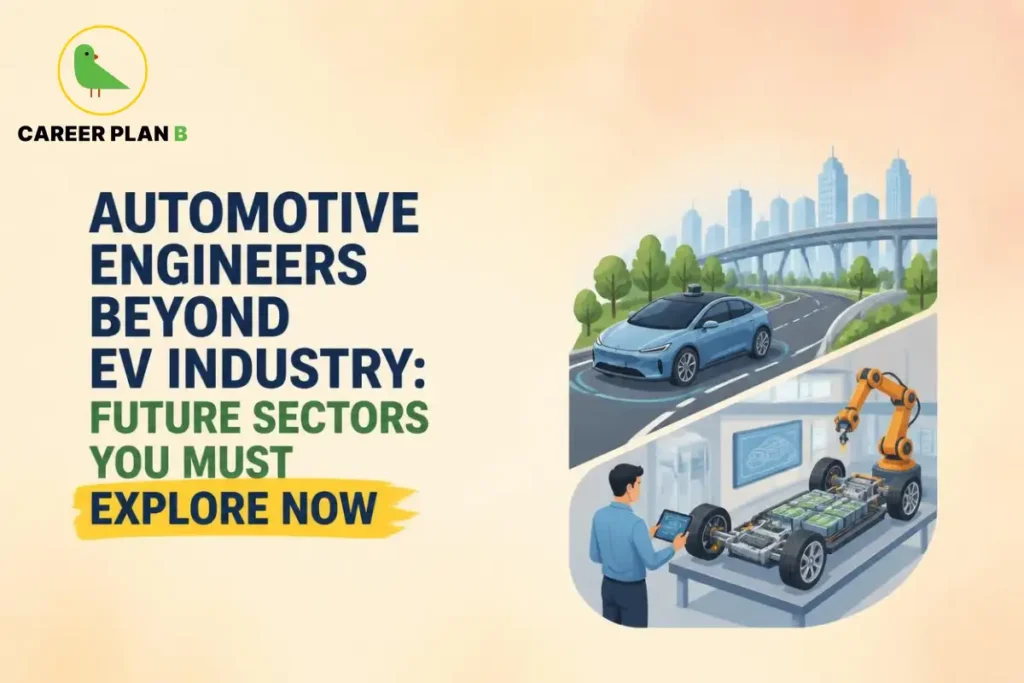
Introduction
Everyone in the engineering world is talking about electric vehicles. And rightly so, the EV revolution is real, it is massive, and it is creating thousands of new engineering roles every year. But here is the question that the smartest automotive engineers are already asking themselves: what comes after EVs, and where else can my skills take me?
India’s automotive industry directly employs over 1.9 million engineers and contributes approximately 7.1% of GDP, making it one of the largest talent pools in the country. (Source: Make in India – Automobile Sector) But that talent pool is not confined to the auto industry alone, and the engineers who recognise that early are the ones who build the most resilient and rewarding long-term careers.
This blog is your complete guide to automotive engineers beyond the EV industry, the future sectors, the specific roles, the transferable skills, and the pathways that take your automotive engineering career far beyond the factory floor of any single industry.
Why Automotive Engineers Are Valuable Beyond the Auto Industry
Before exploring specific sectors, it is worth understanding why automotive engineering career opportunities extend so naturally into other industries, because the answer explains everything about the transferability of your skills.
Automotive engineering is one of the most demanding and comprehensive engineering disciplines in existence. Building a vehicle that is simultaneously safe, efficient, comfortable, reliable, cost-effective, and manufacturable at scale while meeting dozens of regulatory requirements across multiple global markets requires mastery of an extraordinarily broad technical toolkit.
That toolkit translates directly into value across industries:
- Systems Engineering: Automotive engineers are trained to manage the interaction of hundreds of interdependent subsystems, a skill that aerospace, defence, and space industries pay premium salaries for
- Thermodynamics and Heat Management: Engine thermal management, HVAC systems, and battery thermal control all build expertise directly applicable to aerospace propulsion, fuel cells, and industrial systems
- Materials Science: Lightweight materials, advanced high-strength steels, aluminium alloys, and carbon fibre composites developed for automotive use are directly relevant to aerospace, defence, and motorsport
- Precision Manufacturing and Quality: Automotive quality standards IATF 16949, APQP, and PPAP are among the most rigorous in global manufacturing, making automotive-trained engineers highly credible in other precision industries
- Simulation and Digital Tools: CATIA, ANSYS, MATLAB/ Simulink, and CAE tools used daily in automotive are the same platforms used across aerospace, defence, and energy
What Makes Automotive Engineers Uniquely Competitive Across Sectors
The automotive industry builds engineers who understand the full product lifecycle from concept and design through simulation, prototyping, testing, manufacturing, and field validation. That end-to-end perspective is rare and genuinely valuable in sectors where product development cycles are longer, and mistakes are more costly.
Aerospace and Aviation: The Natural Next Step
Of all the future industries for automotive engineers, aerospace is the most natural transition and, increasingly, one of the most actively pursued.
The technical overlap between automotive and aerospace engineering is substantial. Structural analysis, propulsion systems, materials engineering, aerodynamics, thermal management, and systems integration are all disciplines where automotive expertise translates directly. The key difference is the operating environment; aerospace demands higher performance, lower weight, and near-zero failure tolerance, which makes automotive engineers who can adapt their precision mindset to aerospace standards extremely valuable.
In India, the aerospace opportunity is significant and growing:
- HAL (Hindustan Aeronautics Limited) is India’s primary aircraft manufacturer, developing military jets, helicopters, and aero-engines, all of which require structural, propulsion, and systems engineers with backgrounds directly applicable to automotive engineering. (Source: HAL)
- ISRO is expanding its launch vehicle programme and increasingly working with private aerospace companies through IN-SPACe. (Source: ISRO) (Source: IN-SPACe)
- DGCA (Directorate General of Civil Aviation) regulates India’s rapidly growing civil aviation sector, which is driving demand for aerospace maintenance, design, and certification engineers. (Source: DGCA)
- Private aerospace firms Tata Advanced Systems, L&T Aerospace, Safran India, and a growing cluster of IN-SPACe startups are all actively hiring engineers with automotive backgrounds for structural, propulsion, and manufacturing roles.
Globally, Boeing, Airbus, GE Aviation, Rolls-Royce, and Pratt & Whitney all actively recruit automotive engineers, particularly for propulsion, structures, and manufacturing engineering roles.
Automotive engineer jobs in aerospace typically start with roles in structural analysis, component manufacturing, or systems testing with clear progression into senior design and programme management positions.
Hydrogen and Fuel Cell Technology
If EVs represent the present of clean mobility, hydrogen represents a significant part of its future, particularly for heavy transport, industrial applications, and long-range mobility, where battery limitations constrain EV performance.
Automotive engineers already working on fuel cell vehicles, the Toyota Mirai and the Hyundai NEXO, have skills that are directly transferable to the broader hydrogen economy. But even engineers without direct fuel cell experience bring valuable thermal management, fluid systems, and pressure vessel knowledge to hydrogen engineering roles.
India’s National Green Hydrogen Mission, launched by the Ministry of New and Renewable Energy, targets the production of 5 million metric tonnes of green hydrogen annually by 2030, one of the most ambitious clean energy targets in the world. (Source: Ministry of New and Renewable Energy – Green Hydrogen Mission)
This mission is creating a wave of new engineering roles:
- Fuel Cell Systems Engineer: Designing and optimising hydrogen fuel cell stacks for transport and stationary applications
- Hydrogen Storage Engineer: Developing high-pressure and cryogenic storage systems for vehicles and infrastructure
- Electrolysis Systems Engineer: Designing electrolysers that produce green hydrogen from renewable electricity
- Hydrogen Vehicle Integration Engineer: Adapting fuel cell powertrains for buses, trucks, trains, and marine vessels
For automotive engineers with thermodynamics, fluid systems, and powertrain backgrounds, these roles represent a natural and high-value career extension into one of India’s most strategically important emerging industries.
Defence and Unmanned Systems
An automotive engineer in defence and space is a career combination that is less obvious than aerospace but equally compelling and increasingly well-supported by India’s rapidly expanding domestic defence manufacturing ecosystem.
The connections between automotive and defence engineering are deeper than most people realise:
- Armoured Vehicle Engineering: Combat vehicles, tanks, infantry fighting vehicles, and armoured personnel carriers are essentially highly specialised automotive engineering challenges. Powertrain, suspension, structural integrity, and thermal management are all directly relevant. DRDO’s CVRDE (Combat Vehicles Research and Development Establishment) in Chennai is India’s primary centre for this work.
- Unmanned Ground Vehicles (UGVs): The fast-growing field of military robotics draws heavily on automotive dynamics, drivetrain engineering, and autonomous vehicle systems expertise.
- Drone and UAV Systems: Lightweight structures, propulsion integration, and thermal management expertise from automotive translate directly into UAV engineering, a sector growing explosively under India’s drone PLI scheme. (Source: Ministry of Civil Aviation – Drone PLI)
- Missile and Propulsion Systems: Solid and liquid propulsion principles familiar to automotive powertrain engineers apply directly to missile system design at DRDO labs like RCI and DRDL.
India’s iDEX (Innovations for Defence Excellence) initiative is funding startups developing autonomous ground vehicles, next-generation armoured systems, and drone platforms, creating entrepreneurial opportunities for automotive engineers in addition to established defence PSU roles. (Source: iDEX)
Private defence firms Tata Advanced Systems, L&T Defence, and Mahindra Defence are all actively hiring automotive engineers for ground vehicle and unmanned systems programmes. (Source: Tata Advanced Systems) (Source: Mahindra Defence)
Have Any Doubts?
Smart Cities and Urban Mobility Infrastructure
India’s Smart Cities Mission, covering 100 cities across the country, is creating an entirely new category of engineering challenge at the intersection of automotive, civil, and systems engineering: urban mobility infrastructure. (Source: Smart Cities Mission)
Emerging sectors for automotive engineers in urban mobility include:
- Autonomous Urban Transport Systems: Designing and validating self-driving buses, pods, and last-mile vehicles for smart city deployments
- EV Charging Infrastructure Engineering: Designing high-power charging networks, grid integration systems, and thermal management for public charging infrastructure
- Hyperloop and Advanced Rail: Several hyperloop development programmes globally are actively recruiting automotive engineers for pod aerodynamics, propulsion, and structural design
- Intelligent Transport Systems (ITS): Vehicle-to-infrastructure (V2I) communication, traffic management systems, and connected vehicle platforms
- Urban Air Mobility (UAM): Electric vertical take-off and landing vehicles (eVTOLs), essentially flying cars, are being developed by companies worldwide and require automotive engineers for propulsion, structures, and systems integration
The Ministry of Housing and Urban Affairs oversees the Smart Cities Mission and the broader urban mobility transformation agenda that is creating these roles. (Source: Ministry of Housing and Urban Affairs)
Motorsport and High-Performance Engineering
Automotive skills in non-automotive industries also find a natural home in motorsport, a sector that is small in headcount but extraordinarily high in technical intensity and global prestige.
Motorsport is the laboratory where automotive engineering pushes beyond all commercial constraints. Every aerodynamic innovation, lightweight material advance, and hybrid powertrain technology that eventually reaches production vehicles was first developed and validated on a racing car.
In India, the motorsport ecosystem is growing:
- Formula Bharat India’s Formula Student competition develops engineering talent directly applicable to motorsport and high-performance vehicle development
- Mahindra Racing competes in Formula E, the all-electric open-wheel racing series, and actively recruits Indian engineers for vehicle dynamics, powertrain, and data engineering roles (Source: Mahindra Racing – Formula E)
- JK Tyre Motorsport supports multiple racing series in India
Globally, Formula 1 teams, Le Mans prototype developers, and rally car manufacturers recruit automotive engineers for the following:
- Aerodynamics Engineering: CFD simulation and physical testing of downforce-generating bodywork
- Vehicle Dynamics and Simulation: Lap time simulation, tyre modelling, and chassis setup optimisation
- Lightweight Structures: Carbon fibre monocoque design, composite manufacturing, and crash structure engineering
- Data Engineering and Telemetry: Real-time vehicle performance analysis during racing and testing
Motorsport careers are highly competitive globally but represent one of the most technically stimulating paths an automotive engineer can pursue, and the skills built in motorsport are directly transferable to aerospace, defence, and advanced vehicle development.
Space Launch and Satellite Systems
The connection between automotive and space engineering is less obvious than aerospace but increasingly significant, and it represents one of the most exciting emerging sectors for automotive engineers in the decade ahead.
Space launch vehicles are, at their core, extraordinarily sophisticated thermal and structural engineering challenges, exactly the domains where automotive engineers have deep expertise. Rocket engine combustion chambers operate at temperatures exceeding those of any automotive engine. Launch vehicle structures must survive acoustic, vibrational, and thermal loads that dwarf anything encountered in automotive testing. Re-entry vehicles require thermal protection systems that draw on the same heat transfer principles automotive thermal engineers apply daily.
India’s private space sector, enabled by IN-SPACe, is creating genuine entry points for automotive engineers transitioning into space:
- Skyroot Aerospace, developing launch vehicles with composite structures and cryogenic engines, needs lightweight structures and propulsion engineers. (Source: Skyroot)
- Agnikul Cosmos, developing semi-cryogenic engines using additive manufacturing, needs thermal and manufacturing engineers. (Source: Agnikul)
- Pixxel and Bellatrix Aerospace are developing satellite systems and in-space propulsion and need systems and propulsion engineers.
The Indian Space Research Organisation’s YUVIKA programme also provides exposure to space technology for engineering students seeking to explore the space sector. (Source: ISRO YUVIKA)
For automotive engineers with propulsion, structural, or thermal management expertise, the transition into space systems represents a technically demanding but deeply rewarding career switch for automotive engineers into one of the most exciting fields in all of engineering.
How Career Plan B Helps
Navigating a career switch for automotive engineers into new industries requires more than enthusiasm; it requires a clear understanding of which of your existing skills are most transferable, which new skills you need to build, and which specific sectors and roles align best with your profile and long-term goals. Career Plan B offers psyche-intel-based career assessment tests to evaluate your strengths and cross-sector transferability; personalised career counselling for automotive engineers exploring new industries; academic and certification pathway guidance for aerospace, hydrogen, defence, and space transitions; and structured career roadmapping that gives you a clear, actionable plan, not just inspiration.
For Latest Information
Frequently Asked Questions (FAQs)
1. What industries can automotive engineers move into beyond EVs?
Automotive engineers have strong transferable skills that are valued in aerospace and aviation, hydrogen and fuel cell technology, defence and unmanned systems, space launch vehicles, smart city urban mobility, motorsport, and high-performance engineering.
2. What qualifications help automotive engineers transition into aerospace?
A B.Tech or M.Tech in Mechanical, Automotive, or Aerospace Engineering is the standard foundation. Certifications in composite materials, FEA simulation, and propulsion systems strengthen the transition. Familiarity with aerospace-specific tools like CATIA for airframe design and ANSYS for structural analysis.
3. Is hydrogen technology a realistic career path for automotive engineers in India right now?
Yes, and increasingly so. India’s National Green Hydrogen Mission is a government-backed programme with a ₹19,744 crore budget targeting 5 million metric tonnes of annual green hydrogen production by 2030.
4. How can an automotive engineer get into India’s defence sector?
The primary pathways are through DRDO’s RAC (Recruitment and Assessment Centre) examination for scientist positions, GATE-based recruitment for technical roles, and direct hiring by private defence firms like Tata Advanced Systems, L&T Defence, and Mahindra Defence.
Conclusion
The electric vehicle revolution is real and significant, but it is not the ceiling of an automotive engineering career. It is a launching pad. Automotive engineers beyond the EV industry are building careers in aerospace, hydrogen energy, defence robotics, space systems, smart cities, and motorsport sectors that are hungry for the exact combination of systems thinking, physical engineering depth and precision manufacturing expertise that automotive training delivers.
If you are ready to explore what your automotive engineering career can become beyond the EV industry, start with an honest assessment of your strengths and a clear view of the sectors that align with them. Visit Career Plan B today to get the personalised guidance and structured roadmap that takes your automotive engineering career exactly where you want it to go.