Team Career Plan B · October 6, 2026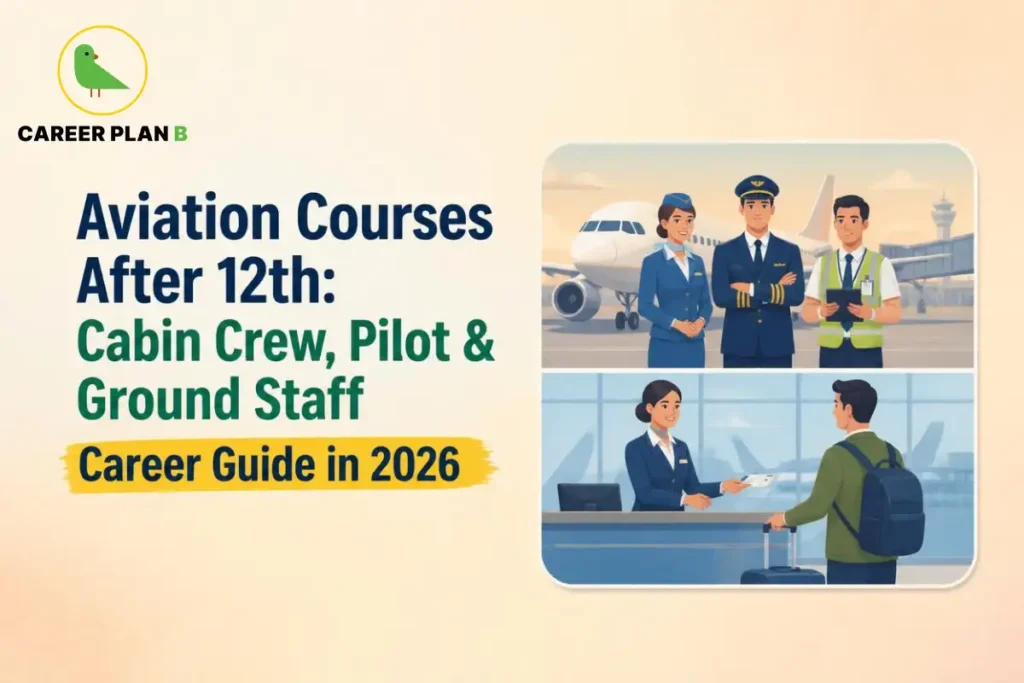
Introduction
Aviation careers span three distinct tracks: flying the aircraft, managing the cabin, and running ground operations. Each track has its own training path, regulatory oversight, and entry requirements.
Aviation Courses After 12th cover all three options. However, confusing the requirements of one track with another is a common and costly mistake.
This guide breaks down what India’s civil aviation regulator requires for each path. The goal is to help you approach Aviation Courses After 12th using verified regulatory facts rather than a training academy’s simplified pitch.
Pilot Training After 12th: What DGCA Actually Requires
Here’s the foundational fact worth knowing first. Pilot licensing in India is governed by the Directorate General of Civil Aviation, the statutory regulator under the Ministry of Civil Aviation. The regulator operates under the Aircraft Rules, 1937.
DGCA’s licensing framework sets minimum ages at different stages. These include 16 years for a Student Pilot License, 17 years for a Private Pilot License, and 18 years for the Commercial Pilot License required for professional airline flying.
For Pilot Training After 12th, DGCA requires Class 12 completion with Physics and Mathematics from a recognised board. Students from Commerce or Arts backgrounds aren’t automatically excluded. They can qualify by completing these subjects separately through the National Institute of Open Schooling.
Candidates must also meet DGCA medical requirements. For a Commercial Pilot License, they need Class 1 medical certification. They must also complete the required flying hours at a DGCA-approved flying training organisation and pass the required DGCA theory examinations before the CPL is issued.
CPL training also involves a significant financial commitment. Costs can reach several tens of lakhs of rupees, depending on the flying school and training structure. Therefore, verify a specific institute’s DGCA approval status and placement record before making a major financial commitment.
Read more: Aviation: Best Courses One Can Study in India After 12th & Graduation
Cabin Crew Courses After 12th: A Separately Regulated Track
Cabin crew training also follows DGCA regulations, but through a separate set of Civil Aviation Requirements. These requirements cover cabin crew standards, training, and safety procedures.
Cabin crew members must complete mandatory training before they can perform their duties. They also undergo recurrent training. DGCA requirements cover areas such as safety, emergency procedures, and flight duty and rest periods.
For Cabin Crew Courses After 12th, eligibility is generally more accessible than pilot training. Students typically need to complete Class 12 from any stream. Airlines may also set specific height, medical fitness, and other recruitment standards.
Candidates must complete structured cabin crew training through an airline or private aviation academy. Training generally covers safety procedures, emergency protocols, and service standards.
Unlike pilot licensing, there is no single centralised age or subject requirement at the DGCA level for entry-level cabin crew training. Individual airlines can set additional recruitment criteria on top of the baseline requirements.
Ground Staff Courses After 12th: The Most Accessible Entry Point
Ground Staff Courses After 12th typically cover airport check-in and boarding operations, baggage handling coordination, and customer service functions.
Most programmes require only a Class 12 pass from any stream. They generally do not require specialised subjects.
Unlike pilot and cabin crew positions, ground staff roles do not follow the same DGCA licensing framework. However, airport security clearance remains important for employees working in restricted airport areas. The Bureau of Civil Aviation Security coordinates this security framework.
This makes ground staff roles one of the more accessible entry points into aviation. Students can enter the industry without the high training costs associated with pilot licensing or the specific physical criteria that some cabin crew positions may require.
Aviation Career Opportunities: Where Each Track Actually Leads
Aviation Career Opportunities branch out considerably after you establish yourself in a chosen track.
Pilots can progress from a CPL toward an Airline Transport Pilot License. With sufficient flying experience, this can support progression toward captain-level positions.
Cabin crew professionals can progress into senior crew and purser roles. They can also move into training and safety management positions.
Ground staff professionals can progress toward airport operations management, ramp and cargo operations supervision, or airline station management.
Each track offers potential for long-term career progression. These careers are not limited to entry-level positions.
For Personalized Guidance
Aviation Courses Admission 2026: Practical Planning Advice
For Aviation Courses Admission 2026, a few practical steps apply across the three tracks.
First, verify a training institute’s genuine DGCA approval status before enrolling in pilot training. Only approved flying training organisations can provide qualifying flight training for the CPL pathway.
Next, complete the relevant DGCA medical assessment early in your planning process. This is particularly important for students considering pilot training. Some students invest heavily in training before discovering a medical issue that affects their eligibility.
For cabin crew and ground staff paths, research specific airline recruitment cycles directly. Hiring volumes and criteria can change based on an airline’s expansion plans.
How Career Plan B Helps
Choosing the right aviation track requires more than comparing course brochures. You also need to understand the regulatory requirements and financial commitment behind each path. This is where Career Plan B can help by offering:
- Personalized Career Counselling: Evaluate whether pilot training, cabin crew, or ground operations fits your goals, risk tolerance, and financial planning.
- Psychometric & Career Assessment Tests: Identify whether your strengths align with technical flying, service-focused cabin roles, or operations-focused ground work.
- Career Roadmapping: Build a realistic plan that accounts for DGCA requirements, medical clearance timing, and training costs.
- Admission & Academic Profile Guidance: Get support in verifying an institute’s DGCA approval and placement record before making a commitment.
Get In Touch With Us
Frequently Asked Questions
Q1. Can Commerce or Arts stream students pursue Pilot Training After 12th?
Yes, indirectly. DGCA requires Physics and Mathematics for CPL eligibility. Students from other streams can qualify by completing these subjects separately through NIOS.
Q2. Is cabin crew training also regulated by DGCA, or is it purely airline-run?
Both. DGCA sets formal Civil Aviation Requirements for cabin crew training and safety standards. Individual airlines can then add their own recruitment and service criteria.
Q3. What’s the most accessible aviation career after 12th if I want to start working quickly?
Ground Staff Courses After 12th generally offer an accessible entry point. They typically have lower training costs and fewer specialised subject requirements than pilot training.
Q4. Do I need to clear a medical test before starting pilot training?
Yes, and completing the required medical assessment early is strongly advisable. DGCA Class 1 medical certification is required for CPL eligibility. Early verification can help students avoid major financial losses later.
Q5. Which Aviation Career Opportunities offer the most long-term growth?
All three tracks offer genuine progression. Pilots can progress toward ATPL and captain roles. Cabin crew can move into senior and training positions. Ground staff can progress toward operations management. Growth potential therefore exists across all three paths.
Conclusion
Aviation Courses After 12th span three distinct and differently regulated paths. Pilot training follows DGCA’s licensing framework. Cabin crew training follows separate DGCA standards. Ground staff roles generally have more accessible entry requirements.
Understanding which regulatory framework applies to your chosen track can protect you from costly misunderstandings before you commit.
Verify DGCA approval status directly for any pilot training institute. Also research airline-specific requirements for cabin crew and ground roles before enrolling.
If you’d like help evaluating which aviation path genuinely fits you, Career Plan B’s counsellors are ready to guide you through it.