Team Career Plan B · October 6, 2026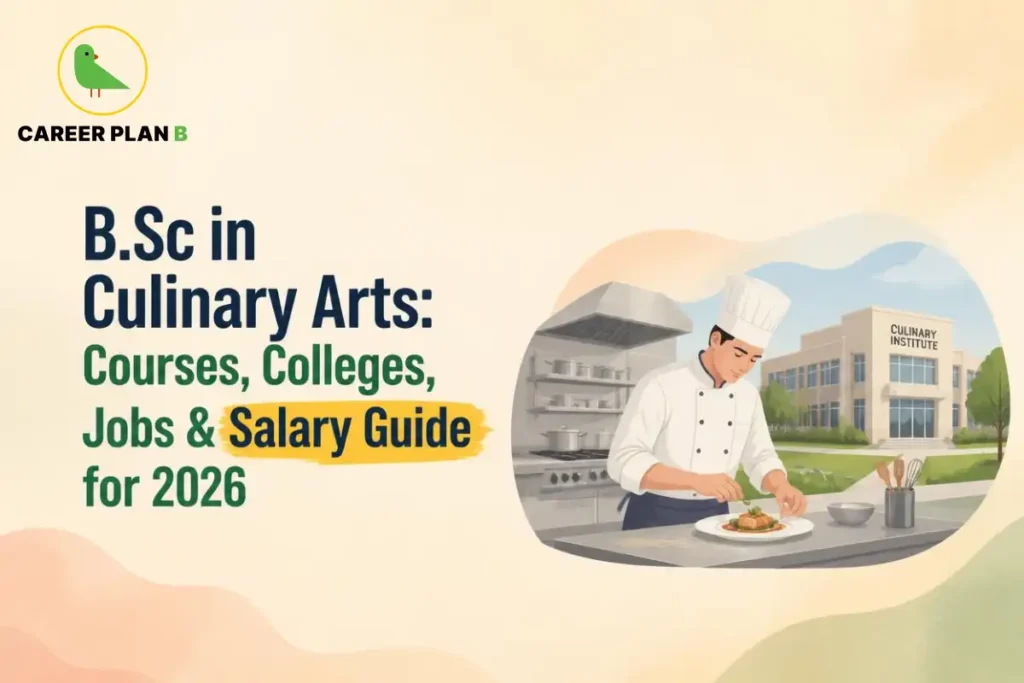
Introduction
Culinary education in India comes with more naming confusion than most students expect. B.Sc, BHM, BBA, and diploma tracks cover overlapping areas, but they aren’t identical. B.Sc in Culinary Arts is a genuine and growing degree option. However, understanding which institutions offer it under this precise name matters before you build your admission plan around it.
This guide clears up that naming confusion honestly. It covers the official government-linked route into culinary education and provides real job and salary context. This helps you approach B.Sc in Culinary Arts using verified facts rather than assumptions from a college brochure.
Clearing Up a Genuine Naming Confusion First
Here’s something worth knowing directly. India’s official government body for hospitality and culinary education is the National Council for Hotel Management and Catering Technology. NCHM is an autonomous body under the Ministry of Tourism. Its flagship degree is a three-year B.Sc. in Hospitality and Hotel Administration, developed in collaboration with IGNOU.
This programme includes substantial food production and culinary coursework within a broader hospitality curriculum (source: nchm.gov.in). NCHM also offers BBA and MBA programmes specifically branded in Culinary Arts.
A standalone degree titled precisely “B.Sc in Culinary Arts” is more commonly offered by individual private institutes under their own branding. It is not NCHM’s standard national degree title.
This isn’t necessarily a red flag. Many private programmes are genuinely well regarded. However, the exact curriculum and quality can vary considerably by institute. There is no single national standard specifically for a degree using this exact name.
B.Sc Culinary Arts Colleges: What to Actually Check
When evaluating B.Sc Culinary Arts Colleges, verify a few concrete factors directly.
First, check whether the institute is affiliated with NCHM or a recognised university. Next, examine the kitchen and laboratory infrastructure available for hands-on training. Also review faculty credentials, including genuine industry chef experience.
Finally, look for documented internship and industry placement partnerships.
Government-run and NCHM-affiliated Institutes of Hotel Management generally offer standardised and verifiable curricula. Private institutes can vary more widely. Therefore, direct verification becomes especially important before you commit.
Culinary Arts Courses After 12th: The Real Format Options
Culinary Arts Courses After 12th span several distinct formats.
Diploma programmes commonly last 12 to 18 months. They focus specifically on food production, baking, and kitchen fundamentals. This format can provide a faster entry into hands-on culinary work.
Full three- to four-year degree programmes can carry B.Sc, BHM, or BBA in Culinary Arts branding. These programmes generally provide broader business, hospitality, and food science knowledge alongside culinary training.
Eligibility across most formats remains accessible. A Class 12 pass from any stream is generally enough, with English often required as a compulsory subject. Despite the “B.Sc” naming used by some institutes, a specific science background is not generally required.
B.Sc Culinary Arts Admission 2026: How the Process Works
For B.Sc Culinary Arts Admission 2026, NCHM-affiliated institutes primarily admit students through the NCHM Joint Entrance Examination. The National Testing Agency conducts this examination. It evaluates areas such as English, reasoning, and general awareness.
Private institutes offering their own culinary-branded degrees commonly follow separate admission processes. They may conduct entrance tests or personal interviews. Some may also admit students directly through Class 12 merit.
Always confirm your target institute’s exact admission route. Assuming that one process applies across the entire field can cost you valuable application time.
B.Sc Culinary Arts Jobs: Where Graduates Actually Go
B.Sc Culinary Arts Jobs span considerably more than the single “chef” title most people picture first.
Career directions include commis and line chef roles, which can lead toward head chef positions over time. Graduates can also specialise in pastry and bakery work. Other options include food styling for media and advertising, culinary product development within food companies, and kitchen or restaurant operations management.
Many graduates also move into food entrepreneurship. After gaining industry experience, they may open restaurants, cloud kitchens, or specialty food businesses.
Read more: Career in Baking & Culinary Arts: No JEE/NEET Needed
For Personalized Guidance
B.Sc Culinary Arts Salary: An Honest Look at the Numbers
Here’s where direct honesty matters more than an appealing figure. There is no single government-published dataset that specifically tracks B.Sc Culinary Arts Salary as a standardised national category.
Compensation varies significantly based on your role, employer, city, and years of hands-on kitchen experience. Experience matters heavily in this field, often beyond formal education alone.
Entry-level kitchen roles typically start modestly, similar to other hospitality entry points. Meaningful growth usually depends on demonstrated skills and experience rather than credentials alone.
Treat any specific salary figure you find elsewhere as a general directional estimate, not a guaranteed outcome.
How Career Plan B Helps
Deciding whether Culinary Science genuinely fits your interests takes more than enjoying cooking shows. This is where Career Plan B can help by offering:
- Personalised Career Counselling: Get guidance based on your interests, skills, and career goals. This can help you choose between craft-focused culinary arts and business-focused hospitality paths.
- Psychometric & Career Assessment Tests: Identify your strengths, personality traits, and suitable career opportunities. This can help confirm your aptitude for hands-on kitchen work.
- Career Roadmapping: Create a clear, step-by-step plan for your academic and professional goals, including the culinary specialisation you want to pursue.
- Admission & Academic Profile Guidance: Get help selecting suitable courses and colleges. This can also keep your NCHM JEE or institute-specific preparation focused.
Get In Touch With Us
Frequently Asked Questions
Q1. Is “B.Sc in Culinary Arts” the official degree name used by NCHM?
Not exactly. NCHM’s own flagship degree is B.Sc. in Hospitality and Hotel Administration, which includes substantial culinary coursework. A degree titled precisely “B.Sc in Culinary Arts” is more commonly a private institute’s own branding.
Q2. What is the eligibility for Culinary Arts Courses After 12th?
Most programmes require a Class 12 pass from any stream. English is generally required as a compulsory subject. A specific science background is usually not required.
Q3. Do I need to clear the NCHM JEE for every culinary degree?
No. NCHM-affiliated institutes use the NCHM JEE, but many private institutes offering their own culinary-branded degrees follow separate entrance tests. Some also admit students through merit or interviews.
Q4. What’s a realistic starting point for B.Sc Culinary Arts Jobs?
Commis or line chef roles are typical starting points. These are normal entry-level positions, with progression toward specialised or leadership roles depending heavily on hands-on experience.
Q5. Why doesn’t this guide give a specific B.Sc Culinary Arts Salary figure?
There is no unified government dataset that tracks this specific category nationally. Real compensation varies significantly by role, employer, city, and experience level.
Conclusion
B.Sc in Culinary Arts is a valuable path into a hands-on and creative career. However, the exact degree naming varies more across institutes than many students expect. NCHM’s official route runs through B.Sc HHA, along with separately branded Culinary Arts BBA and MBA programmes.
Verifying an institute’s curriculum, affiliation, and placement record matters more than trusting the degree title alone.
Check your target institute’s genuine NCHM affiliation or accreditation status before applying. Also, build realistic salary expectations around growth through hands-on experience.
If you’d like help evaluating genuine culinary programmes for your goals, Career Plan B’s counsellors are ready to guide you through it.