Deepti · July 14, 2026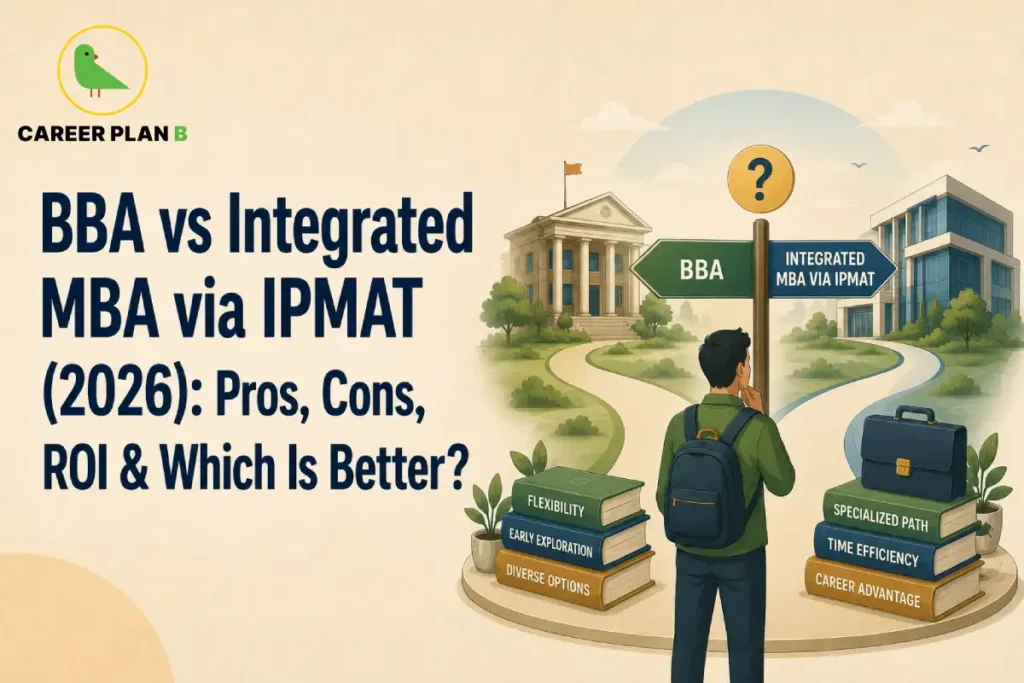
Introduction
Every Class 12 student who’s serious about management will eventually face this specific comparison.
BBA vs Integrated MBA via IPMAT looks simple on paper, a three-year degree versus a five-year programme, but the real differences run much deeper into fee commitment, career certainty, flexibility, and what happens if your interests change along the way. BBA vs Integrated MBA via IPMAT in 2026 involves a genuinely different risk-reward profile for each path, and making the right call depends on understanding both sides honestly rather than defaulting to whichever option sounds more prestigious.
This guide breaks down the pros and cons of both routes using the latest 2026 data, so your decision reflects actual trade-offs rather than assumptions.
The Core Structural Difference
A BBA is a three-year undergraduate degree in business administration, typically entered through exams like CUET, NPAT, MET, or SET. It gives you a foundational management education and keeps your options wide open after graduation, whether that’s CAT for an MBA, a job, a startup, or further study abroad.
An Integrated MBA via IPMAT is a five-year programme, combining three years of undergraduate studies with two years of MBA at IIM Indore, IIM Rohtak, IIM Ranchi, IIM Jammu, or IIM Bodh Gaya.
As of 2026, over 32,000 students compete annually for approximately 600 total IPM seats across all five institutions. You enter at 18, graduate at 23, and hold an MBA degree from an IIM without ever sitting for CAT.
Pros of BBA in 2026
Lower upfront financial commitment- BBA fees range from ₹50,000 to ₹2 lakh at government colleges through CUET, and ₹3 lakh to ₹15 lakh at quality private institutes like NMIMS or Christ. That’s dramatically less than the ₹28 lakh to ₹39 lakh total cost of an IPM programme at IIM Indore or IIM Jammu.
More flexibility to change direction- A BBA year at university exposes you to real college life and gives you room to discover whether management genuinely excites you before committing to an MBA. Students who later decide they’d rather study law, economics, or pursue a startup can do so without the pressure of a five-year residential programme.
Multiple paths to a strong MBA afterward- BBA is a recognised undergraduate degree for CAT, XAT, GMAT, and global MBA applications. A student who does BBA at SSCBS and then clears CAT for IIM Ahmedabad may end up at a stronger IIM than they could have accessed directly through IPMAT.
Lower competition to enter a good BBA- CUET, NPAT, and MET are considerably less competitive than IPMAT Indore, which is a genuinely hard exam where only a fraction of 32,000 applicants secure one of 150 seats at the flagship institute.
Cons of BBA in 2026
No IIM guarantee in the path- A BBA doesn’t secure your MBA destination. Most BBA graduates targeting top IIMs later need to compete in CAT, where getting into older IIMs is far from guaranteed regardless of your BBA college.
The total timeline is longer- Three years of BBA plus two years of MBA means five years before you hold a full management degree, identical to the IPM timeline but without the structured integration or the IIM residential experience during the BBA phase.
Entry-level BBA salary is modest- Average BBA graduate salaries range from ₹4 to ₹6 LPA at entry level, with even the strongest BBA colleges like SSCBS averaging ₹9 to ₹13 LPA. Without an MBA, BBA’s standalone career ceiling is limited for most corporate tracks.
For Personalized Guidance
Pros of Integrated MBA via IPMAT in 2026
Guaranteed IIM MBA without CAT- This is the single most compelling advantage. Once you’re inside an IPM, you progress to the MBA phase without the brutal uncertainty of CAT in your final BBA year. IPM students join the same final placement pool as regular MBA students in Year 5, with identical recruiter access.
Strong placement outcomes at 22 to 23 years old- IIM Indore’s IPM batch posted an average of ₹29.57 LPA in the 2025 placement cycle, with 225-plus recruiters including BCG, Goldman Sachs, HUL, and Amazon. That’s a ₹29 LPA average at 23, which most traditional BBA-then-MBA routes cannot replicate unless the student gets into an equivalent IIM through CAT later. Click here for the placement report (Placement Report 2025 | IIM Indore)
IIM brand from day one- The residential campus experience, faculty quality, alumni network access, and international exchange programmes are available from your first year, not just the MBA phase.
NEP 2020 exit options reduce risk- IIM Indore and several other IPMs allow students to exit after Year 3 with a BBA degree rather than completing all five years. This means the commitment isn’t entirely irreversible if circumstances genuinely change.
Cons of Integrated MBA via IPMAT in 2026
Very high upfront cost, total fees at IIM Indore are approximately ₹38.3 lakh, IIM Rohtak ₹32.6 lakh, and IIM Jammu ₹39.3 lakh. This is a substantial financial commitment for a family at the point when a student is 18, before they’ve tested whether management is genuinely their calling.
An Integrated MBA requires a five-year commitment immediately after Class 12, offering less flexibility if your career interests change later. Students who are still exploring different fields may find a BBA to be the more adaptable option.
The exam is genuinely competitive, IPMAT Indore is a hard, math-heavy exam where top cutoffs require scores in the 90-plus percentile range. Families who underestimate preparation requirements and treat IPMAT as a “Class 12 level” exam are consistently disappointed.
Which One Should You Choose?
Choose a BBA if you want greater flexibility, more time to explore career options, and plan to target top IIMs through CAT later. Choose an Integrated MBA via IPMAT if you are certain about a management career, can afford the programme, and want to secure an IIM degree without going through CAT.
How Career Plan B Helps
Choosing between BBA and Integrated MBA via IPMAT is one of the most consequential decisions a Class 12 student makes.
Career Plan B offers personalised career counselling, Psycheintel assessment tests, and admission profile guidance to help you and your family evaluate this choice clearly.
Our career roadmapping turns this pros and cons comparison into a confident, grounded decision.
Get In Touch With Us
Frequently Asked Questions
Q1. Can a BBA graduate still get into IIM Indore’s MBA later?
Yes, through CAT, and some students end up at stronger IIMs this way than they would have through IPMAT.
Q2. What is the total fee for IIM Indore’s IPM programme in 2026?
Approximately ₹38.3 lakh for the full five-year programme including both the UG and MBA phases.
Q3. Is IPMAT harder than CAT?
No, IPMAT Indore is competitive but generally considered less difficult than CAT in terms of conceptual depth.
Q4. Can IPM students exit early if they change their mind?
Yes, IIM Indore and several other IPMs offer an exit with a BBA degree after completing the first three years.
Q5. What average salary can IPM graduates expect from IIM Indore?
The 2025 placement cycle posted an average of ₹29.57 LPA for the combined IPM and PGP batch.
Conclusion
IPMAT is ideal for students who are certain about a management career, can invest in the programme, and want the advantage of an IIM degree with direct MBA progression. A BBA followed by CAT is a better option for those exploring their interests, managing a tighter budget, or aiming for top IIMs later. The right choice depends on your career goals, financial situation, and long-term plans.