Team Career Plan B · August 27, 2026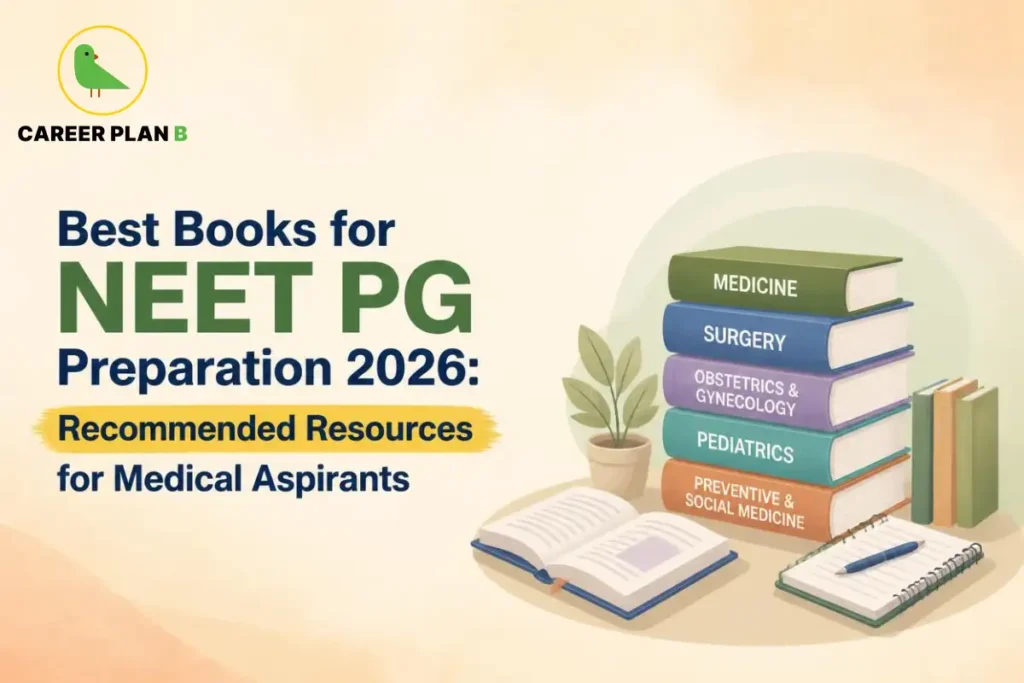
Introduction
Securing a top All India Rank in national postgraduate medical entrance examinations requires selecting high-yield study resources while maintaining disciplined time management. Medical graduates organizing their study tables must balance demanding hospital internship shifts with systematic academic review.
Selecting concise reading materials prevents resource overload and maintains focus across all 19 medical disciplines tested during the entrance exam. Utilizing a structured guide to Preparation Books & Study Resources enables aspirants to cover high-yield clinical vignettes while systematically identifying knowledge gaps.
Choosing the best books for NEET PG preparation ensures that your daily study hours translate directly into percentile growth on test day.
Curating Core Reference Textbooks & Review Books for 2026
Building a solid academic foundation begins with curating reliable recommended books alongside updated digital question banks.
The National Board of Examinations in Medical Sciences (NBEMS) conducts the national entrance exam under curriculum guidelines authorized by the National Medical Commission (NMC). Candidates engaging in comprehensive NEET PG preparation should limit their primary reading to one concise source per subject to prevent memory decay.
While standard undergraduate textbooks build initial conceptual depth, utilizing specialized review books allows candidates to focus on recent exam patterns and multi-step clinical vignettes. Aspirants can monitor public health notices and official exam updates on the Ministry of Health and Family Welfare (MoHFW) portal.
Selecting the best NEET PG books for 2026 preparation helps postgraduates bridge foundational medical knowledge with applied reasoning skills. Furthermore, using concise NEET PG books enables quick recall of volatile facts during late-stage revision cycles.
NEET PG 2026 Subject-Wise Recommendations & High-Yield Titles
Structuring a data-driven reading list requires selecting targeted titles across major pre-clinical, para-clinical, and clinical disciplines.
Evaluating the best books for NEET PG subject-wise preparation allows candidates to allocate study hours proportional to subject mark distributions. Reviewing official NEET PG 2026 subject-wise recommendations ensures complete syllabus coverage across all 19 NEET PG subjects.
High-Yield Clinical Disciplines
Clinical subjects account for over 57 percent of the entire test paper, making resource selection critical for clinical rankers.
- Medicine: Harrison’s Principles of Internal Medicine serves as the standard reference, while concise review books by Dr. Deepak Marwah or Dr. Mukesh Bhatia provide rapid clinical summaries.
- Surgery: Bailey & Love’s Short Practice of Surgery builds core operative concepts, complemented by review guides by Dr. Pritesh Singh for rapid revision.
- Obstetrics & Gynaecology: Shaw’s Textbook of Gynaecology and DC Dutta’s Textbook of Obstetrics provide foundational depth, paired with review modules by Dr. Sakshi Arora.
High-Yield Para-Clinical & Pre-Clinical Disciplines
Para-clinical and pre-clinical subjects bridge basic biological mechanisms with bedside diagnostic reasoning.
- Pathology: Robbins and Cotran Pathologic Basis of Disease remains the gold standard, while review books by Dr. Devesh Mishra deliver high-yield slide practice.
- Pharmacology: KD Tripathi’s Essentials of Medical Pharmacology builds drug mechanism fundamentals, paired with concise review guides by Dr. Gobind Rai Garg.
- Pre-Clinical Subjects (Anatomy, Physiology, Biochemistry): Standard undergraduate texts paired with concise review titles by Dr. Rebecca James for Biochemistry and Dr. B.D. Chaurasia for Anatomy ensures strong foundational recall.
Candidate options can also be verified against quota guidelines managed by the Medical Counselling Committee (MCC) under the Directorate General of Health Services (DGHS).
Selecting the Best NEET PG Books for MCQ Practice & PYQs
Integrating active problem-solving into your daily routine is essential to master the computer-based testing format.
Finding the best NEET PG books for MCQ practice ensures that aspirants build physical speed and decision accuracy under timed conditions. Solving custom question banks consistently develops the pattern recognition needed for high-score MCQ practice.
Furthermore, analyzing past exam trends requires working through the best NEET PG previous year question paper books available. Reviewing previous 5 to 7 years’ questions highlights recurring examiners’ themes and high-frequency topics.
Identifying the best books for NEET PG 2026 includes choosing titles that provide detailed explanations and diagnostic algorithms for every answer choice. Relying on verified Best Books for NEET PG 2026 protects your attempt from outdated answer keys and factual errors.
Want to Know Best app and resources Click Me
How to Use NEET PG Books for Effective Preparation
Learning how to use NEET PG books for effective preparation maximizes retention across multiple revision cycles.
Follow this structured roadmap to optimize your daily reading and practice schedule:
- Single Source Adherence: Stick strictly to one primary review book per subject and avoid switching sources close to the examination.
- Active Annotation: Annotate your concise subject notes with incorrect MCQ explanations and volatile drug dosages directly during daily practice.
- Timed Custom Modules: Solve 50 to 100 clinical vignette questions daily from your chosen practice books to train your biological clock.
- Three-Tier Revision Strategy: Complete primary subject reading in Phase 1, high-yield topic scans in Phase 2, and rapid mistake notebook scans in Phase 3.
Adhering to this structured approach ensures you build testing stamina and maintain recall speed on exam day.
For Personalized Guidance
Operational Summary Matrix: Resource Categories, Focus & Strategy
The following matrix outlines primary resource categories, operational focus areas, candidate benefits, and strategic study steps for 2026.
| Resource Category | Operational Focus Area | Primary Candidate Benefit | Strategic Candidate Action |
|---|---|---|---|
| Standard Reference Textbooks | Foundation building & conceptual depth | Establishes core medical subject mastery | Consult selectively for complex pre-clinical concepts |
| Concise Subject Review Books | High-yield facts & diagnostic algorithms | Accelerates repeat revision and recall speed | Annotate concise notes during daily MCQ practice |
| MCQ Practice Question Banks | Clinical vignettes & decision training | Enhances test speed & decision accuracy | Solve 50–100 clinical vignette MCQs daily |
| Previous Year Question Guides | Trend analysis & examiner theme tracking | Pinpoints high-yield core recurring topics | Solve past 5–7 years’ questions thoroughly |
(Source: Operational parameters compiled in alignment with guidelines published on the NBEMS Official Portal).
How Career Plan B Helps
Evaluating study resource choices, analyzing test performance trends, and planning postgraduate healthcare career roadmaps requires strategic guidance. Career Plan B supports medical postgraduates through:
- Personalised Career Counselling: Evaluating your mock test percentile standings, clinical branch preferences, and seat allotment probabilities across state and central quotas.
- Psycheintel & Career Assessments: Scientific evaluations confirming whether high-volume surgical tracks, diagnostic branches, or non-clinical specialties fit your natural strengths best.
- Customized Admission Guidance: Support navigating centralized MCC counselling, state quota registrations, and stray vacancy rounds smoothly.
- Career Roadmapping: Strategic planning extending beyond residency toward DM/MCh super-specialization, corporate hospital consulting, and state medical service.
Get In Touch With Us
Frequently Asked Questions
Q1. What are the primary best books for NEET PG preparation for clinical subjects?
Key recommended review books include Dr. Deepak Marwah for Medicine, Dr. Pritesh Singh for Surgery, and Dr. Sakshi Arora for Obstetrics & Gynaecology.
Q2. Where can medical graduates verify official examination guidelines for NEET PG preparation?
Candidates can verify official examination bulletins, marking schemes, and syllabus breakdowns directly on the NBEMS Official Portal.
Q3. How many standard NEET PG books should a candidate read per subject?
Candidates should strictly limit primary reading to one concise review book per subject paired with a reliable digital question bank to avoid resource overload.
Q4. Why are previous year question paper books essential for high-score MCQ practice?
Solving previous year questions helps candidates identify core examiner themes, high-frequency topics, and the multi-step clinical reasoning style used in the exam.
Q5. How many times should I revise review books before exam day?
Aspirants should aim for a minimum of 3 complete revision cycles before test day to ensure optimal knowledge retention and rapid recall speed.
Conclusion
Analyzing competitive preparation trends proves why selecting the right study resources is essential for every medical graduate. Securing a top All India Rank requires evaluating mock test metrics, refining weak subjects, and maintaining testing speed.
Remember that reviewing performance analytics after every mock test protects your academic attempt and builds exam confidence. Curating concise notes early guarantees complete familiarity with volatile facts on test day.
Developing a disciplined preparation strategy ensures you transition safely into your target clinical specialty. Connect with Career Plan B today to build a personalized medical career roadmap tailored to your long-term goals.