Careerplanb · May 15, 2026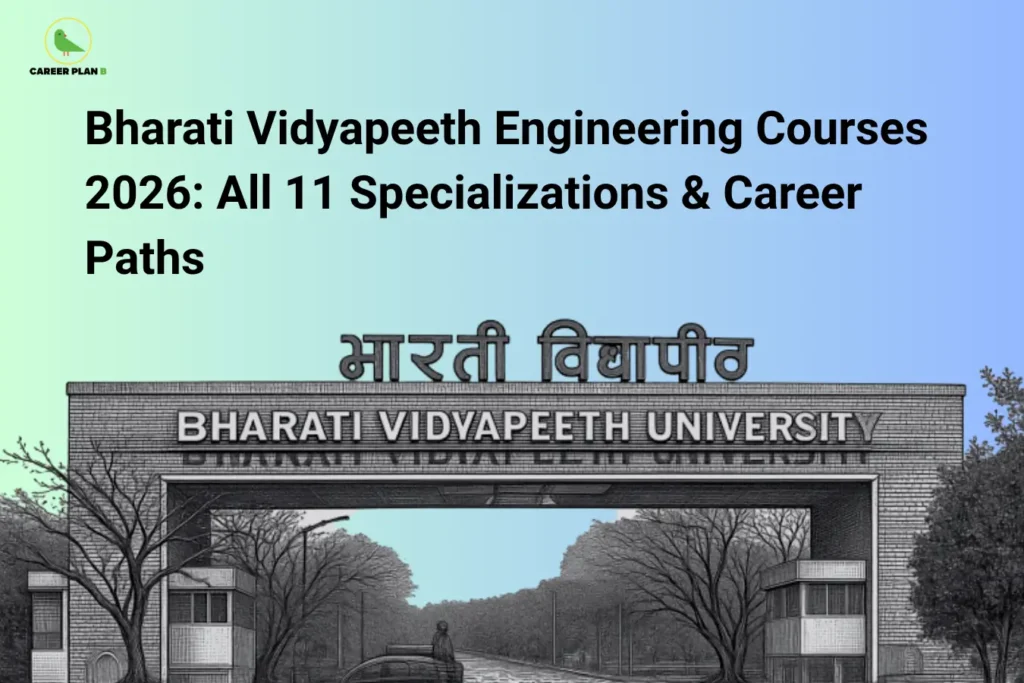
Introduction
Choosing an engineering branch is one of the biggest decisions a student or a parent will make. It is not just about picking a subject you find interesting. It is about understanding where the world is heading, what your strengths are, and which door will open the right opportunities for your future. And that decision becomes even more layered when you are looking at a university that offers more than a dozen options under one roof.
Bharati Vidyapeeth Engineering Courses have earned a strong reputation across India, with campuses in Pune and New Delhi, NAAC A+ accreditation, and a track record of producing industry-ready graduates. BVUCOE Pune is ranked among the top 100 universities globally in the Times Higher Education (THE) Interdisciplinary Science Rankings 2026. Whether you are a student trying to figure out your path or a parent trying to make sense of it all this guide is for you. Let us walk through every specialization, what it covers, who it suits, and where it can take you.
Why Bharati Vidyapeeth for Engineering in 2026?
Bharati Vidyapeeth Deemed University is not a new name in Indian higher education. The university offers innovative and emerging programs across 29 constituent institutions, including three dedicated research institutes, and is a multi-campus, multi-disciplinary university catering to both urban and rural students.
For engineering specifically, BVUCOE is accredited by the National Assessment and Accreditation Council (NAAC) with an A+ grade, and holds accreditation from the National Board of Accreditation (NBA), which evaluates the quality of engineering programs based on specific academic standards.
BTech at Bharati Vidyapeeth is a 4-year full-time UG degree offered in 12 specializations, with total fees for the 2026–2027 academic year ranging from ₹7 Lakhs to ₹11.6 Lakhs. Admissions to the Pune campus are conducted through the BVP CET, while the Delhi campus follows JEE Main scores via GGSIPU counselling.
Have Any Doubts?
Campus-Wise Program Availability at a Glance
| Specialization | Pune (BVUCOE) | New Delhi (BVCOE) |
| Computer Engineering | Yes | Yes |
| CSE | Yes | Yes |
| CSBS | Yes | Yes |
| Information Technology | Yes | Yes |
| AI & ML | Yes | Yes |
| E&TC | Yes | Yes |
| ECE | Yes | Yes |
| Civil Engineering | Yes | No |
| Mechanical Engineering | Yes | No |
| Chemical Engineering | Yes | No |
| Robotics & Automation | Yes | No |
| Electrical & Computer | Yes | No |
Note: Program availability is subject to annual updates. Always verify with the official university website at bvuniversity.edu.in or the Delhi campus site at bvcoend.ac.in before applying.
All 11 BTech Specializations
1. Computer Engineering
Think of Computer Engineering as the original blueprint — the branch that laid the foundation for everything digital. It blends hardware and software, teaching students how computers actually work, from microprocessors and circuits to operating systems and networks.
What you study: Digital logic, computer architecture, data structures, operating systems, embedded systems, VLSI design.
Who it suits: Students who are curious about both the inside of a machine and the software running on it.
Career paths: Hardware Engineer, Embedded Systems Developer, Firmware Engineer, VLSI Design Engineer, System Architect.
Computer Science Engineering offers the highest salaries among BTech branches, with entry-level graduates earning ₹4–6 LPA and mid-level professionals reaching ₹8–12 LPA.
2. Computer Science & Engineering (CSE)
CSE is the most sought-after branch — and for good reason. It covers everything from algorithms and databases to cloud computing and cybersecurity. If Computer Engineering is the engine room, CSE is the command center.
What you study: Programming, algorithms, AI fundamentals, databases, software engineering, machine learning basics, web development.
Who it suits: Students who love coding, problem-solving, and building software products.
Career paths: Software Engineer, Backend Developer, Data Scientist, Cloud Architect, Product Manager.
The Delhi campus offers 240 seats in Computer Science and Engineering (CSE) and 120 seats for CSE with AI & ML in the first year, along with lateral entry options.
3. Computer Science & Business Systems (CSBS)
This is one of the newer, smarter additions to Bharati Vidyapeeth Engineering Courses — and it deserves more attention than it gets. CSBS is a hybrid program developed in partnership with TCS (Tata Consultancy Services) that merges computer science with business analytics, ERP systems, and enterprise management.
What you study: Core CS subjects + supply chain management, business analytics, ERP, data-driven business decision making.
Who it suits: Students who want a tech career but also have a flair for business strategy and management.
Career paths: Business Analyst, ERP Consultant, IT Project Manager, Systems Analyst, Digital Transformation Consultant.
4. Information Technology (IT)
IT is often confused with CSE — but there is a meaningful difference. While CSE focuses heavily on software development and algorithms, IT is more about deploying, managing, and securing systems and networks that organizations depend on daily.
What you study: Networking, cloud infrastructure, database management, cybersecurity, system administration, IT governance.
Who it suits: Students interested in keeping systems running smoothly at scale — in banks, hospitals, corporations, or government bodies.
Career paths: Network Engineer, IT Security Analyst, Cloud Engineer, Database Administrator, IT Consultant.
Starting salaries for IT graduates range from ₹3.5–6 LPA, with mid-level professionals earning ₹8–12 LPA and niche-skilled professionals reaching ₹15–30+ LPA.
5. Artificial Intelligence & Machine Learning (AI & ML)
If there is one branch that has changed the entire conversation around engineering careers in the last five years, it is this one. AI & ML is not just a trend — it is the backbone of how businesses will operate for the next few decades.
What you study: Python, deep learning, neural networks, natural language processing (NLP), computer vision, model deployment, data engineering.
Who it suits: Students who love mathematics, data, and the idea of building machines that can think and learn.
Career paths: AI Engineer, Machine Learning Engineer, Data Scientist, NLP Specialist, AI Researcher.
On average, an AI/ML engineer’s salary in India ranges from ₹6–10 LPA at the entry level and can go up to ₹50 LPA or more at senior levels. Mid-level professionals (3–6 years) move into roles like Machine Learning Engineer or NLP Specialist, with salaries growing to ₹15–25 LPA in India.
6. Electronics & Telecommunication Engineering (E&TC)
India’s telecom sector is in the middle of a massive 5G rollout, and E&TC engineers are right at the center of it. This branch deals with signal processing, communication systems, and the hardware that keeps the world connected.
What you study: Signal processing, communication systems, antenna design, microwave engineering, 5G technology, optical fiber networks.
Who it suits: Students fascinated by how wireless communication, radar systems, and satellite technology work.
Career paths: Telecom Engineer, RF Engineer, Signal Processing Specialist, Network Planning Engineer, ISRO/DRDO research roles.
7. Electronics & Communication Engineering (ECE)
ECE and E&TC are closely related — so what is the difference? ECE leans more towards embedded systems, VLSI, and the intersection of electronics with computing, while E&TC tilts towards communication networks and signal flow. Both are strong branches, but ECE often offers broader placement options across consumer electronics, defence, and automotive sectors.
What you study: Analog and digital electronics, VLSI design, embedded systems, microcontrollers, communication protocols.
Career paths: Embedded Systems Engineer, VLSI Designer, Automotive Electronics Engineer, Robotics Hardware Developer, Defence Electronics Specialist.
8. Civil Engineering
Civil Engineering is the branch that builds the country — literally. From highways and bridges to smart cities and water treatment plants, civil engineers are behind every piece of infrastructure that shapes daily life. And with India investing heavily in infrastructure, the demand is only going up.
What you study: Structural engineering, fluid mechanics, geotechnical engineering, transportation planning, environmental engineering, construction management.
Who it suits: Students who think in terms of scale, structure, and real-world impact.
Career paths: Structural Engineer, Urban Planner, Construction Project Manager, Environmental Engineer, Geotechnical Engineer, PSU roles (NHAI, CPWD, Railways).
9. Mechanical Engineering
Mechanical Engineering is the grandfather of all engineering branches — and it is evolving faster than ever. The rise of electric vehicles, 3D printing, and industrial automation has given mechanical engineers an entirely new career landscape to work in.
What you study: Thermodynamics, fluid dynamics, machine design, manufacturing processes, CAD/CAM, robotics, EV technology.
Who it suits: Students who enjoy working with physical systems, design, and manufacturing.
Career paths: Mechanical Design Engineer, Automotive Engineer, EV Powertrain Specialist, Manufacturing Engineer, PSU roles (BHEL, ONGC, ISRO).
10. Chemical Engineering
Chemical Engineering is often underestimated — but it sits at the heart of pharma, oil & gas, food processing, and materials science. If you enjoy chemistry but want an engineering career with real industrial scale, this is the branch for you.
What you study: Chemical reaction engineering, thermodynamics, mass transfer, process simulation, plant design, petrochemical processes.
Who it suits: Students with a strong chemistry foundation who want to work in production, R&D, or process optimization.
Career paths: Process Engineer, Chemical Plant Manager, R&D Chemist (Pharma), Petroleum Engineer, Environmental Compliance Officer.
Chemical Engineering is one of the most popular specializations at Bharati Vidyapeeth, with total BTech fees of ₹7 Lakhs for the full course — the most affordable among the listed programs.
11. Robotics & Automation
Robotics & Automation is where mechanical engineering, electronics, and computer science converge. This is an Industry 4.0 branch — built for a world where factories run on smart machines and AI-powered robots handle complex tasks.
What you study: Mechatronics, PLC programming, industrial automation, robotic kinematics, sensor systems, computer vision integration, IoT.
Who it suits: Students who want to work at the cutting edge of manufacturing, logistics, healthcare robotics, or autonomous systems.
Career paths: Robotics Engineer, Automation Engineer, IoT Systems Developer, Industrial AI Specialist, Drone Technology Engineer.
Bharati Vidyapeeth Deemed University College of Engineering offers Robotics & Automation as one of its specialized BTech programmes, designed to provide technical knowledge and skills aligned with industry requirements.
BTech Curriculum Structure — What 4 Years Actually Look Like
Many students pick a branch without really understanding what they will be studying each year. Here is a straightforward overview:
Year 1 — Foundation Phase: Mathematics, physics, chemistry, basic programming, engineering drawing. Common across most branches. Think of it as the runway before takeoff.
Year 2 — Core Branch Introduction: Your branch-specific fundamentals begin here. If you picked AI & ML, you start with data structures and Python. If you picked Civil, structural mechanics comes in. This is where your identity as an engineer starts forming.
Year 3 — Specialization & Lab-Intensive: Elective subjects, advanced labs, mini-projects, and internship prep. This year often determines your placement trajectory. Industry certifications (AWS, Cisco, AutoCAD) are best pursued alongside this year.
Year 4 — Industry Integration: Major project, internship (integrated or external), and final placements. The quality of your Year 3 skills directly impacts Year 4 outcomes.
Lab Facilities & Infrastructure
Theory is only half the story. Labs are where engineers are actually made.
At Bharati Vidyapeeth’s engineering campuses, department-specific labs include AI & Deep Learning labs with GPU clusters, Embedded Systems and VLSI labs for electronics branches, Civil Engineering labs with structural testing equipment, Robotics and Automation labs with industrial-grade robot arms, and a Digital Library with access to IEEE and ScienceDirect journals.
The Delhi campus library alone houses 46,481 books, 169 IEEE journals, and 275 Science Direct journals, along with a digital library and a book bank for students.
Industry Collaborations & Internship Opportunities
One of the most important questions to ask about any engineering college is: who do they work with outside the campus walls?
Bharati Vidyapeeth’s College of Engineering, New Delhi, signed an MoU with NIELIT to strengthen industry–academia collaboration for skill development and training opportunities for students. The CSBS program has a structural tie-up with TCS, which influences both curriculum design and placement pathways.
Internship opportunities are integrated into the curriculum across most branches in Year 3, with additional tie-ups in pharma, automotive, IT, and infrastructure sectors based on the branch you choose.
Career Paths & Salary Expectations by Branch
| Branch | Top Job Roles | Avg Starting Salary | Growth Sector |
| Computer Engineering | Embedded Dev, VLSI Engineer | ₹5–8 LPA | Semiconductors, Defence |
| CSE | Software Engineer, Data Scientist | ₹6–10 LPA | IT, Product Companies |
| CSBS | Business Analyst, ERP Consultant | ₹5–8 LPA | BFSI, Consulting |
| Information Technology | Cloud Engineer, Security Analyst | ₹4–7 LPA | Banking, Govt IT |
| AI & ML | AI Engineer, ML Engineer | ₹6–12 LPA | Tech, Healthcare, Finance |
| E&TC | RF Engineer, Telecom Planner | ₹4–6 LPA | 5G, ISRO, DRDO |
| ECE | Embedded Engineer, VLSI Designer | ₹4–6 LPA | Automotive, Consumer Electronics |
| Civil Engineering | Site Engineer, Urban Planner | ₹3.5–5 LPA | Infrastructure, Smart Cities |
| Mechanical Engineering | Design Engineer, EV Specialist | ₹3.5–5 LPA | Automotive, Manufacturing |
| Chemical Engineering | Process Engineer, R&D | ₹4–6 LPA | Pharma, Oil & Gas |
| Robotics & Automation | Robotics Engineer, IoT Dev | ₹5–8 LPA | Industry 4.0, Logistics |
| Electrical & Computer | Power Engineer, Smart Grid | ₹4–6 LPA | Renewable Energy, Utilities |
Emerging vs Traditional Engineering — Which Should You Pick?
This is the question every family debates at the dinner table. And honestly? There is no single right answer.
Emerging branches like AI & ML, Robotics, and CSBS offer higher starting salaries and are riding the wave of a digital economy. By 2030, BTech graduates in high-demand tech roles (AI, ML, Cloud, and Data) are expected to earn ₹30–40 LPA at mid-level positions.
Traditional branches like Civil, Mechanical, and Chemical offer something equally valuable: stability, PSU opportunities, and the chance to contribute to India’s physical infrastructure boom. Core engineering roles could reach ₹15–20 LPA by 2030, driven by growth in green tech, EV manufacturing, and smart infrastructure.
The real question is not which branch is better — it is which branch is better for you.
How to Choose the Right Engineering Branch
Step 1: Know Your Aptitude First
Are you someone who loves abstract logic and coding? Or do you prefer designing physical systems? Do numbers excite you, or do structures? Before you follow trends, follow your strengths. A career assessment test can make this process significantly clearer.
Step 2: Look Beyond the Hype
AI & ML is booming — but if you do not enjoy mathematics and statistics, you will struggle by Year 2. Civil Engineering may seem traditional — but if you love large-scale problem solving, it can take you to some of the most exciting infrastructure projects in the country.
Step 3: Think 10 Years Ahead, Not Just Placement Season
The branch that gives you a ₹6 LPA package straight out of college is good. But the branch that aligns with your long-term interest is the one that keeps giving — in growth, in promotions, and in job satisfaction. Think about where you want to be at 35, not just at 22.
How Career Plan B Helps
Career Plan B supports students, parents, and professionals in making informed, self-aware career decisions:
- Personalized Career Counselling: Helps individuals move beyond assumptions to choices grounded in self-awareness.
- Psycheintel & Career Assessment Tests: Identifies aptitude, personality, and interests with data-backed precision.
- Admission & Academic Profile Guidance: Assists in building strong, competitive applications.
- Career Roadmapping: Provides a clear, actionable plan—not just for admission, but for long-term career growth.
For Latest Information
Frequently Asked Questions
Q1. Which is the best BTech branch at Bharati Vidyapeeth?
There is no single “best” branch — it depends on your aptitude and career goals. That said, Computer Science & Engineering and AI & ML are the most competitive in terms of placement packages. Civil and Mechanical Engineering are strong choices for PSU aspirants and infrastructure-focused careers.
Q2. How many total BTech seats are available at Bharati Vidyapeeth?
BTech at Bharati Vidyapeeth is offered across 12 specializations, with the total course fees ranging from ₹7 Lakhs to ₹11.6 Lakhs for the 2026–2027 academic year. Seat availability varies by campus and specialization.
Q3. Is AI & ML better than Computer Engineering at Bharati Vidyapeeth?
Both are strong — but they lead to different roles. AI & ML is ideal for students who want to work with data, algorithms, and intelligent systems. Computer Engineering suits those interested in hardware-software integration and embedded systems. If you are unsure, a career assessment test can help you make a data-backed decision.
Q4. What is the admission process for Bharati Vidyapeeth BTech 2026?
For the Pune campus, candidates must appear in MHT-CET and obtain a valid score, fill out the application form, and then go through document verification before fee payment confirms admission. For the Delhi campus, admissions for 90% of seats are based on JEE Main rank through GGSIPU counselling, with the remaining 10% under Management Quota filled through institutional counselling.
Q5. What is the average salary after BTech from Bharati Vidyapeeth?
The median salary package for BVUCOE Pune BTech graduates is ₹4 LPA, while the Delhi campus reports stronger placement outcomes. BVCOE Delhi’s highest package stands at ₹64 LPA, with an average package of ₹7.36 LPA, with top recruiters including Amazon, TCS, Infosys, Adani Group, and Wipro.
Conclusion
Engineering is not just a degree — it is a four-year investment in who you are becoming. And when you are choosing from 11 specializations across campuses in two major cities, the decision can feel overwhelming. But it does not have to be. Every branch covered in this guide has a real, rewarding career path waiting at the other end. What matters is matching that path to your strengths, your interests, and your vision for the future.
If you are still not sure which Bharati Vidyapeeth Engineering Course is right for you, do not leave that decision to chance or peer pressure. Speak to a career counsellor, take a proper aptitude assessment, and give yourself the clarity you deserve before making a commitment you will live with for years. The best engineering choice is not the most popular one — it is the one made with intention and self-knowledge.