Team6 · September 23, 2026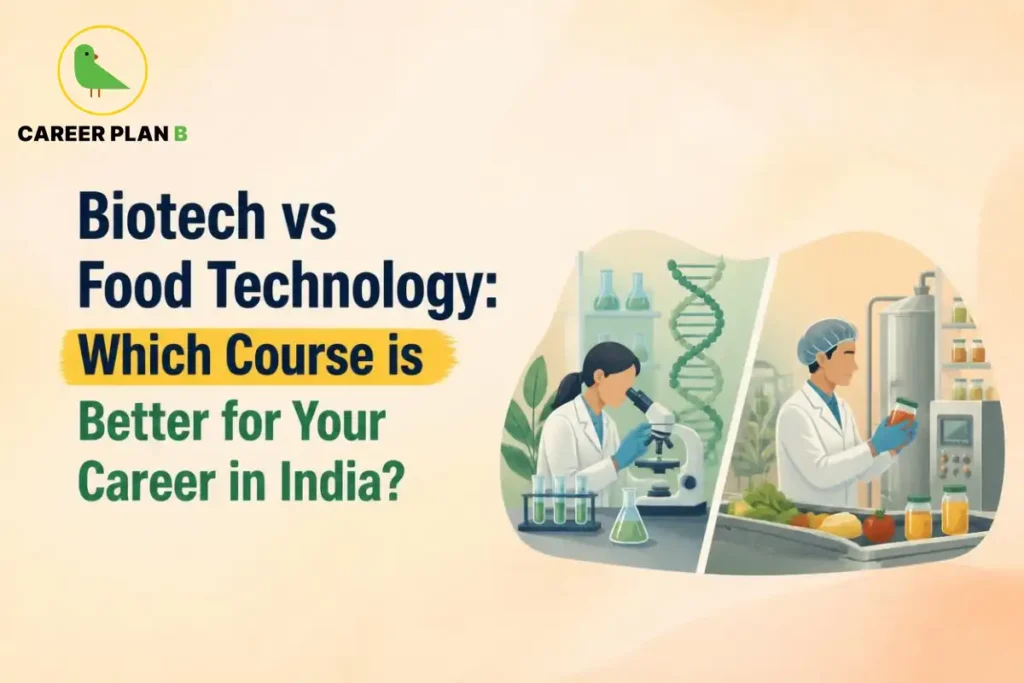
Introduction
Every year, thousands of science students in India face the same dilemma after completing their 12th standard: which course will actually build the future they are imagining? Two fields that consistently appear at the top of that list are biotechnology and food technology. Both are rooted in life sciences, both are growing rapidly, and both offer strong career prospects. But when it comes to biotech vs food technology, which course is better? The answer is not one-size-fits-all; it depends entirely on your interests, strengths, and long-term goals.
India’s biotechnology sector is backed by the Department of Biotechnology (DBT) and is expanding across pharmaceuticals, agriculture, and research. India’s food technology sector is regulated and promoted by the Food Safety and Standards Authority of India (FSSAI) and is booming alongside the country’s massive food processing industry. This blog gives you a clear, honest, side-by-side comparison of both courses covering curriculum, careers, salaries, and a practical framework to help you decide which path is right for you.
Understanding the Two Fields: What Are You Actually Studying?
Before comparing careers and salaries, it helps to understand what each field actually involves at its core.
Biotechnology is the application of biological systems and living organisms to develop products, processes, and technologies across multiple industries. A biotechnology degree covers molecular biology, genetics, cell biology, biochemistry, microbiology, and increasingly, bioinformatics and computational biology. Graduates work across pharmaceuticals, agricultural research, clinical trials, environmental science, and biotech startups. Biotechnology career options after 12th grade are genuinely diverse, spanning everything from laboratory research to regulatory affairs to entrepreneurship.
Food technology, on the other hand, focuses on the science of food: how it is produced, processed, preserved, packaged, and made safe for consumption. A food technology degree covers food chemistry, nutrition, microbiology, food engineering, quality control, and food safety regulation. Graduates work in food manufacturing, quality assurance, product development, export compliance, and regulatory bodies like FSSAI. The scope of food technology in India is particularly strong given that India is one of the world’s largest food producers and the food processing industry is a government priority sector.
In the B.Sc. biotechnology vs. B.Sc. food technology comparison, the key distinction is this: biotechnology is broader and more research-orientated, while food technology is more industry and process-focused with a direct link to food safety and consumer products.
Course Structure and Eligibility: What Does Each Degree Involve?
Both biotechnology and food technology programmes require a 10+2 qualification with physics, chemistry, and biology (or mathematics in some cases) as core subjects. Both are available as 3-year B.Sc programmes or 4-year B.Tech programmes, with postgraduate options at the M.Sc and M.Tech levels.
For biotechnology, core subjects across the degree include cell biology, genetics, molecular biology, biochemistry, immunology, bioprocess engineering, and bioinformatics. Elective areas often include plant biotechnology, pharmaceutical biotechnology, and environmental biotechnology. For food technology, core subjects include food chemistry, food microbiology, food processing technology, food packaging, nutrition science, quality management systems, and food laws and regulations, including FSSAI standards.
Entrance examinations differ between the two. For food technology programmes at agricultural universities and ICAR-affiliated institutes, the ICAR All India Entrance Examination for Admission (ICAR-AIEEA) is the primary exam. Details and notifications are available at the following: For both biotech and food tech programmes at central universities, the Common University Entrance Test (CUET) is applicable. For postgraduate admissions and government research positions, GATE Biotechnology and GATE Food Technology are the relevant qualifying exams. This makes choosing the best science course after 12th biology highly dependent on which entrance pathway you are prepared for.
Career Opportunities: Where Does Each Degree Take You?
Career Paths in Biotechnology
Biotechnology graduates have career pathways across research, industry, and regulatory sectors. Key roles include:
- Research Scientist at government institutes such as ICMR, CSIR, and DBT-funded labs
- Clinical Research Associate managing pharmaceutical and biotech clinical trials
- Regulatory Affairs Specialist at companies dealing with drug approvals and biologics
- Bioinformatics Analyst working on genomic and proteomic data pipelines
- Agricultural Biotechnologist at ICAR institutes and agri-biotech companies
- Biotech Entrepreneur supported by BIRAC funding schemes
Primary government employers include ICMR, DBT, CSIR institutes, and BIRAC. Private employers span pharmaceutical companies, biotech startups, contract research organisations, and multinational life sciences firms.
Career Paths in Food Technology
Food technology graduates have a direct pipeline into India’s food processing industry, which is one of the largest employment sectors in the country. Key roles include:
- Food Safety Officer at FSSAI or state food regulatory bodies
- Quality Control and Quality Assurance Analyst at food manufacturing companies
- Product Development Scientist creating new food products and formulations
- Food Regulatory Affairs Specialist managing FSSAI licensing and compliance
- Export Quality Manager ensuring compliance with international food-safety standards
- Nutrition and Labelling Consultant for food brands
Food technology jobs in India are supported by FSSAI, the Ministry of Food Processing Industries, and the Agricultural and Processed Food Products Export Development Authority (APEDA). Food science and technology careers in India are growing rapidly as the government pushes for expansion of the food processing sector under its PLI scheme and Pradhan Mantri Kisan Sampada Yojana.
Have Any Doubts?
Salary Comparison: Which Pays Better?
The biotechnology vs food technology career comparison in terms of salary shows that both fields offer competitive packages, with variation depending on role, sector, and qualifications:
Entry Level (B.Sc. / B.Tech., 0–2 years’ experience):
- Biotechnology: ₹2.5 – ₹5 LPA (lab technician, project associate, junior research fellow)
- Food Technology: ₹2.5 – ₹4.5 LPA (quality analyst, production trainee, food safety assistant)
Mid-Level (M.Sc / M.Tech or 3–6 years’ experience):
- Biotechnology: ₹5 – ₹12 LPA (research scientist, regulatory affairs officer, clinical research associate)
- Food Technology: ₹4.5 – ₹10 LPA (QA manager, product development scientist, regulatory affairs specialist)
Senior Level (PhD or 7+ years’ experience):
- Biotechnology: ₹12 – ₹25 LPA and above (principal scientist, R&D head, biotech entrepreneur)
- Food Technology: ₹10 – ₹20 LPA (plant head, food safety director, senior regulatory consultant)
In terms of government fellowship and stipend support, biotechnology has a slight edge with DBT, ICMR, and CSIR fellowships available at both JRF and SRF levels. Food technology graduates pursuing agricultural research fellowships can access ICAR-JRF support. Both fields have strong government backing and long-term salary growth potential.
Which Course Should You Choose? A Practical Decision Framework
If you are still weighing biotech vs food technology and which course is better for your specific situation, here is a straightforward decision framework:
Choose Biotechnology if:
- You are fascinated by how living cells, genes, and molecules work
- You want to work in pharmaceutical research, clinical trials, or genomics
- You are interested in pursuing a PhD and building a research career
- You want access to a wider range of industries, from healthcare to agriculture to environment
- You are drawn to biotech entrepreneurship and the startup ecosystem
Choose Food Technology if:
- You are passionate about food science, nutrition, and food safety
- You want to work directly in India’s food processing industry or with the FSSAI
- You prefer a more structured industry career with clear compliance and quality management pathways
- You are interested in product development, export quality, or food entrepreneurship
- You want strong placement opportunities with large FMCG and food manufacturing companies
It is important to note that neither course is universally better. The best science course after 12th biology is the one that aligns with your natural interests and long-term career vision. Both fields have strong government support, growing private sector demand, and expanding global opportunities for Indian graduates.
How Career Plan B Helps
Choosing between biotech vs food technology which course is better? is one of the most important decisions a science student will make, and it should never be based on guesswork. Career Plan B offers personalised career counselling to help students in exactly this situation. Through the Psycheintel psychometric assessment, you can discover whether your aptitude and personality align better with research-driven biotechnology or process-orientated food technology careers. Career Plan B also provides academic profile guidance to strengthen your entrance exam strategy and a structured career roadmap that maps your current qualifications to your target career, whether that is a food science and technology career in India’s FMCG sector or a research role in a DBT-funded biotechnology lab.
Get In Touch With Us
Frequently Asked Questions
1. Is biotechnology better than food technology in terms of salary?
At senior levels, biotechnology roles, particularly in pharmaceutical research, bioinformatics, and biotech entrepreneurship, tend to offer higher salary ceilings. However, food technology offers strong mid-level salaries in India’s large food processing sector. The biotechnology vs food technology career comparison in salary terms is competitive at entry and mid levels, with biotech pulling ahead at senior research roles.
2. Can I switch from food technology to biotechnology after graduation?
Yes, with the right postgraduate course. Students with a B.Sc. in Food Technology can pursue an M.Sc. in Biotechnology or Food Biotechnology, which bridges both fields. GATE scores in relevant subjects can support admission to such programmes. However, a clear aptitude check before switching is advisable.
3. Which course has more government job opportunities in India?
Both have strong government job pathways. Biotechnology graduates can access positions at ICMR, CSIR, DBT, and ICAR institutes. Food technology graduates can pursue roles at FSSAI, MOFPI, APEDA, and state food regulatory bodies.
4. Is food technology regulated by FSSAI in India?
Yes. The Food Safety and Standards Authority of India (FSSAI) is the primary regulatory body governing food safety, licensing, and standards in India. Food technology professionals working in manufacturing, quality, and regulatory roles work directly within the FSSAI compliance framework.
5. What is the scope of biotechnology vs food technology in India’s future?
Both fields have excellent long-term scope. The scope of food technology in India is expanding with the government’s push for food processing infrastructure and export growth. Biotechnology career options after 12th are growing with India’s pharmaceutical, agricultural biotech, and genomics sectors. Both are future-proof career choices for science students.
Conclusion
There is no single right answer to the question of biotech vs food technology: which course is better? Because the right course is the one that fits your interests, your strengths, and the kind of career you genuinely want to build. Biotechnology offers depth in research, molecular science, and a wide range of industries. Food technology offers clarity of purpose, direct industry placement, and a booming sector backed by government investment and growing consumer demand. Both are excellent choices for science students in India looking to build meaningful, well-paying careers.
If you are finding it difficult to decide, you do not have to figure it out alone. Visit Career Plan B to speak with expert career counsellors, take the Psycheintel psychometric assessment, and get a personalised roadmap that matches your unique profile to the right course and career path.
The right choice made today can define the next twenty years of your career. Make it with confidence and clarity.