Team6 · September 23, 2026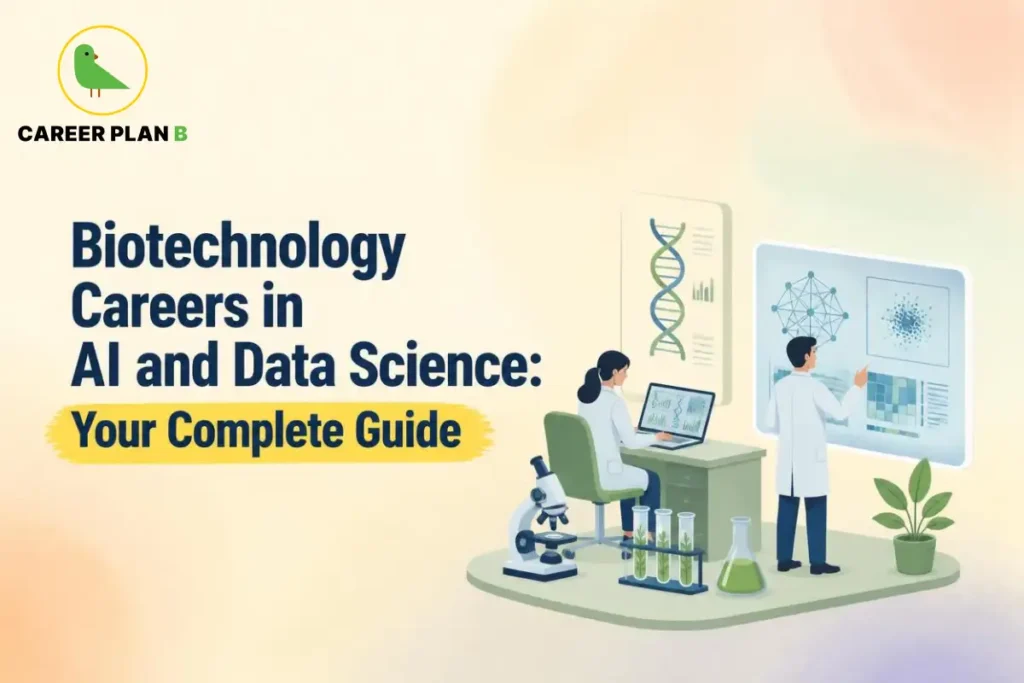
Introduction
What happens when a biology textbook meets a machine learning algorithm? You get one of the fastest-growing career spaces of the decade. Biotechnology careers in AI and data science are no longer a niche concept reserved for PhD researchers at elite institutions. They are real, accessible, and in high demand right here in India.
According to the Department of Biotechnology (DBT), India’s biotechnology sector is projected to reach USD 150 billion by 2025, with AI-driven research playing a central role in that growth. From decoding genomes to building drug discovery pipelines, data is now the backbone of modern biology. If you are a biotech student wondering whether your degree has a future beyond the lab bench, the answer is a loud yes, and this blog will show you exactly where that future leads.
Why Is AI Changing Biotechnology Careers?
Not long ago, a biotechnologist’s primary tools were pipettes and petri dishes. Today, they include Python scripts, neural networks, and terabytes of genomic data. AI in biotechnology is not replacing biologists; it is amplifying what they can do.
Consider drug discovery. A process that once took over a decade can now be accelerated to a fraction of that time using machine learning models that predict how molecules will behave inside the human body. Similarly, in agriculture, AI is being used to develop disease-resistant crop varieties by analysing genetic sequences at a scale no human team could manually process.
The Indian government recognised this shift early. The Department of Biotechnology and the Biotechnology Industry Research Assistance Council, or BIRAC, have been actively funding AI-biotech convergence projects under programmes like BioNEST and Innovate in India. This institutional push is creating real demand for professionals who sit comfortably at the intersection of biology and data.
Top Career Roles at the Intersection of Biotech and AI
Bioinformatics Scientist
This is one of the most well-established bioinformatics jobs in India. A bioinformatics scientist analyses biological data, particularly DNA, RNA, and protein sequences, using computational tools and statistical models. They work in genomics labs, pharmaceutical companies, and research institutions. Skills like sequence alignment, database management, and programming in Python or R are essential.
Computational Biologist
A computational biology career involves building mathematical models to understand biological systems. Think of it as translating biology into equations that computers can simulate. These professionals often work on problems like protein folding, cell signalling, and population genetics. IITs and IISERs in India have dedicated computational biology research groups that regularly hire for these roles.
Biotech Data Analyst
If you are more drawn to interpreting data than generating it in a lab, the biotech analyst role might suit you. These professionals handle clinical trial data, market research, and regulatory submissions. They are employed across pharmaceutical companies, CROs (Contract Research Organisations), and healthcare startups. Proficiency in Excel, SQL, and basic statistics is the starting point.
Machine Learning Engineer in Life Sciences
Machine learning in life sciences is a relatively newer role but is growing rapidly. These engineers build predictive models for applications such as disease diagnosis, patient outcome prediction, and personalised medicine. A strong foundation in both biology and ML frameworks like TensorFlow or PyTorch is what sets candidates apart for these positions.
Clinical Data Scientist
Clinical data scientists work with data generated from patient trials and hospital systems. They ensure data quality, perform statistical analysis, and help pharmaceutical companies make evidence-based decisions. ICMR and AIIMS regularly collaborate with professionals in this space for national health research projects.
Have Any Doubts?
What Skills Do You Need to Build a Career Here?
One of the most common questions from biotech students is do I need to become a full-stack data scientist to enter this field? The answer is no. But you do need a thoughtful combination of domain knowledge and technical skills.
Technical Skills:
- Programming: Python and R are the most widely used languages in data science for biotech students
- Bioinformatics tools: BLAST, Galaxy, Bioconductor, and GATK for genomics and data science workflows
- Machine learning: Familiarity with scikit-learn, TensorFlow, or Keras
- Databases: SQL for structured data; experience with biological databases like NCBI, UniProt, and Ensembl
Domain Knowledge:
- Molecular biology, genetics, and biochemistry fundamentals
- Understanding of clinical research and regulatory frameworks
- Familiarity with omics data: genomics, proteomics, metabolomics
Soft Skills:
- Ability to communicate findings to non-technical stakeholders
- Research mindset and attention to detail
- Comfort working in interdisciplinary teams
Which Companies and Institutes Are Hiring?
India has a growing ecosystem of employers looking for talent in this exact space.
Industry:
- Biocon one of India’s largest biotech firms, increasingly investing in data-driven R&D
- Strand Life Sciences a Bangalore-based company specialising in genomics and bioinformatics
- TCS Life Sciences division works on digital health and AI-assisted drug development
- Syngenta and Bayer CropScience for those interested in agricultural biotechnology
Research and Government Institutions:
- CSIR laboratories, multiple institutes under CSIR, such as IGIB and CCMB, work on genomics and computational biology
- ICMR funds and conducts national-level biomedical data research
- DBT-funded research centres across the country offer project-based and permanent positions
Startups: India’s health-tech and agri-tech startup ecosystem includes companies working on precision medicine, AI diagnostics, and crop genomics, all of which actively hire biotech graduates with data skills.
What Educational Pathways Work Best?
There is no single route into this field, which is actually good news. Here are the most practical pathways:
Undergraduate to Postgraduate:
- B.Tech in Biotechnology → M.Tech in Bioinformatics or Computational Biology
- BSc in Life Sciences or Microbiology → MSc in Computational Biology or Data Science
- B.Tech in any branch → MSc/MTech with a strong self-taught data foundation
Top Institutions:
- IIT Delhi, IIT Bombay, IIT Kharagpur offer M.Tech. in Computational Biology or related programmes
- IISER Pune and IISER Kolkata known for research-oriented computational biology programmes
- BITS Pilani offers strong programmes combining engineering with life sciences
- For JNU and central university options, check the DBT’s JRF and SRF fellowship programmes
Online Upskilling: If a full postgraduate degree is not your immediate plan, targeted certifications in Python, bioinformatics, or machine learning can meaningfully strengthen your profile. CSIR-IGIB and NIPGR also offer short-term training programmes for computational biology.
How Career Plan B Helps
Figuring out which role fits your biology background and data skills can feel overwhelming. Career Plan B helps science and engineering students find clarity through personalised career counselling and the PsycheIntel assessment, a tool designed to map your strengths, aptitude, and interests to the right career path in fields like bioinformatics, data science, and life sciences research.
Get In Touch With Us
Frequently Asked Questions
1. Can a biotech student without coding experience enter AI and data science roles?
Yes, but upskilling is essential. Start with Python basics and bioinformatics tools. Many professionals transition successfully after 6 to 12 months of focused learning alongside their core biotech studies.
2. What is the salary range for bioinformatics jobs in India?
Entry-level roles typically range from INR 4 to 7 LPA, while experienced professionals in machine learning or computational biology roles at established firms can earn INR 12 to 20 LPA or more.
3. Is a PhD necessary for a computational biology career?
Not always. Research-heavy roles at institutes like CSIR or ICMR often require or prefer a PhD, but industry positions at biotech companies and startups actively hire M.Tech and MSc graduates with strong practical skills.
4. Which government programmes support AI and biotech integration in India?
BIRAC’s BioNEST programme, DBT’s National Bioscience Awards, and CSIR’s research fellowship schemes are among the key government initiatives supporting this space.
Conclusion
The boundary between biology and data science is dissolving, and that is creating opportunity, not confusion. Biotechnology careers in AI and data science are among the most future-proof paths available to life sciences students in India today. The roles are diverse, the demand is real, and the educational pathways are more accessible than ever.
Whether you see yourself analysing genomic sequences, building disease prediction models, or interpreting clinical trial data, the key is to start building your skill stack intentionally. Your biology degree is not a limitation; it is your competitive advantage in a world that needs people who understand both the data and the science behind it.
Take the first step. Explore your options, assess your strengths, and map out a path that is built around who you are, not just what is trending.