Team6 · September 23, 2026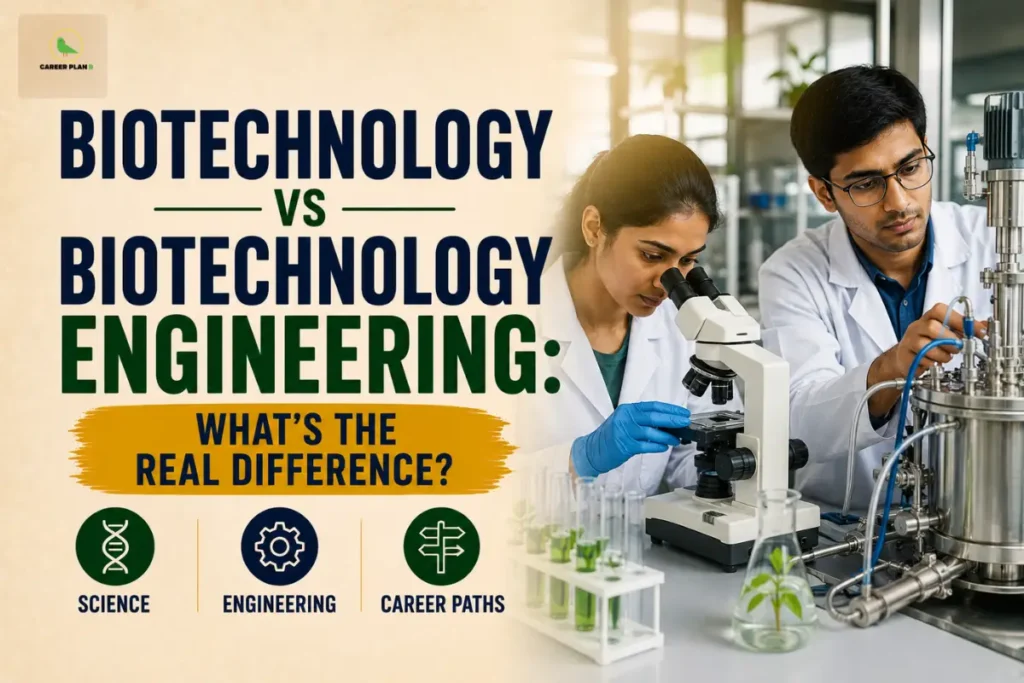
Introduction
Every year, thousands of students in India fill out college applications and pause at the same confusing crossroad: biotechnology or biotechnology engineering? The names sound almost identical. The subjects seem to overlap. Even some counsellors struggle to explain the difference clearly. But make no mistake: biotechnology vs biotechnology engineering are two distinctly different academic paths that lead to different careers, different skill sets, and different professional identities. Choosing the wrong one not because it is bad, but because it does not match who you are, can cost you years of frustration. This blog breaks down exactly what separates these two courses, what careers they lead to, and most importantly, which one is the right fit for you.
What Is Biotechnology? Understanding the Pure Science Path
Biotechnology as a standalone degree, typically offered as a B.Sc. or M.Sc. in biotechnology, focuses on pure and applied biological science. Students learn how living systems work at the molecular and cellular levels. They also learn how to apply this knowledge to medicine, agriculture, environmental science, and industrial processes.
Biotechnology students study subjects such as molecular biology, genetics, microbiology, biochemistry, cell biology, immunology, and bioinformatics. They spend significant time in laboratory settings. Their coursework emphasises scientific thinking, experimental design, and research methodology.
This path suits students who are deeply curious about how life works at the biological level. They may find questions such as “Why does this gene behave this way?” more interesting than “How do I design a system to produce this protein at scale?”
Who Should Choose a Biotechnology Degree?
A biotechnology degree suits students who enjoy laboratory research, want to pursue higher studies like an M.Sc. or PhD, aspire to work in academic research or government science institutions, or want to enter fields like pharmaceutical research, genomics, clinical research, or environmental biotechnology. It is the right choice if science excites you more than systems and engineering.
Official Reference: University Grants Commission (UGC) which governs B.Sc. and M.Sc. programmes in India.
What Is Biotechnology Engineering? The Applied Technical Path
Biotechnology engineering offered as a B.Tech in Biotechnology Engineering is a fundamentally different kind of degree. While it shares some biological science content with a pure biotechnology programme, its core identity is engineering. It applies the principles of chemical engineering, process engineering, and instrumentation to biological systems.
A B.Tech in Biotechnology Engineering covers subjects like bioprocess engineering, bioreactor design, thermodynamics, mass transfer, fluid mechanics, instrumentation and control systems, downstream processing, and biochemical engineering alongside foundational biology. The learning environment blends laboratory work with engineering design, process simulation, and industrial problem-solving. Think of it this way: if a biotechnology graduate studies how a microorganism produces insulin, a biotechnology engineer figures out how to build the industrial system that produces insulin at a scale of thousands of litres efficiently and economically. Both are essential. But the thinking required is very different.
Who Should Choose Biotechnology Engineering?
Biotechnology engineering is the right choice for students who enjoy problem-solving with a systems and design mindset, want to work in industrial biotech, biomanufacturing, or product development, are comfortable with mathematics and engineering principles, and aspire to roles in bioprocess development, quality engineering, or plant operations at pharmaceutical and biotech companies.
Official Reference: All India Council for Technical Education (AICTE) which governs B.Tech programmes in India.
Biotechnology vs Biotechnology Engineering A Detailed Comparison
Here is a clear, side-by-side look at the difference between biotechnology and biotechnology engineering across the parameters that matter most to students making this decision.
| Parameter | Biotechnology (B.Sc./M.Sc.) | Biotechnology Engineering (B.Tech) |
|---|---|---|
| Course Type | Pure/Applied Science | Engineering |
| Duration | B.Sc.: 3 years; M.Sc.: 2 years | B.Tech: 4 years |
| Eligibility | 10+2 with Biology and Chemistry | 10+2 with Physics, Chemistry, Mathematics (PCM); some colleges accept PCB |
| Governing Body | UGC | AICTE |
| Core Focus | Molecular biology, genetics, biochemistry, research methodology | Bioprocess engineering, bioreactor design, chemical engineering principles, industrial biotech |
| Primary Learning Mode | Laboratory research and scientific analysis | Engineering design, process development, and applied problem-solving |
| Career Outcomes | Research scientist, clinical researcher, academic, government lab professional | Bioprocess engineer, downstream processing specialist, plant manager, R&D engineer |
The biotechnology degree vs engineering degree comparison essentially comes down to this: one trains you to discover and understand; the other trains you to design and build.
Career Scope Which Degree Opens More Doors?
Both degrees open real and growing career opportunities in India. The difference lies in which doors they open, not in how many.
Biotech Engineering Job Roles in India
Biotechnology engineering career scope in India is strongly tied to the industrial and manufacturing side of the life sciences sector. Graduates work as Bioprocess Development Engineers, Upstream and Downstream Processing Specialists, Production Managers in biopharmaceutical plants, Quality Assurance and Quality Control Engineers, Regulatory Compliance Engineers, and Plant Operations Managers.
Major employers for biotechnology engineering graduates include pharmaceutical manufacturers like Sun Pharma, Cipla, and Biocon, biofuel companies, food and beverage biotechnology firms, and environmental biotech organisations. The rapid expansion of India’s biopharmaceutical manufacturing sector particularly in Hyderabad and Pune is creating sustained demand for trained bioprocess engineers.
Pure Biotechnology Graduate Roles
Graduates with a B.Sc. or M.Sc. in Biotechnology typically enter roles such as Research Assistant, Junior Scientist, Quality Control Analyst, Clinical Research Associate, Bioinformatics Analyst, and Laboratory Manager. Those who pursue a PhD can move into principal investigator roles at universities, senior scientist positions at research institutes, or leadership roles in pharmaceutical R&D.
Government research opportunities are particularly strong for pure biotech graduates. The Department of Biotechnology (DBT) and Indian Council of Medical Research (ICMR) offer Junior Research Fellowships and Senior Research Fellowships that provide structured research careers with competitive stipends and long-term growth.
Have Any Doubts?
Which Is Better Biotechnology or Biotechnology Engineering?
This is one of the most asked questions in the biotechnology course comparison India debate. The honest answer is that neither degree is better in absolute terms. The better choice depends on your natural strengths, working style, and long-term goals.
If you enjoy learning how diseases work at the cellular level, pure biotechnology may be a natural fit for you. It suits students who enjoy conducting and analysing experiments. It can also support careers in research, academia, and pharmaceutical science.
The path may take longer to establish your career, and pursuing a postgraduate degree can significantly strengthen your career prospects. However, biotechnology offers deep knowledge and opens doors to a wide range of research fields.
If you are someone who enjoys mathematics, likes designing systems and solving industrial problems, and sees yourself working on the production floor of a biopharmaceutical company or in a quality engineering role, biotechnology engineering is a stronger choice. It gets you into industry faster and gives you a clear technical identity that employers in manufacturing and process development value highly.
Life sciences engineering careers India supports are growing on both tracks. And increasingly, the two paths converge at the postgraduate level. A B.Sc. Biotechnology graduate who pursues an M.Tech in Bioprocess Engineering gains engineering credentials. A B.Tech Biotechnology Engineering graduate who pursues a PhD in Molecular Biology gains research depth. Flexibility across both tracks is possible with thoughtful planning.
When deciding which is better between biotechnology or biotechnology engineering, also consider the entrance exams and admission pathways available to you. B.Tech programmes are typically accessed through JEE or state-level engineering entrance exams, while B.Sc. programmes have their own admission processes through central and state universities.
Official Reference: Ministry of Education
Regulatory and Academic Bodies You Should Know
Understanding which regulatory and academic bodies govern these programmes helps you make informed decisions about college selection, course recognition, and career pathways. AICTE regulates all B.Tech programmes in India, including B.Tech in Biotechnology Engineering. Only AICTE-approved institutions can offer recognised engineering degrees. UGC governs B.Sc. and M.Sc. programmes offered by universities and affiliated colleges. The Department of Biotechnology sets research and industry priorities that shape what skills are in demand. CSIR and ICMR govern fellowship and research career pathways for science graduates.
When evaluating colleges for either programme, always verify their recognition with the relevant statutory body.
How Career Plan B Helps
Still unsure whether biotechnology or biotechnology engineering is the right fit for your strengths and goals? Career Plan B offers personalised career counselling designed specifically for life science students. Through the PsycheIntel assessment, it evaluates your aptitude, interests, and working style to help you make a confident, well-informed choice and builds a clear roadmap covering the right course, the right colleges, and the career path that genuinely suits you.
Get In Touch With Us
Frequently Asked Questions
Q1. What is the main difference between biotechnology and biotechnology engineering?
Biotechnology is a science-based degree focused on understanding and applying biological systems through research and laboratory work. Biotechnology engineering is an engineering degree that applies chemical and process engineering principles to design industrial-scale biological systems. The core difference lies in the depth of engineering training and the career outcomes each pathway leads to.
Q2. Can a B.Sc. Biotechnology graduate apply for engineering jobs?
In some cases, yes particularly in quality control, clinical research, and laboratory management roles that do not require a formal engineering qualification. However, for core bioprocess engineering and production roles in industry, a B.Tech qualification is typically preferred. Pursuing an M.Tech in Bioprocess Engineering after a B.Sc. can bridge this gap effectively.
Q3. Which course has better government job opportunities in India?
Both courses offer strong government job pathways. B.Sc. and M.Sc. Biotechnology graduates are eligible for DBT, ICMR, and CSIR fellowships and scientist positions. B.Tech Biotechnology Engineering graduates can apply to organisations like DRDO, public sector pharmaceutical units, and government biomanufacturing facilities. The specific role determines which qualification is preferred.
Q4. Is mathematics required for a B.Sc. in Biotechnology?
Most B.Sc. Biotechnology programmes in India require Physics, Chemistry, and Biology (PCB) at the 10+2 level, without a mandatory mathematics requirement. B.Tech Biotechnology Engineering programmes, however, typically require Physics, Chemistry, and Mathematics (PCM), as the engineering curriculum involves significant mathematical content.
Conclusion
The biotechnology vs biotechnology engineering debate is not about which degree is more prestigious or which one pays more at entry level. It is about understanding who you are as a learner and professional.
Ask yourself what interests you more: scientific discovery or engineering practical solutions. Both paths offer valuable career opportunities and continue to grow. India needs skilled professionals from both fields to strengthen its life sciences industry.
Take the time to understand your own strengths before you choose. A degree that matches your natural aptitude will always outperform one chosen purely on reputation or ranking. Choose wisely and then commit fully to making the most of it.