Team6 · September 23, 2026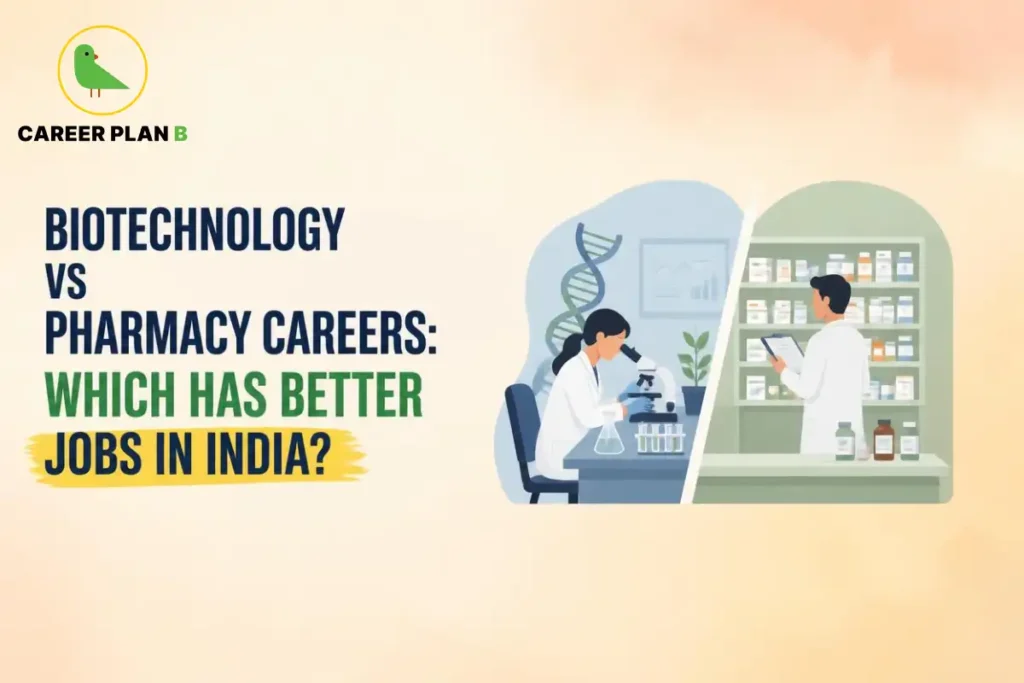
Introduction
Picture two students sitting in the same Class 12 biology class. Both are fascinated by medicine and molecules. Both want careers that sit at the intersection of science and healthcare. One picks B.Tech. biotechnology. The other picks B.Pharma. Five years later, they are working in entirely different worlds, and both are doing well.
This is the reality of biotechnology vs pharmacy careers in India. These are not two versions of the same degree. They are distinct disciplines with different academic demands, different career trajectories, and different kinds of people who thrive in them. Yet every admission season, thousands of students choose between the two without fully understanding what each path actually involves.
This blog will not tell you which degree is universally better because that answer does not exist. What it will do is give you a clear, honest picture of what each field covers, what jobs it leads to, what those jobs pay, and most importantly, which one is the right fit for the kind of person you are. That is the only comparison that actually matters.
What Does a Biotechnology Degree Cover?
Biotechnology is the science of using living organisms, cells, and biological molecules to develop products and solutions across healthcare, agriculture, food production, and the environment. At its core, it is about engineering biology to solve real-world problems.
A biotechnology programme, whether a B.Tech or a B.Sc., typically covers the following:
- Molecular biology and genetics
- Genetic engineering and recombinant DNA technology
- Fermentation technology and bioprocess engineering
- Bioinformatics and computational biology
- Microbiology and cell culture
- Immunology and genomics
- Industrial and environmental biotechnology
The degree is research-and-development-orientated. Students spend significant time in laboratories working with DNA, proteins, microorganisms, and biological data. The output of a biotechnology education is a professional who can contribute to the development of new drugs, diagnostic tools, agricultural innovations, and biotechnology-based products.
Biotechnology jobs after graduation span a wide range of industries: pharmaceutical R&D, agricultural biotech, genomics, biofuels, food technology, and increasingly, AI-driven life sciences. The Department of Biotechnology and BIRAC actively fund biotech research and startups in India, creating a growing ecosystem of employment opportunities for graduates.
What Does a Pharmacy Degree Cover?
Pharmacy is the science and practice of preparing, dispensing, and monitoring medications to ensure their safe and effective use in patient care. It is a professionally regulated discipline with a strong clinical and regulatory identity.
A pharmacy programme, B.Pharma, D.Pharma, or PharmD typically covers the following:
- Pharmaceutical chemistry and drug synthesis
- Pharmacology: how drugs act in the human body
- Pharmacognosy plant-based and natural drug sources
- Pharmaceutical analysis and quality control
- Clinical pharmacy and patient counselling
- Drug regulatory affairs and pharmaceutical law
- Hospital and community pharmacy practice
The scope of pharmacy in India is defined by its professional licensing structure. Pharmacists must be registered with the Pharmacy Council of India to practise legally. This gives pharmacy a clear professional identity that biotechnology as a science degree does not have in the same way.
Pharmacy graduates work across retail and hospital pharmacies, pharmaceutical manufacturing companies, drug regulatory bodies, and clinical research organisations. The degree balances laboratory science with clinical practice and regulatory knowledge, making it one of the most versatile healthcare qualifications in India.
Biotechnology vs Pharmacy Careers: Head-to-Head Comparison
Here is a direct comparison to help you see the key differences at a glance:
| Parameter | Biotechnology | Pharmacy |
|---|---|---|
| Core Focus | Research, product development, biological innovation | Drug preparation, dispensing, clinical use, regulation |
| Key Subjects | Genetics, bioinformatics, fermentation, molecular biology | Pharmacology, pharmaceutical chemistry, clinical pharmacy |
| Work Environment | R&D labs, biotech companies, agri-biotech firms, startups | Hospitals, retail pharmacies, pharma manufacturing, regulatory bodies |
| Professional Licence | Not required for most roles | PCI registration required to practise as a pharmacist |
| Further Study Options | M.Tech. Bioinformatics, MBA, PhD in Life Sciences | M.Pharma, PharmD, MBA in Pharma Management |
| Top Recruiters | Biocon, CSIR, Dr. Reddy’s, genomics startups, ICAR | Sun Pharma, Cipla, hospital chains, CDSCO, retail pharmacy |
| Starting Salary | INR 3.5 – 6 LPA | INR 3 – 5.5 LPA |
The table makes one thing clear: these are not competing versions of the same career. They serve different functions within the broader healthcare and life sciences ecosystem.
Job Roles After Biotechnology
Biotechnology jobs after graduation are diverse and span multiple industries. Here are the most common career paths:
Research and Development:
- Research scientists develop new biological products, drugs, or agricultural solutions in R&D labs
- A bioinformatics analyst uses computational tools to analyse genomic, proteomic, and clinical data
- A bioprocess engineer designs and optimises the manufacturing processes used to produce biological products at scale
Quality and Regulatory:
- A quality assurance / Quality Control Analyst ensures that biological products meet safety and efficacy standards
- Regulatory Affairs Specialist prepares documentation for product approvals with bodies like CDSCO
Clinical and Diagnostics:
- Clinical Research Associate manages clinical trials that test new drugs or biological therapies
- Diagnostic scientists work with molecular diagnostic tools in hospital or commercial labs
Drug Discovery and Biotechnology: The overlap between drug discovery and biotechnology is one of the most exciting growth areas in Indian life sciences. Biotech graduates are increasingly employed in early-stage drug discovery using molecular biology tools, genomics, and AI to identify new drug targets and therapeutic candidates. Companies like Biocon, Syngene International, and a growing number of biotech startups are actively hiring in this space.
Government Opportunities:
- CSIR institutes research roles across microbiology, genomics, and bioprocess science
- DBT-funded research centres’ project-based and permanent research positions
- ICAR agricultural biotechnology research roles
- DRDO defence-related biotech and life sciences research
Job Roles After Pharmacy
The scope of pharmacy in India translates into a well-defined set of career roles, many of which carry professional licensing requirements and regulatory backing.
Clinical and Community Practice:
- A hospital pharmacist manages drug dispensing, patient counselling, and medication safety in hospital settings
- Community Pharmacists run or works in retail pharmacy outlets, the most common entry-level role for B.Pharma graduates
- A clinical pharmacist works directly with medical teams to optimise drug therapy for individual patients
Pharmaceutical Industry:
- A drug regulatory affairs specialist prepares and manages submissions for drug approvals with regulatory bodies
- Pharmaceutical Sales Representatives / Medical Representatives promote prescription drugs to healthcare professionals
- A quality control analyst tests pharmaceutical products for compliance with pharmacopoeial standards
- A formulation scientist develops new drug delivery systems and dosage forms
Government and Regulatory: Pharmacy jobs in India in the government sector are well-structured and competitive:
- Drug inspectors regulate and inspect pharmaceutical manufacturing facilities and retail pharmacies; recruited through state public service commissions
- Central Drugs Standard Control Organisation (CDSCO), the national regulatory authority for pharmaceuticals, which employs pharmacy professionals in technical and regulatory roles
- State Drug Regulatory Authorities: each state has its own drug controller office that recruits pharmacy graduates
- Public sector pharmaceutical companies such as Hindustan Antibiotics Limited and IDPL also hire pharmacy graduates
The professional licensing framework through the Pharmacy Council of India gives pharmacy graduates a clear and legally recognised professional identity in the Indian healthcare system.
Salary Comparison: Biotechnology vs Pharmacy
Understanding the salary landscape is a practical and important part of the biotechnology vs pharmacy careers decision.
Biotechnology Salary Benchmarks:
Entry-Level (0–3 years):
- Research or lab roles at biotech or pharma companies: INR 3.5 to 6 LPA
- Government research fellowships (CSIR-JRF, DBT-JRF): INR 3.1 to 3.5 LPA stipend basis
- Quality and regulatory roles: INR 4 to 6.5 LPA
Mid-Level (3–7 years):
- Bioinformatics or computational biology roles: INR 8 to 14 LPA
- Bioprocess and fermentation scientist roles: INR 7 to 12 LPA
- Clinical research roles with experience: INR 7 to 11 LPA
Senior Level (7+ years):
- R&D managers or department heads at established biotech or pharma firms: INR 18 to 30 LPA and above
Pharmacy Salary Benchmarks:
Entry-Level (0–3 years):
- Community or hospital pharmacist: INR 2.5 to 4.5 LPA
- Medical representative: INR 3 to 5 LPA plus incentives
- QC analyst in pharma manufacturing: INR 3.5 to 5.5 LPA
Mid-Level (3–7 years):
- Regulatory affairs specialist: INR 6 to 11 LPA
- Formulation scientist in established pharma companies: INR 7 to 12 LPA
- Clinical pharmacist in tertiary hospitals: INR 5 to 9 LPA
Senior Level (7+ years):
- Regulatory affairs manager or head of quality at large pharma firms: INR 15 to 25 LPA and above
- PharmD holders in clinical roles command significantly higher packages than B.Pharm. graduates
Have Any Doubts?
Biopharmaceuticals Where Both Fields Converge
One of the most important trends reshaping both biotechnology vs pharmacy careers in India is the rise of biopharmaceuticals medicines produced using biological systems rather than chemical synthesis. This includes monoclonal antibodies, vaccines, insulin, growth hormones, and biosimilars.
Biopharmaceutical career opportunities in India are growing rapidly. India has positioned itself as one of the world’s leading biosimilar manufacturers, with companies like Biocon, Dr. Reddy’s Laboratories, Sun Pharma, and the Serum Institute of India at the forefront of this growth.
What makes this sector particularly interesting for students choosing between biotech and pharmacy is that it genuinely demands expertise from both disciplines. A biopharmaceutical company needs the following:
- Biotechnologists for upstream process development, cell culture, and genetic engineering
- Pharmacy professionals for drug formulation, regulatory submissions, and quality control
- Professionals who understand both for roles in technology transfer, clinical development, and regulatory affairs
Drug discovery and biotechnology are also converging in ways that were not possible even a decade ago. AI-driven drug discovery platforms, genomics-based target identification, and protein engineering are creating a new class of roles that sit firmly at the intersection of both disciplines.
If you are drawn to this convergence space, building expertise in one discipline while developing literacy in the other through elective courses, internships, or postgraduate study is a genuinely powerful career strategy.
Which Should You Choose: Biotech or Pharmacy?
This is the question the entire blog has been building toward. And the honest answer is: it depends entirely on who you are, not which degree is objectively better.
Choose Biotechnology if:
- You are fascinated by research discovering how biological systems work and engineering them to solve problems
- You are comfortable with data, computation, and the idea of combining biology with technology
- You want the flexibility to work across pharma, agriculture, food tech, genomics, and environmental science
- You are open to a career path that may require a postgraduate degree for full specialisation
- You are drawn to emerging fields like AI in drug discovery, precision medicine, or synthetic biology
Choose Pharmacy if:
- You are clinically inclined and want your work to be directly connected to patient care and medication management
- You want a professionally licensed identity, the structured recognition that comes with PCI registration
- You are interested in drug formulation, pharmaceutical manufacturing, or regulatory affairs as long-term career directions
- You prefer a more defined career pathway with clear professional milestones
- You are interested in government roles as a Drug Inspector or regulatory officer
B.Pharma vs B.Tech Biotechnology Practical Decision Framework:
- If you scored well in mathematics and are comfortable with engineering subjects, B.Tech Biotechnology offers a broader base
- If your strength is chemistry and you are drawn to clinical or formulation science, B.Pharma is the more natural fit
- If you are unsure, consider which work environment excites you more: an R&D laboratory developing new biological products, or a hospital or manufacturing setting where medicines reach patients
Neither choice closes doors. Many biotech graduates enter pharmaceutical companies, and many pharmacy graduates move into research and regulatory roles. The degree is your starting point, not your ceiling.
Top Colleges and Regulatory Bodies
For Biotechnology:
- IIT Delhi, IIT Bombay, IIT Kharagpur B.Tech and M.Tech in Biotechnology or Biochemical Engineering
- BITS Pilani’s strong industry-linked biotech programme
- JNU School of Life Sciences excellent for research-oriented students
- IISERs integrated MSc programmes with strong research focus
- Verify B.Tech programme approvals through AICTE
For Pharmacy:
- JSS College of Pharmacy, Ooty and Mysuru, are consistently ranked among India’s top pharmacy colleges
- Manipal College of Pharmaceutical Sciences’ strong industry connections and PharmD programme
- Jamia Hamdard, New Delhi: one of India’s most respected pharmacy institutions
- Amrita School of Pharmacy, Kochi: strong clinical pharmacy focus
- All pharmacy programmes must be approved by the Pharmacy Council of India. Always verify approval status before applying
- UGC regulates university-affiliated B.Pharma programmes
How Career Plan B Helps
Choosing between biotechnology and pharmacy is not just an academic decision; it is a reflection of your strengths, thinking style, and what kind of work will keep you engaged for decades. Career Plan B offers personalised career counselling and the PsycheIntel assessment, which helps science students identify which life sciences path genuinely matches their aptitude and personality.
Get In Touch With Us
Frequently Asked Questions
1. Which is better for getting a government job: biotechnology or pharmacy?
Both offer government job pathways, but through different routes. Pharmacy graduates have direct access to licensed roles like ‘drug inspector’ and positions at CDSCO and state drug regulatory authorities. Biotechnology graduates can access government research positions through CSIR, DBT, ICAR, and DRDO. The pharmacy route to government jobs is more structured and clearly defined; the biotech route is more research-orientated.
2. Can a biotechnology graduate work in a pharmacy or drug store?
No. To dispense medicines as a pharmacist in India, you must hold a pharmacy degree and be registered with the Pharmacy Council of India. A biotechnology degree does not qualify you for licensed pharmacy practice. However, biotech graduates can work in pharmaceutical companies in R&D, quality, and regulatory roles without a pharmacy licence.
3. Is the scope of pharmacy shrinking due to online pharmacies and automation? The nature of pharmacy practice is evolving, not shrinking. Online pharmacies still require licensed pharmacists for oversight, and clinical pharmacy, which focuses on patient medication management in hospitals, is growing rapidly in India. Regulatory affairs and pharmaceutical manufacturing roles are entirely unaffected by retail automation.
4. What postgraduate options strengthen a biotechnology vs. pharmacy career the most?
For biotechnology: M.Tech in Bioinformatics, Bioprocess Engineering, or a PhD in a specialised life sciences area significantly improves research and senior industry roles. For pharmacy, an M.Pharma in Pharmacology, Pharmaceutical Chemistry, or Regulatory Affairs, or a PharmD for clinical roles, are the strongest postgraduate options.
Conclusion
The biotechnology vs pharmacy careers debate is one that will not be settled by ranking one degree above the other because the better degree is simply the one that fits you better. Biotechnology gives you a broad, research-orientated foundation with the flexibility to move across multiple industries and emerging scientific frontiers. Pharmacy gives you a clinically grounded, professionally licensed identity with a clear pathway into drug formulation, patient care, and regulatory science. Both feed into India’s pharmaceutical and life sciences ecosystem: one from the research and innovation end, the other from the clinical and regulatory end.
What the Indian healthcare and pharma industry needs is not more graduates choosing the more popular degree. It needs graduates who chose their discipline deliberately, built genuine expertise, and entered the workforce ready to contribute. That starts with knowing yourself well enough to make the right choice.
Use the tools available to you, speak to professionals, research career outcomes, and take structured assessments if you need help mapping your strengths to the right path. Your degree will shape the next decade of your life. It deserves more than a coin flip.