Careerplanb · August 3, 2026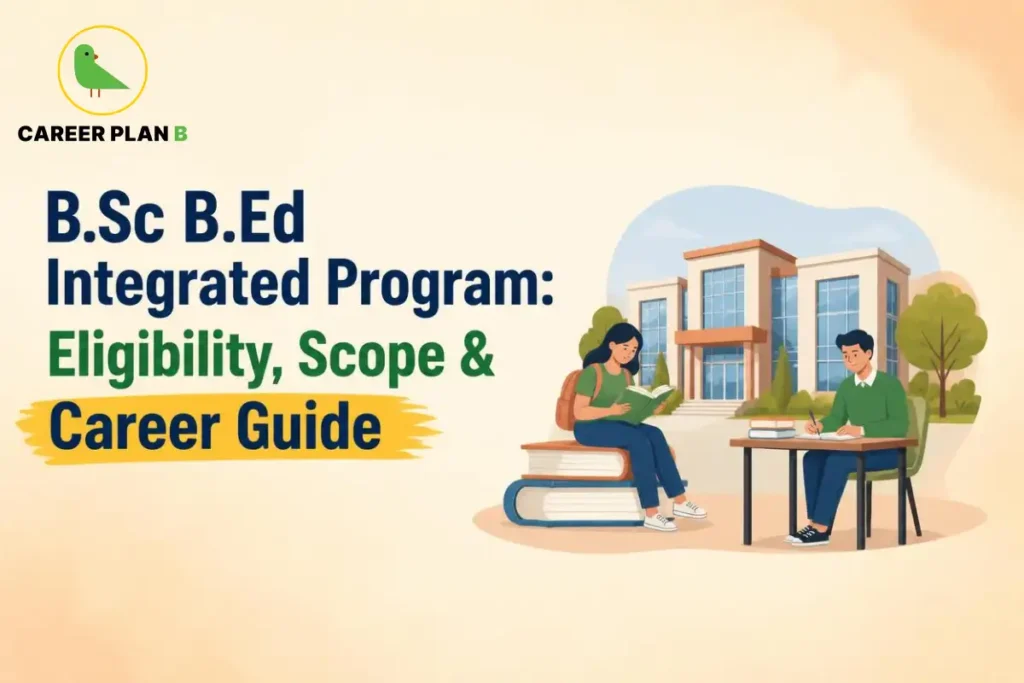
Introduction
Most Science students after Class 12 think only about engineering or medicine. However, a quieter, equally rewarding path exists for those drawn to teaching. The B.Sc B.Ed Integrated Program trains students to become qualified science teachers, all within a single four-year degree.
So, does this integrated route actually make sense compared to studying separately? This guide breaks down eligibility, curriculum, and genuine career scope. By the end, the B.Sc B.Ed Integrated Program will feel like a clear, well-understood choice.
What Exactly Is B.Sc B.Ed Integrated?
B.Sc B.Ed Integrated is a four-year undergraduate programme combining a science degree with professional teacher training. Essentially, students earn two qualifications together, a Bachelor of Science and a Bachelor of Education. This structure sits under the Integrated Teacher Education Programme, introduced as part of NEP 2020 reforms.
Consequently, students save an entire academic year compared to the traditional route. Normally, a separate B.Sc followed by a B.Ed takes five years total. The integrated format compresses this into four years without cutting essential content.
Why Was This Integrated Format Introduced?
The National Council for Teacher Education launched ITEP to reduce fragmentation in teacher training. Additionally, it aims to integrate subject expertise with pedagogy much earlier. As a result, graduates enter classrooms with stronger, more cohesive preparation than the older, disconnected model offered.
For Personalized Guidance
B.Sc B.Ed Integrated Program Course Details: Eligibility and Admission
Eligibility remains fairly consistent across most NCTE-approved institutions. Generally, candidates need Class 12 completion from the Science stream, PCM or PCB, with at least 50 percent marks. Importantly, admission now runs primarily through a dedicated national entrance test
How Does the NCET Admission Process Work?
Most ITEP admissions require a valid NCET scorecard, the National Common Entrance Test conducted specifically for integrated teacher education programmes. Therefore, students must register for NCET separately from other entrance exams like JEE or CUET. Some private universities also accept direct admission based on Class 12 marks alone.
- Minimum marks: Typically 50% in Class 12, PCM or PCB stream
- Entrance requirement: A valid NCET 2026 result card for most participating institutions
- Duration: Four years, spread across eight semesters
- Recognition: Must be NCTE-approved for the degree to hold teaching validity
What Does the B.Sc B.Ed Curriculum Actually Include?
The curriculum blends two genuinely distinct tracks throughout the programme. Here is a simple breakdown of what students typically study:
| Track | Core Subjects | Focus Area |
|---|---|---|
| Science Track | Physics, Chemistry, Biology or Mathematics | Subject depth for future classroom teaching |
| Education Track | Educational Psychology, Pedagogy, Curriculum Planning | Professional teaching skills and classroom management |
| Practical Track | Micro-Teaching, Digital Pedagogy, Teaching Internship | Real classroom exposure and hands-on training |
Notably, the teaching internship carries genuine weight in this programme. Many universities require a rigorous internship spanning several weeks, during which students actively teach and manage real classrooms. This hands-on exposure often matters more to future employers than theoretical grades alone.
Which Subjects Can You Actually Teach After Graduating?
Graduates typically qualify to teach Science or Mathematics at upper primary, secondary, and senior secondary levels. Specifically, this includes Physics, Chemistry, Biology, or Mathematics, depending on the specialisation chosen during the science track of the degree.
Suggested blog:- B.Sc B.Ed Integrated Course – Scope & Career Opportunities
What Are the Real B.Sc B.Ed Career Opportunities?
This is usually the central question for students and parents alike. Fortunately, the answer extends well beyond classroom teaching alone. Graduates find genuine opportunities across several distinct paths.
- Government school teacher – eligible for TGT positions in KVS, NVS, and state government schools after clearing TET or CTET
- Private school teacher – working with reputed schools across secondary and senior secondary levels
- EdTech content creator or instructor – developing curriculum or teaching content for online education platforms
- Curriculum designer – contributing to textbook or syllabus design for education boards and publishers
- Higher education path – pursuing M.Sc in the specialised science subject for research or lecturing roles
How Much Can Graduates Actually Earn?
Starting salaries for private school teachers typically range between three and five and a half lakh rupees annually. However, government sector roles often pay considerably more once selected. For instance, primary and secondary teachers in government schools frequently earn between six and nine lakh rupees annually, though this varies by state and experience.
Is B.Sc B.Ed Better Than Doing B.Sc and B.Ed Separately?
In most cases, yes. The integrated route saves one full academic year while still meeting all NCTE requirements. Furthermore, it provides earlier classroom exposure through built-in internships, something the traditional, separated route often delivers much later.
Are There Any Genuine Downsides to Consider?
Since ITEP is still a relatively new programme, awareness and seat availability remain limited compared to traditional degrees. Therefore, always confirm that your shortlisted institution is genuinely NCTE-approved and actively running the programme before applying.
Should You Actually Choose This Path?
B.Sc B.Ed suits students who genuinely enjoy science and also feel drawn to teaching and mentoring others. However, success in this field demands patience, communication skill, and comfort with classroom management, not just subject knowledge alone.
- Confirm your NCET readiness, since most reputed institutions now require this scorecard for admission
- Verify NCTE approval for any shortlisted college before applying, since this affects your future teaching eligibility
- Reflect honestly on your interest in mentoring, since genuine enjoyment of teaching matters more than subject scores alone
- Research placement support specifically for teaching roles, not just general college placement statistics
A Word of Caution Before You Apply
Always verify a university’s NCTE recognition directly through the NCTE official website, and confirm current NCET admission timelines and eligibility through the official NCET portal before finalising your application.
How Career Plan B Helps
Deciding whether a dedicated teaching path like the B.Sc B.Ed Integrated Program genuinely fits you takes more than family opinion alone.This is where Career Plan B can help by offering:
- Personalised Career Counselling: Provides expert guidance based on individual interests, skills, and career goals, helping students judge if a science and teaching combination genuinely fits them.
- Psychometric & Career Assessment Tests: Identifies strengths, personality traits, and suitable career opportunities, useful for confirming genuine aptitude for mentoring and classroom teaching.
- Career Roadmapping: Creates a clear step-by-step plan to achieve academic and professional goals, including which science specialisation to pursue within the programme.
- Admission & Academic Profile Guidance: Helps in selecting the right courses and colleges and improving academic profiles, so NCET preparation stays genuinely focused and effective.
Get In Touch With Us
Frequently Asked Questions
1. What is the eligibility for B.Sc B.Ed Integrated Program?
Most institutions require Class 12 completion in the Science stream, PCM or PCB, with at least 50 percent marks, along with a valid NCET scorecard for admission.
2. Is NCET mandatory for B.Sc B.Ed admission?
No, For most NCTE-approved institutions offering this programme under ITEP, yes, a valid NCET result card is required for admission.
3. What are the main B.Sc B.Ed career opportunities after graduation?
Graduates commonly work as government or private school teachers, EdTech content creators, curriculum designers, or pursue higher studies through M.Sc programmes.
4. Is B.Sc B.Ed valid for government teaching jobs?
Yes, since it is NCTE-recognised, graduates qualify to appear for TET, CTET, or state-level teacher eligibility tests required for government teaching positions.
5. Can I pursue M.Sc after completing B.Sc B.Ed?
Yes, graduates can pursue an M.Sc in the science subject they specialised in during the programme, opening doors to research or lecturing careers.
Conclusion
The B.Sc B.Ed Integrated Program offers a genuinely efficient path for students who want both scientific depth and a real teaching career. For those drawn to mentoring young minds while staying rooted in science, this four-year investment builds a stable, respected, and increasingly in-demand career.
If you are still weighing this path against other science-based options, thoughtful guidance can bring real clarity before you commit. The right decision now shapes a career that stays meaningful for decades. Talk to a Career Plan B counsellor today to see if B.Sc B.Ed is the right fit for you.