Team6 · October 7, 2026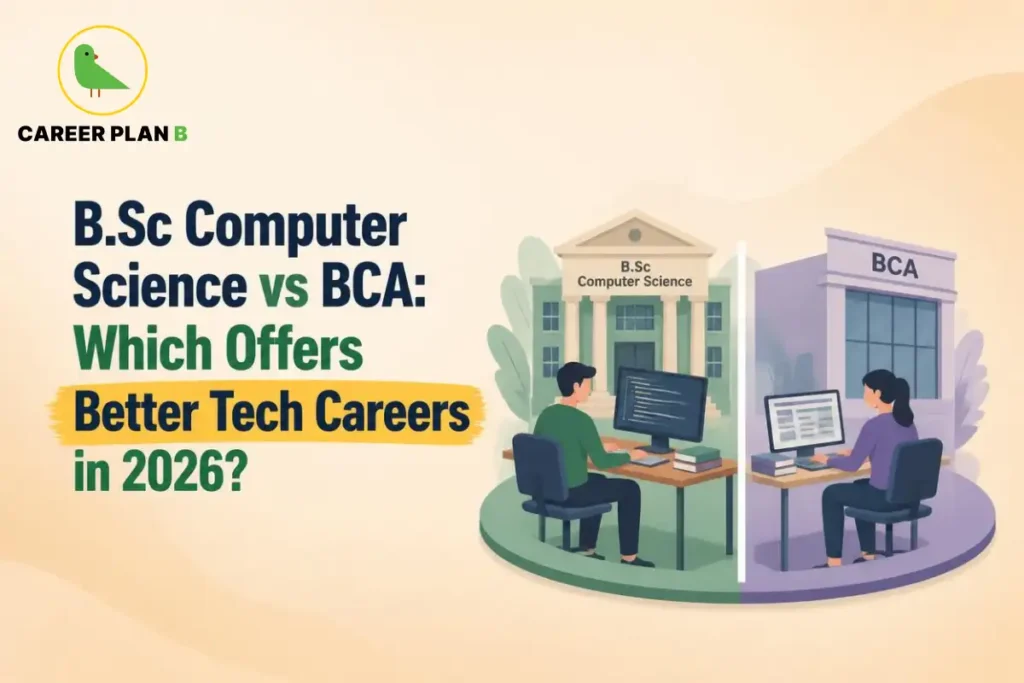
Introduction
Two degrees, both three years, both landing you squarely in the tech industry, yet B.Sc Computer Science vs BCA is one of the most persistently confusing comparisons students face after Class 12. The honest answer isn’t that one is definitively better; it’s that they emphasize genuinely different things, and understanding that difference matters more than chasing whichever title sounds more technical.
This guide breaks down the real curriculum distinctions, honest career scope, and salary expectations for both degrees, so your choice rests on genuine fit rather than assumption.
What Each Degree Actually Emphasizes
B.Sc Computer Science leans toward theoretical computer science: algorithms, data structures, computational theory, and mathematical foundations underlying software and systems design, typically with a more rigorous, academically oriented curriculum. BCA, Bachelor of Computer Applications, leans more toward applied, practical software development: programming languages, application development, database management, and web technologies, generally with less theoretical depth but more hands-on, industry-application focus from earlier in the degree. Both fall under the same broader UGC undergraduate degree framework, giving institutions flexibility in exact curriculum design (source: ugc.gov.in), which is precisely why the exact balance between theory and application can vary somewhat by specific college.
B.Sc Computer Science Career Scope: Where Theory-Heavy Training Leads
B.Sc Computer Science Career Scope tends to open doors toward roles requiring deeper computational understanding: software engineering roles at companies building complex, performance-critical systems, roles requiring strong algorithmic thinking like backend engineering or systems programming, and a smoother path toward postgraduate study, an M.Sc or even research-oriented master’s programmes abroad, given the degree’s stronger theoretical foundation. Graduates who want to eventually specialize in areas like machine learning research or systems architecture often find this theoretical grounding genuinely valuable later in their careers, even if entry-level roles look similar to a BCA graduate’s options initially.
Read more:- Best Job-Oriented Courses After BSc: Top Picks to Supercharge Your Career
BCA vs B.Sc Computer Science Salary: An Honest, Grounded Comparison
Here’s where direct honesty matters more than a confident number: there’s no single, government-published dataset comparing BCA vs B.Sc Computer Science Salary as a standardized national category. Real compensation depends far more on your specific institution, individual skill and project portfolio, and the specific company and role you land, than on which of these two degree titles you hold. Entry-level salaries at similar-tier institutions and companies tend to land in comparable ranges for both degrees, with meaningful divergence emerging later based on specialization and additional skill-building, certifications, advanced coursework, or a relevant master’s degree, rather than the undergraduate degree title alone.
Have Any Doubts?
Best Computer Course After 12th: How to Actually Decide
Determining the Best Computer Course After 12th for your specific situation comes down to a few honest questions rather than trusting either degree’s general reputation. Are you drawn to understanding how things work at a deeper, more mathematical level, or do you want to start building deployable applications as quickly as possible? Do you see graduate study or research in your future, which favors B.Sc Computer Science’s theoretical grounding, or do you want to enter the workforce with immediately marketable practical skills, which BCA typically emphasizes earlier? Neither answer is wrong; they simply point toward genuinely different, equally legitimate paths.
B.Sc Computer Science vs BCA Admission 2026: What to Expect
For B.Sc Computer Science vs BCA Admission 2026, both degrees generally require a Class 12 pass, with B.Sc Computer Science more commonly requiring Physics, Chemistry, and Mathematics specifically, while BCA eligibility is often somewhat more flexible, sometimes accepting Mathematics or Computer Science as the key required subject rather than mandating the full PCM combination. Admission processes vary by institution: some admit through Class 12 merit directly, others through CUET UG scores at participating universities, and some private institutions run their own entrance tests. Always verify your specific target institution’s exact eligibility and admission route directly.
How Career Plan B Helps
Choosing correctly between B.Sc Computer Science and BCA, based on genuine curriculum fit rather than assumed prestige, takes honest self-assessment alongside real research.
- Personalized Career Counselling: Helps you evaluate whether B.Sc Computer Science’s theoretical depth or BCA’s applied focus genuinely fits your goals.
- Psychometric & Career Assessment Tests: Identifies whether you’re drawn to deeper theoretical understanding or immediate, practical application-building.
- Career Roadmapping: Builds a realistic plan connecting your chosen degree to genuine career or postgraduate study outcomes.
- Admission & Academic Profile Guidance: Supports you in verifying specific institutions’ curriculum depth and admission requirements for both options.
Get In Touch With Us
Frequently Asked Questions
1. Is B.Sc Computer Science genuinely harder than BCA?
It’s typically more theoretically demanding, with heavier emphasis on mathematics and computational theory, though “harder” depends on your own strengths; BCA’s applied focus brings its own genuine challenges too.
2. Which degree is better for pursuing an M.Tech or research career later?
B.Sc Computer Science generally provides a smoother path, given its stronger theoretical and mathematical foundation, though strong BCA graduates can also pursue further technical study with additional preparation.
3. Does BCA vs B.Sc Computer Science Salary really differ significantly at the entry level?
Not dramatically at comparable institutions and companies; meaningful salary divergence typically emerges later based on specialization and additional skill-building rather than the undergraduate degree title alone.
4. Is BCA a “lesser” degree compared to B.Sc Computer Science?
No. They’re differently oriented, not hierarchically ranked; BCA’s applied focus is a genuine strength for students wanting immediately deployable practical skills.
5. What eligibility differs most between B.Sc Computer Science vs BCA Admission 2026?
B.Sc Computer Science more commonly requires the full Physics-Chemistry-Mathematics combination, while BCA eligibility is often somewhat more flexible regarding specific Class 12 subjects.
Conclusion
B.Sc Computer Science vs BCA comes down to genuine curriculum emphasis, theoretical depth versus applied, practical training, rather than one degree being objectively superior to the other. Your honest answer to whether you’re drawn to deeper computational theory or immediate application-building should guide this choice far more than either degree’s general reputation.
Research your specific target institutions’ actual curriculum balance before deciding, and choose based on genuine fit rather than assumed prestige. If you’d like help figuring out which path suits you better, Career Plan B’s counsellors are ready to guide you through it.