Careerplanb · November 2, 2026
Introduction
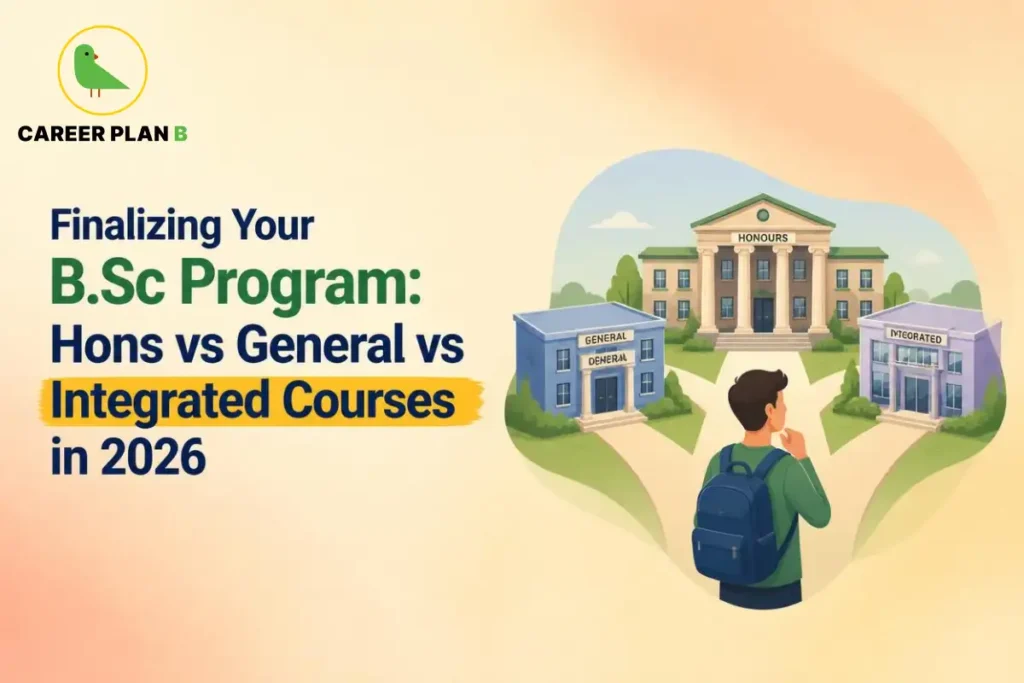
Filling out your admission form and staring at three nearly identical-sounding options, Honours, General, and Integrated, is a genuinely confusing moment for most students. The BSc Hons vs General vs Integrated decision isn’t just about a fancier-sounding label; it’s built on an actual credit and duration framework set by India’s higher education regulator.
This guide breaks down exactly how that official framework works, so your BSc Hons vs General vs Integrated choice is based on real structure, not guesswork or which option “sounds better” on a resume.
The Official Framework Behind These Three Options
Since the rollout of the National Education Policy 2020, the University Grants Commission has implemented what it calls the Curriculum and Credit Framework for Undergraduate Programmes, a flexible, credit-based system with multiple entry and exit points built directly into undergraduate degrees (source: UGC official notification). This single framework is what actually defines the difference between General, Honours, and Integrated BSc pathways, rather than each being a separate, unrelated degree type.
Understanding this framework first makes the rest of the comparison much easier to follow.
BSc Honours vs General: What’s the Real Structural Difference?
The BSc Honours vs General distinction ultimately comes down to duration and credit depth in a single subject. Under the UGC framework, a student can exit with a standard Bachelor’s degree after three years upon completing the prescribed credits, generally around 120 credits under the national framework. Students who continue into a fourth year, going deeper into their chosen major subject, become eligible for the Honours degree instead.
BSc Honours Credits requirements sit meaningfully higher than the General degree, reflecting the additional year of specialized, in-depth study in the major subject. Some universities also offer an “Honours with Research” variant, which requires completing an actual research project in the final year, on top of the standard coursework.
Read more:- BSc + MSc Integrated Programs in India: Benefits, Colleges & Admission
Integrated BSc Course 2026: Where Does It Fit In?
An Integrated BSc Course 2026 typically refers to a combined programme, such as an Integrated BSc-MSc, that merges undergraduate and postgraduate study into a single, continuous track, often completed in four or five years total. Unlike the standard Honours-versus-General distinction within a single UGC framework, integrated programmes are usually designed and approved separately by individual universities or institutes, and function as a distinct academic pathway rather than simply a longer version of the Honours route.
If your goal is eventually pursuing a master’s degree in the same subject, an integrated programme can save time compared to completing a separate BSc followed by a separate MSc application process later.
For Personalized Guidance
UGC Four Year Undergraduate Programme: Multiple Entry and Exit Explained
One of the most practically useful features of the UGC Four Year Undergraduate Programme structure is its built-in flexibility. Rather than a rigid, all-or-nothing commitment, the framework allows for multiple exit points along the way:
| Exit Point | Duration | Credential Awarded |
|---|---|---|
| After Year 1 | 1 year | UG Certificate |
| After Year 2 | 2 years | UG Diploma |
| After Year 3 | 3 years | Bachelor’s Degree |
| After Year 4 | 4 years | Bachelor’s (Honours) Degree |
Students who exit early are also generally permitted to re-enter and complete their degree within a stipulated window, rather than losing their earlier credits entirely.
BSc Multiple Exit Options: What Happens If You Leave Early?
Understanding BSc Multiple Exit Options matters if your circumstances change mid-degree, whether that’s a job opportunity, financial constraints, or a shift in career direction. Under the UGC framework, credits earned at each stage are meant to be preserved and portable, meaning a student who exits after two years with a diploma isn’t simply starting over if they choose to resume later.
This structure is a deliberate departure from the older, rigid three-year-only system, where leaving early typically meant walking away with nothing formally recognized.
So, Which Path Should You Actually Choose?
If you’re not yet certain about specializing deeply in one subject, the standard three-year Bachelor’s route keeps your options genuinely open. Students who already know their preferred subject and want the deeper academic credibility of an Honours degree, particularly for postgraduate study or research-oriented careers, will generally benefit more from the four-year Honours route. Meanwhile, those confident about pursuing a master’s in the same field may find an Integrated programme the most time-efficient option overall.
How Career Plan B Helps
Choosing correctly between BSc Hons vs General vs Integrated depends on where you genuinely see yourself in four or five years, not just which option sounds more prestigious.This is where Career Plan B can help by offering:
- Personalized Career Counselling: Helps you evaluate whether Honours, General, or an Integrated programme genuinely fits your academic and career direction.
- Psychometric & Career Assessment Tests: Identifies whether you’re ready to commit to deep specialization now, or would benefit from the flexibility of a General degree first.
- Career Roadmapping: Builds a realistic plan connecting your BSc structure choice to postgraduate study or your first job.
- Admission & Academic Profile Guidance: Supports you in shortlisting universities that clearly implement the UGC framework’s credit and exit structure.
Get In Touch With Us
Frequently Asked Questions
1. Is a BSc Honours degree considered better than a General BSc?
Not inherently “better,” but it does represent an additional year of deeper specialization, which can matter for postgraduate admissions or research careers.
2. Can I switch from General to Honours partway through my degree?
This depends on your specific university’s implementation of the UGC framework, though the structure is generally designed to allow continuation into the fourth year if eligibility criteria are met.
3. Is an Integrated BSc Course 2026 the same as a BSc Honours with an extra year?
Not exactly. Integrated programmes combine undergraduate and postgraduate study into one continuous track, while Honours is a deeper specialization within the undergraduate degree alone.
4. Do all universities follow the same BSc Honours Credits requirements?
The overall national framework sets broad guidelines, but exact credit requirements can vary slightly by university, so always check your specific institute’s implementation.
Conclusion
The BSc Hons vs General vs Integrated decision isn’t really three unrelated options; it’s one flexible, UGC-designed framework offering different depths and timelines based on your own certainty about your academic direction. Understanding the actual credit and exit structure behind these labels makes the choice far less confusing than it first appears.
Think honestly about how certain you already are about your subject and long-term goals before committing to a path. If you’d like help figuring out which structure genuinely fits you, Career Plan B’s counsellors are ready to guide you through it.