Team6 · October 8, 2026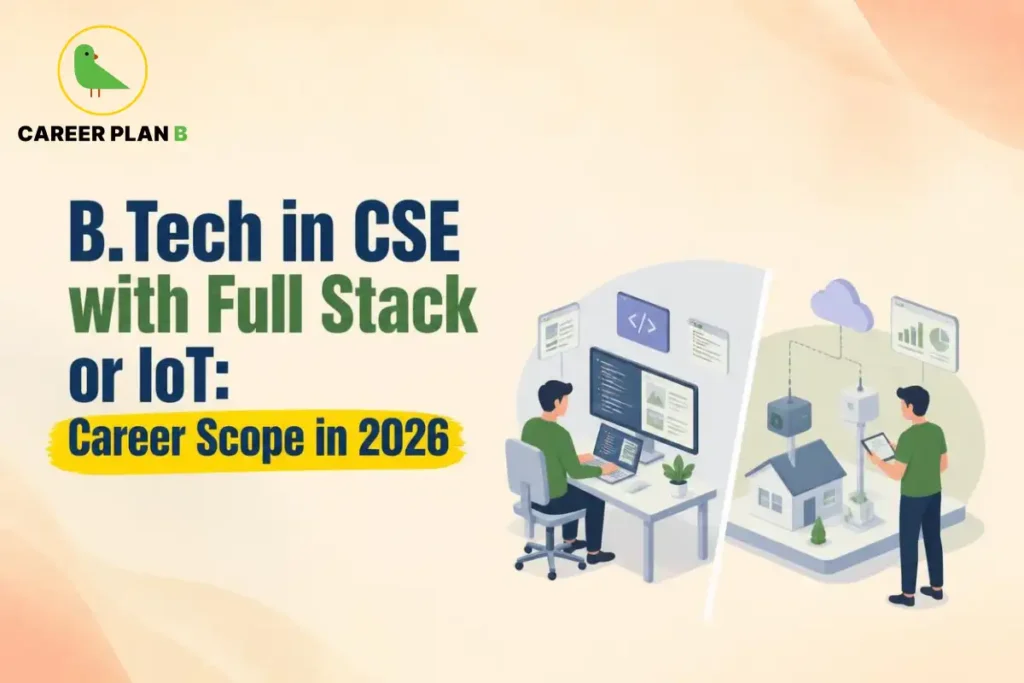
Introduction
Choosing a B.Tech CSE specialization used to mean picking between a handful of familiar tracks, but Full Stack Development and IoT now sit among the most commonly chosen electives, each leading toward genuinely distinct career directions. B.Tech CSE with Full Stack or IoT career scope depends heavily on understanding what each specialization actually trains you for, rather than picking whichever sounds more current.
This guide breaks down both tracks honestly, grounded in real government certification frameworks and policy context where they exist, so your specialization choice rests on genuine understanding rather than trend-chasing.
B.Tech CSE Full Stack Development: What This Track Actually Covers
B.Tech CSE Full Stack Development trains students across both front-end and back-end software development, covering user interface design, server-side logic, database management, and the deployment infrastructure connecting all three layers together. This breadth matters practically: full stack developers can independently build and ship a complete application, rather than depending entirely on a separate specialist for each layer, which is precisely why this skill set remains consistently in demand across startups and larger technology companies alike.
B.Tech CSE IoT Specialization: What This Track Actually Covers
B.Tech CSE IoT Specialization trains students in embedded systems, sensor networks, wireless communication protocols, and the software layer connecting physical devices to cloud-based data processing. This is a genuinely more hardware-adjacent specialization than full stack development, requiring comfort with both software logic and physical device constraints, power consumption, connectivity reliability, and real-world sensor behavior, rather than working purely within a software environment.
India’s IoT sector carries real government policy backing: the Ministry of Electronics and Information Technology has driven IoT-focused initiatives since its 2015 draft IoT policy under the broader Digital India programme, and more recently, established formal security certification frameworks including the IoT System Certification Scheme, operated by the Standardisation Testing and Quality Certification Directorate under MeitY (source: meity.gov.in). This regulatory infrastructure signals a maturing, policy-supported industry, not just a passing technical trend.
Full Stack Developer Career India: Where Graduates Actually Go
Full Stack Developer Career India directions include product engineering roles at technology startups and established companies, where the ability to work across the entire application stack is genuinely valued, freelance and independent contracting work, since full stack skills allow you to take on complete projects rather than needing a team for each layer, and increasingly, technical founder or co-founder roles, given that full stack competency lets you build a minimum viable product independently before hiring a larger team. This versatility is precisely why full stack training remains one of the most consistently practical specializations within CSE.
Have Any Doubts?
IoT Engineer Career Opportunities: Where This Specialization Leads
IoT Engineer Career Opportunities span smart manufacturing and industrial automation, where connected sensors and devices drive real-time operational decisions, smart city infrastructure projects, connecting directly to government initiatives like the Smart Cities Mission, healthcare technology roles building connected medical devices and remote monitoring systems, and automotive and agricultural technology roles, both sectors increasingly investing in IoT-driven efficiency improvements. Given the government’s own stated focus on skilling for agriculture, health, and transportation IoT applications specifically, these sectors represent genuinely policy-supported growth areas for IoT-trained engineers.
Read more:- Career After B.Tech in Gurgaon: Options Beyond IT and Core Engineering
B.Tech CSE Specialization 2026: How to Choose Between the Two
For B.Tech CSE Specialization 2026 decisions, the honest choice comes down to whether you’re drawn to purely software-based problem-solving or genuinely enjoy working at the intersection of hardware and software. Full stack development offers faster, more immediately deployable skills with broad applicability across nearly any software-driven company. IoT specialization offers a more specialized, hardware-adjacent skill set with strong growth tied to specific, policy-supported sectors like smart cities, healthcare technology, and industrial automation, though it generally demands a steeper, more specialized learning curve than full stack development.
How Career Plan B Helps
Choosing between Full Stack and IoT specialization within your B.Tech CSE degree, based on genuine interest and career direction rather than trend appeal, takes honest self-assessment alongside real research.That’s where Career Plan B comes in.
- Personalized Career Counselling: Helps you evaluate whether Full Stack or IoT genuinely aligns with your interests and working style.
- Psychometric & Career Assessment Tests: Identifies whether pure software problem-solving or hardware-software integration work suits you better.
- Career Roadmapping: Builds a realistic plan connecting your chosen specialization to genuine industry entry points and further certifications.
- Admission & Academic Profile Guidance: Supports you in evaluating specific institutions’ curriculum depth for each specialization before you commit.
Get In Touch With Us
Frequently Asked Questions
1. Is Full Stack Development a genuinely recognized, certifiable skill in India, or just an industry term?
Genuinely recognized. An NSQC-approved Full Stack Software Development qualification, developed with IBM, is registered on India’s official National Qualification Register.
2. Is IoT specialization backed by real government policy, or just industry hype?
Genuinely backed. MeitY has driven IoT policy since 2015 under Digital India, and operates formal certification frameworks like the IoT System Certification Scheme today.
3. Which specialization offers more immediate job opportunities, Full Stack or IoT?
Full Stack Development generally offers broader, more immediately applicable opportunities across most software companies, while IoT offers more specialized roles concentrated in specific sectors.
4. Do I need hardware knowledge for a B.Tech CSE IoT Specialization?
Yes, genuinely. IoT specialization requires comfort with embedded systems and physical device constraints, distinctly different from a purely software-focused track like full stack development.
5. Can I pursue both Full Stack and IoT skills within one B.Tech CSE degree?
Many programmes allow elective flexibility to build foundational exposure to both, though genuine depth in either track typically requires focused specialization rather than splitting effort evenly across both.
Conclusion
B.Tech CSE with Full Stack or IoT career scope depends on genuinely different skill sets and industry directions, both backed by real government recognition, a verified NSQC-approved qualification for Full Stack Development and active MeitY policy infrastructure for IoT. Choosing between them should reflect your honest interest in pure software work versus hardware-software integration, not which term sounds more current.
Research your specific target institution’s curriculum depth for whichever specialization genuinely interests you. If you’d like help figuring out which path fits you better, Career Plan B’s counsellors are ready to guide you through it.