Team8 · July 27, 2026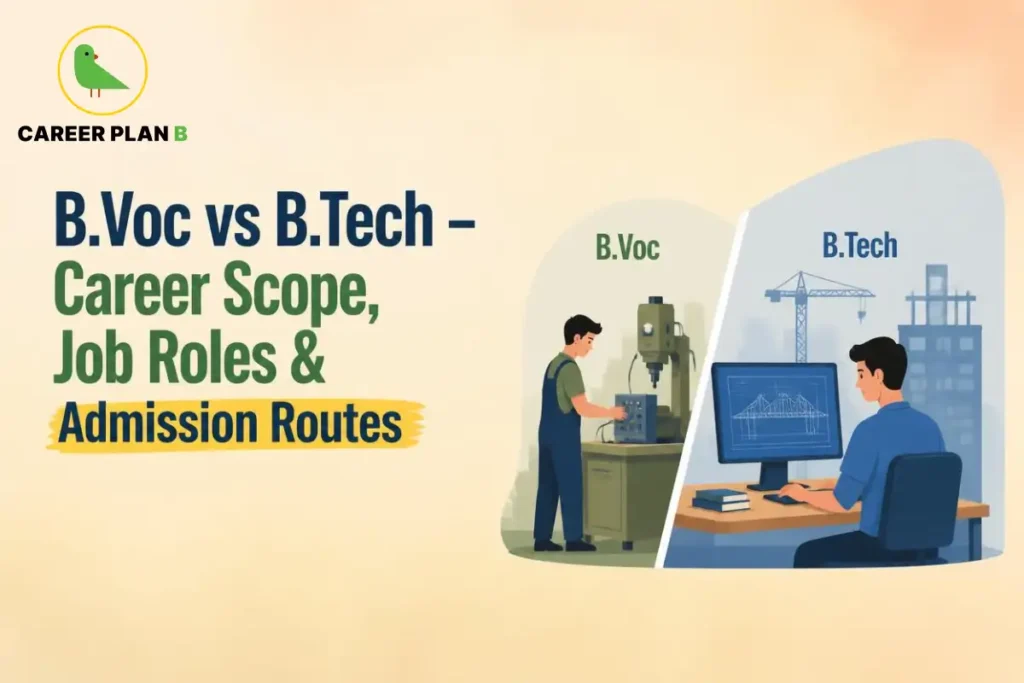
Introduction
Choosing between B.Voc vs B.Tech career scope is about more than selecting a technical degree. Although both programmes prepare students for careers in technology and industry, they are built on different educational approaches. While B.Voc focuses on hands-on, job-role-specific skills and industry training, B.Tech emphasises engineering theory, design principles, and technical problem-solving over four years. Therefore, understanding these differences is essential before making a decision. In this guide, we compare B.Voc vs B.Tech career scope, job roles, admission routes, and future opportunities to help you choose the programme that best matches your career goals.
What B.Voc Course Actually Is
Bachelor of Vocation, introduced under a UGC scheme, integrates specific job-role training — built around National Occupational Standards — directly into a general undergraduate degree. According to UGC’s own guidelines, the skill component carries 60% weightage of total credits, making this a genuinely practice-heavy programme.
Consequently, B.Voc is designed for direct workplace readiness, with built-in exit points at Diploma, Advanced Diploma, and full Degree levels, giving students flexibility if their plans change mid-way.
What B.Tech Course Actually Is
B.Tech, meanwhile, is a rigorous four-year engineering degree covering deep theoretical foundations in mathematics, physics, and specialised engineering domains like mechanical, computer science, or electrical engineering. It typically requires clearing JEE Main, a state CET, or direct admission at AICTE-approved private colleges.
As a result, B.Tech prepares students for roles requiring strong analytical and design-level engineering knowledge, often as a foundation for further specialisation through M.Tech or professional certifications.
Comparing Career Scope: Where Each Degree Actually Leads
B.Voc graduates typically enter industry-specific roles quickly, since their training is built around actual job requirements from day one. Sectors like retail, IT, healthcare support, and manufacturing frequently hire B.Voc graduates directly into operational roles.
B.Tech graduates, however, generally aim for engineering, design, or core technical roles, often requiring campus placements or additional certifications for specialised positions. Consequently, B.Tech tends to open a broader range of senior technical career tracks over time, while B.Voc offers faster, more targeted workforce entry.
Have Any Doubts?
Job Roles: A Direct Comparison
B.Voc graduates commonly move into roles like technical support executive, junior retail operations manager, healthcare support technician, or manufacturing floor supervisor, depending on their specific specialisation.
B.Tech graduates, meanwhile, typically enter as software engineers, design engineers, or core technical analysts, with a clearer pathway toward specialised or research-oriented roles as experience builds.
Admission Routes Compared
B.Voc admission requires only a 10+2 pass in any stream, according to UGC’s own eligibility guidelines, making it broadly accessible without any entrance exam.
B.Tech admission, by contrast, generally requires Physics, Chemistry, and Mathematics in Class 12, along with clearing JEE Main, a state CET, or securing a private college seat through direct admission.
Comparison Table: B.Voc vs B.Tech
| Aspect | B.Voc | B.Tech |
|---|---|---|
| Eligibility | 10+2 pass (any stream) | Class 12 with Physics, Chemistry, and Mathematics (PCM) plus entrance exam or direct admission |
| Duration | 3 years with Diploma and Advanced Diploma exit options | 4 years |
| Governing Framework | UGC’s NSQF-integrated vocational education framework | AICTE-regulated engineering education |
| Focus | Job-role-specific skill training with approximately 60% skill-based credits | Theoretical knowledge, engineering fundamentals, and design-oriented learning |
Note: Course structures and eligibility criteria vary by institution. Verify current details directly on each official website.(Source: University Grants Commission, B.Voc guidelines)
How Career Plan B Helps
Choosing between B.Voc’s fast, skill-first entry and B.Tech’s deeper, longer engineering path depends entirely on your specific goals. Career Plan B offers Personalised Career Counselling to help you weigh these two genuinely different tracks.
It also provides Psycheintel and Career Assessment Tests to check whether hands-on job readiness or theoretical engineering depth suits you better. Admission and Academic Profile Guidance and Career Roadmapping then help you plan the right entrance route accordingly.
Get In Touch With Us
Frequently Asked Questions
01. Can I switch from B.Voc to B.Tech later if I change my mind?
This depends on specific university transfer or lateral entry policies, which vary considerably, so verify this directly before assuming it’s straightforward.
02. Is B.Voc a lesser degree compared to B.Tech?
Not lesser, just different in purpose. B.Voc prioritises direct job-role skill training, while B.Tech builds deeper theoretical engineering foundations — both are UGC/AICTE recognised.
03. Does B.Voc require Class 12 Science background?
No. UGC’s own eligibility guidelines state that B.Voc requires only a 10+2 pass in any stream, unlike B.Tech’s PCM requirement.
04. Which degree offers faster job placement?
B.Voc generally offers faster entry into operational, job-role-specific positions, while B.Tech often takes slightly longer but can lead to more specialised senior roles.
05. Can I exit a B.Voc programme early with a lesser qualification?
Yes. B.Voc’s structure specifically allows exit at Diploma or Advanced Diploma level if you choose not to complete the full degree.
Have Any Doubts?
Conclusion
B.Voc and B.Tech genuinely serve different purposes rather than competing directly for the same students. B.Voc offers faster, skill-focused entry into specific job roles, while B.Tech builds deeper engineering theory suited for broader technical career growth over time.
That said, your decision should rest on whether you want quick workforce readiness or a longer, more analytical technical foundation. If you’re unsure which fits you, Career Plan B can help you compare both paths against your actual strengths and goals.
Neither path is the “safer” choice — the right one is simply the one that matches how you actually want to work.