Team2 · June 16, 2026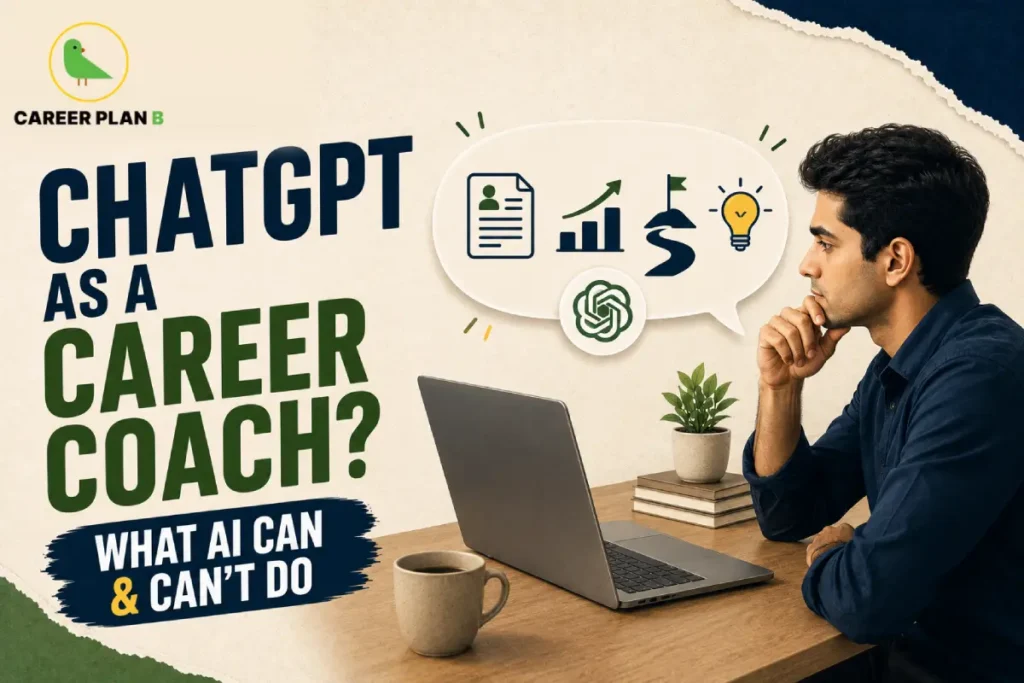
Introduction
It’s 11:47 PM. Your entrance exam results just came in, your parents are asleep, and your mind is spinning — engineering or design? MBA or startup? Delhi or abroad? You open your laptop, type your fears into ChatGPT, and within seconds, you have a five-point career plan sitting in front of you. So the question worth asking right now is: can ChatGPT be a career coach — a real one — for the millions of Indian students turning to it every night when the pressure feels unbearable? It feels like a lifeline. And honestly? You’re not alone.
India is currently the second-largest user base of ChatGPT in the world, with students making up a huge chunk of those millions of daily conversations. The question everyone — students, parents, even counselors — is now quietly asking is: “Why pay for guidance when ChatGPT is free?” When you look closely at the standard career counselling cost in India, it’s a fair question—and it deserves an equally fair, honest answer. And it deserves an equally fair, honest answer.
What ChatGPT Actually Does Really Well (And We Mean It)
Let’s give credit where it’s genuinely due. ChatGPT is not a gimmick. For certain career-related tasks, it is remarkably capable and pretending otherwise would be doing you a disservice.
CV and Cover Letter Drafting
Staring at a blank resume is a rite of passage nobody enjoys. ChatGPT can help you break that paralysis. Feed it your experience, the job description, and a few bullet points about yourself, and it will return a structured, readable draft in under a minute. It won’t replace your voice but it’ll give you a starting point that would’ve taken hours on your own.
Researching Roles and Industries
Want to understand what a UX researcher actually does day-to-day? Curious about the difference between investment banking and corporate finance? ChatGPT can break down job roles, salary ranges, required skills, and industry trends in plain language — no jargon, no gatekeeping. Think of it as a very well-read friend who has skimmed thousands of job descriptions.
Mock Interview Practice
This one is genuinely underutilised. You can ask ChatGPT to play interviewer for a specific company or role, ask you HR questions, behavioural questions, even case study rounds and then critique your responses. For students who feel nervous about interviews, practising with a non-judgemental AI at 2 AM has real value.
Exploring Options You Didn’t Know Existed
Many students in India grow up with a mental map of about 10–12 “acceptable” careers. ChatGPT can quietly expand that map introducing you to fields like computational biology, urban planning, ESG consulting, or UX writing that your school counsellor may never have mentioned.
So yes for tasks, ChatGPT is a genuinely useful tool. The problem begins when you start treating tasks as decisions.
Where ChatGPT Quietly Fails You
Here’s the part that doesn’t get talked about enough.
1. It Doesn’t Actually Know You
ChatGPT only knows what you share in a single conversation. It has no way of seeing that you’ve been quietly dreading the engineering path chosen for you since Class 9. Maybe your only internship interview ended with you freezing up from anxiety rather than a lack of preparation. Those experiences sit outside the prompt box. It cannot hold your full history or fully understand what you’re leaving unsaid.
2. Confidence Doesn’t Guarantee Accuracy
One of the most important things to understand about AI is that it can be wrong while sounding completely certain. OpenAI has publicly acknowledged that language models can “hallucinate” — generating information that sounds plausible but isn’t accurate. For low-stakes tasks like improving a resume bullet point, that’s manageable. But when you’re asking about entrance exams, admission criteria, cut-off trends, or scholarship eligibility, a confident mistake can have real consequences.
3. A Global Tool in a Local Context
The Indian career landscape is shaped by realities that are difficult for AI to fully understand: family expectations, the UPSC-versus-private-sector debate, the pressure of JEE and NEET rankings, the stigma around taking a gap year, and the different opportunities available across cities and regions. AI often applies global frameworks to uniquely Indian situations, which can miss important nuances.
That’s why platforms like the National Career Service (NCS) Portal exist — to connect students with verified guidance, vocational support, and local career resources.
4. Some Decisions Need More Than Information
Career choices in India are rarely just about jobs. They’re tied to family sacrifice, financial concerns, social expectations, and personal identity. When a student says, “I want to study design, but my parents want engineering,” AI can offer balanced advice. What it cannot do is truly understand the emotions underneath that conflict or help navigate them with human empathy and judgment.
Have Any Doubts?
The “Output vs. Outcome” Problem
This is the distinction that matters most, and almost nobody talks about it clearly enough.
ChatGPT gives you output — a resume, a list of career options, a mock interview question, a summary of what data scientists do.
A career counsellor helps you reach an outcome — a decision you feel confident in, that is grounded in who you actually are, that you can explain to your parents, that accounts for your strengths and your patterns of self-sabotage, and that you will still feel okay about six months from now.
Think of it this way: a GPS gives you a route. But a friend who knows you, knows the city, and knows that you always second-guess yourself at the last junction that friend gives you something a GPS never can. The route is the same. The journey is completely different. Information is not the same as guidance. And guidance is not the same as a decision. ChatGPT can get you to step one. The real work begins at step two.
Same Question. Two Very Different Answers.
Let’s make this concrete. Imagine a 22-year-old student — let’s call her Rhea who has just finished her B.Com and is wondering whether to pursue an MBA or a CFA.
Rhea asks ChatGPT: She gets a well-structured comparison: MBA pros and cons, CFA pros and cons, salary benchmarks, time commitment, recommended institutes. It’s accurate, well-formatted, and genuinely informative. In under 60 seconds, Rhea has a document she can show her parents.
Rhea speaks to a CareerPlanB counsellor: The counsellor asks her what she enjoyed most in her B.Com — not what she scored highest in. They ask what her parents’ financial situation looks like, knowing that a two-year MBA carries very different costs and commitments than a self-study CFA. Then they notice something else: when Rhea talks about finance, her energy drops, but when she mentions her marketing internship, she comes alive. That becomes the next thread to explore. Twenty minutes later, Rhea isn’t choosing between an MBA and a CFA. She’s exploring a completely different question: Is finance even the path she wants, or is it the path that was chosen for her? Same initial question. Completely different conversation. Completely different outcome. That’s the gap. And it’s not a small one.
The Hybrid Approach: Use Both, But Know the Difference
Here’s the honest truth — the goal is not to replace AI, nor to dismiss it. The goal is to use it wisely.
Use ChatGPT for:
- First-draft resumes and cover letters (then get them reviewed)
- Researching industries, roles, and companies
- Practising interview answers before a real session
- Understanding concepts — what is a CTC? What does a product manager do?
- Breaking the blank-page paralysis at the start of any career task
Use a career counsellor for:
- Deciding which path to pursue, not just how to pursue it
- Understanding your own strengths, values, and patterns
- Navigating family pressure and identity conflicts around career
- India-specific guidance: exams, cut-offs, market demand by sector and city
- Accountability — someone who will follow up, remember what you said, and hold you to your plan
The NITI Aayog’s FrontierTech initiative has recognised this exact balance that AI in career guidance works best when it complements human mentorship rather than replacing it, particularly for students in diverse, underserved contexts across India. That’s not a criticism of AI. That’s just an honest reading of what it can and cannot do.
How Career Plan B Helps
There’s something quietly important about the not-for-profit model in career counselling and it’s worth naming directly.
When career guidance is profit-driven, there’s often a pressure (conscious or not) to keep students engaged, to recommend premium programs, or to steer them toward options that generate referral revenue. A not-for-profit counsellor has none of those incentives. Their only metric of success is whether you made a better decision for yourself.
Paired with free AI tools that you can access any time of day, this creates a genuinely powerful combination. Use ChatGPT to come in prepared — research done, options listed, questions ready. Then, using specialized career counselling for working professionals or students, utilize your live session to pressure-test those options against reality, your values, and your actual situation.
You shouldn’t have to choose between access and quality. You shouldn’t have to choose between affordable and trustworthy. That’s the gap that accessible, not-for-profit career counselling exists to fill and it’s the gap that no AI tool, however advanced, has been built to close.
Get In Touch With Us
Frequently Asked Questions
Q1: Can ChatGPT actually be a career coach for serious career decisions?
For surface-level tasks like resume formatting or interview prep, yes. For decisions involving identity, values, and career direction where self-awareness matters more than information — AI consistently falls short of what a human counsellor provides.
Q2: What can ChatGPT career advice do well, and where does it break down?
ChatGPT is strong at generating options, drafting documents, and answering factual questions. It breaks down when the real problem isn’t information but clarity understanding your own motivations, blind spots, and what you actually want.
Q3: Is AI career counselling in India a reliable substitute for professional guidance?
Not yet. AI can simulate a conversation but can’t assess you. It has no way to challenge your assumptions, read between the lines of what you’re saying, or bring experience from working with hundreds of professionals in similar situations.
Q4: Why do people turn to ChatGPT for career advice in the first place?
Mostly accessibility and cost — it’s instant, free, and non-judgmental. But the same qualities that make it comfortable also make it limited; it tells you what you want to hear far more often than what you need to hear.
Q5: When should I choose an AI vs career counsellor for my situation?
Use AI for research, preparation, and drafting. Choose a career counsellor when the decision is high-stakes, emotionally loaded, or when you’ve been going in circles with the same question for months without resolution.
Conclusion
ChatGPT is a genuinely impressive tool, and students who learn to use it well will have a real advantage in researching options, drafting applications, and preparing for interviews. That’s not up for debate. What is up for debate is the idea that having access to information is the same thing as having a career plan. It isn’t and mistaking one for the other is one of the most common and costly errors students make.
The best career decisions aren’t made by the student with the most information. They’re made by the student who has processed that information with honesty, self-awareness, and the right questions asked by the right person at the right time. That’s what a counsellor is for and that’s what no prompt, however cleverly worded, can fully replace.