Team2 · August 25, 2026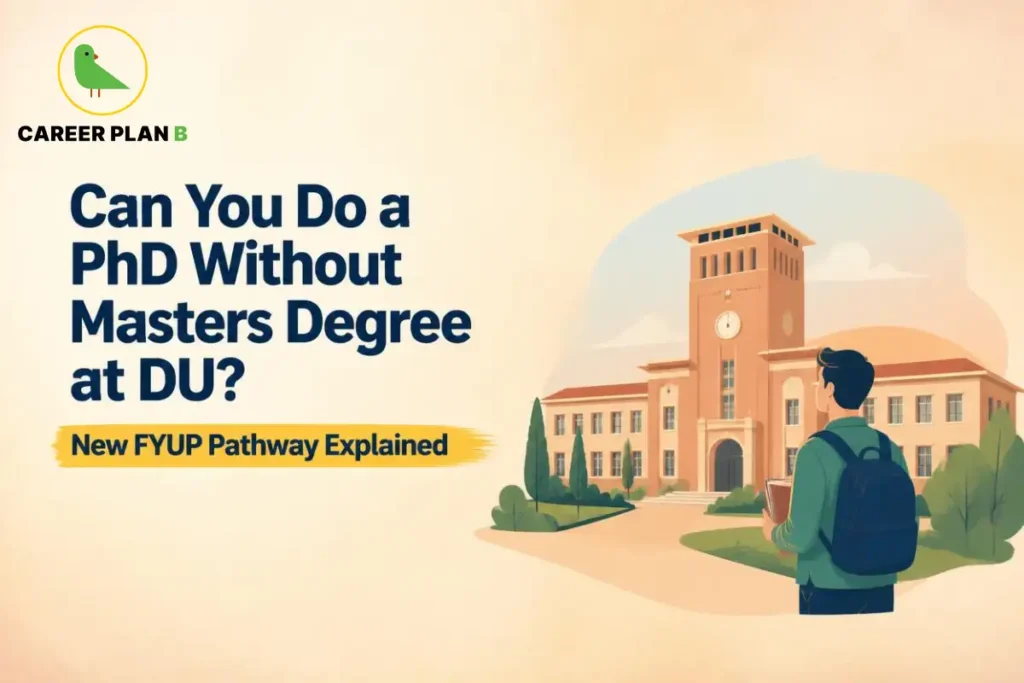
Introduction
Securing admission into a doctoral program traditionally required completing both an undergraduate degree and a two-year master’s program. However, higher education reforms in India have introduced flexible multi-entry and multi-exit academic frameworks.
Students can now explore a PhD without masters requirement directly following an four-year undergraduate program. The University of Delhi (DU) has aligned its ordinances to allow eligible Four-Year Undergraduate Programme (FYUP) graduates to enter doctoral research.
Navigating the DU FYUP to PhD pathway helps high-achieving scholars save time and accelerate their research careers. This guide explains the national regulations, DU-specific criteria, entrance exam rules, and critical career considerations for 2026.
UGC Framework for Direct PhD Admission After 4-Year Bachelor’s
The primary national foundation for direct doctoral entry is the UGC (Minimum Standards and Procedure for Award of Ph.D. Degree) Regulations, 2022. Notified on November 7, 2022, these guidelines align with the vision of the National Education Policy (NEP 2020).
Under these rules, pursuing a PhD after undergraduate degree completion requires completing an accredited four-year or eight-semester bachelor’s degree. The UGC framework specifies that candidates entering through this route must secure at least 75% aggregate marks or an equivalent grade.
A relaxation of 5% marks (or equivalent grade) is allowed for SC, ST, OBC-NCL, EWS, and differently-abled candidates. This framework proves that a PhD without masters in India is legally valid across recognized higher education institutes.
Official UGC regulations can be reviewed directly on the University Grants Commission (UGC) portal. Policy background details are available on the Ministry of Education (MoE) portal.
Understanding Delhi University Direct PhD without Masters Admission 2026
To implement national reforms, DU amended its research ordinances through Academic Council and Executive Council approvals. This established a dedicated FYUP graduates PhD pathway for qualifying scholars.
Under the Delhi University direct PhD 2026 framework, FYUP graduates completing their fourth year with research can apply directly for doctoral programs. DU’s Academic Affairs framework highlights that the optional fourth year strengthens undergraduate research, skill enhancement, internships, and entrepreneurship.
To qualify for DU direct PhD admission FYUP rounds, General, OBC, and EWS candidates must achieve a minimum CGPA of 7.5 out of 10. Reserved category candidates (SC, ST, PwD) receive relaxation, requiring a minimum CGPA threshold of 7.0 out of 10.
Official university ordinances and research notices can be verified directly on the University of Delhi Official Portal.
Does FYUP Eligibility Guarantee Direct PhD Admission?
Meeting minimum CGPA thresholds establishes basic eligibility, but it does not guarantee automatic admission into a doctoral department. Having the required marks grants authorization to participate in the university’s official selection process.
For the Delhi University PhD without masters cycle, eligible candidates must sit for a mandatory written entrance examination. However, as a special inaugural measure for the first batch, university authorities indicated that the traditional oral interview requirement will not apply.
Additionally, while an earlier Academic Council proposal contemplated strict publication criteria, the university relaxed publication requirements for the inaugural FYUP cohort. Evaluating these departmental rules clarifies the overall Delhi University PhD eligibility criteria for direct applicants.
Candidates evaluating whether a PhD without PG degree fits their profile must remember that individual departments notify final seat intake numbers.
FYUP Retention Statistics & Postgraduate Options
Analyzing student choices highlights how undergraduate cohorts have responded to the four-year degree structure. Out of 75,948 students initially admitted to DU’s inaugural FYUP batch in 2022-23, exactly 40,005 students chose to exit after three years in 2025.
Meanwhile, exactly 35,943 students elected to continue into their fourth year to pursue advanced honors and research training. This cohort represents the primary applicant pool for DU FYUP direct PhD admissions in 2026.
Graduating fourth-year scholars can choose among three broad academic directions:
- One-Year Postgraduate Programmes: DU introduced 1-year PG options, offering 5,857 seats across 46 courses for 2026-27, with 12,111 fourth-year students submitting applications.
- Traditional Two-Year Postgraduate Programmes: Students can opt for standard two-year master’s degrees where advanced subject specialization is desired.
- Direct PhD Pathway: High-performing fourth-year graduates meeting CGPA cutoffs can enter doctoral research directly.
Transitioning through a 4 year degree to PhD route enables high-achieving scholars to directly convert undergraduate dissertations into doctoral research.
Have Any Doubts?
Critical Considerations: One-Time Measure vs Permanent Model
While entering a direct PhD after bachelor’s degree offers clear speed advantages, students must evaluate long-term career implications. DU administrators designated the direct admission route for the 2026-27 session as a special measure for its inaugural FYUP batch, leaving its permanent implementation unconfirmed.
Pursuing a direct PhD without master’s qualifications requires candidates to consider future academic employment norms. Certain teaching positions or international postdoctoral fellowships still specify a formal master’s degree in their eligibility rules.
Academic critics have also raised questions regarding whether students moving directly from undergraduate studies possess sufficient research depth. Furthermore, students entering a PhD after a 4 year bachelor’s degree must ensure they meet external fellowship criteria, such as UGC NET eligibility guidelines.
Candidates evaluating whether a PhD without postgraduate degree fits their goals should balance time savings against future credential flexibility. Choosing a direct PhD admission after graduation remains ideal for candidates clear about pursuing full-time research or corporate R&D careers.
Operational Summary Matrix: UGC Guidelines vs. DU Direct PhD Rules
The following matrix compares national UGC standards against Delhi University’s specific operational parameters for FYUP graduates in 2026.
| Admission Parameter | National UGC Regulations (2022) | DU Direct PhD Operational Rule (2026–27) | Strategic Candidate Guidance |
|---|---|---|---|
| Qualifying Degree | 4-Year / 8-Semester Bachelor’s Degree | Four-Year Undergraduate Programme (FYUP) | Replaces traditional 2-year Master’s requirement |
| Minimum Academic Benchmark | 75% Aggregate Marks or Equivalent Grade | 7.5 CGPA out of 10 for Unreserved / OBC / EWS | High academic standing required for direct application |
| Category Relaxation | 5% Relaxation for SC / ST / OBC / EWS / PwD | 7.0 CGPA out of 10 for SC / ST / PwD Categories | Relaxation granted under university ordinances |
| Selection Mechanism | Entrance Test (70% weight) + Interview (30% weight) | Written Entrance Test Mandatory; Interview Waived | Entrance test required; oral interview waived for first batch |
| Publication Criteria | As notified by individual institution | Relaxed / Waived for Inaugural FYUP Batch | Research publication mandate relaxed for initial cycle |
| Implementation Scope | Permanent National Eligibility Pathway | Special Measure for Inaugural 2026–27 Cohort | Test case for DU; long-term permanence yet to be settled |
(Source: Operational parameters compiled in alignment with official guidelines published by the University of Delhi and the UGC).
How Career Plan B Helps
Evaluating doctoral research routes, choosing higher education pathways, and planning academic career roadmaps requires strategic guidance. Career Plan B supports graduates through:
- Personalised Career Counselling: Evaluating your CGPA, research interests, and admission probabilities across central universities, IITs, and global doctoral programs.
- PsycheIntel & Career Assessments: Scientific evaluations confirming whether corporate research, academic professorships, or industrial development fit your natural strengths best.
- Customized Admission Guidance: Support navigating direct PhD applications, statement of purpose (SOP) drafting.
- Career Roadmapping: Strategic planning extending beyond doctoral graduation toward postdoctoral fellowships, corporate consulting, and higher education leadership.
Get In Touch With Us
Frequently Asked Questions
Q1. Can you do a PhD without masters degree in India?
Yes, under UGC PhD Regulations 2022, candidates completing a four-year bachelor’s degree with required marks can apply directly for PhD programs without a master’s degree.
Q2. Is a 4 year bachelor’s degree enough for direct PhD admission?
A four-year bachelor’s degree establishes academic eligibility under national UGC rules, but admission remains subject to university selection procedures and department seat intake.
Q3. What is the eligibility for PhD without a master’s degree?
Candidates must complete a recognized four-year bachelor’s degree securing at least 75% aggregate marks (or 7.5 CGPA out of 10 at DU) and pass the prescribed entrance selection process.
Q4. What is the PhD eligibility after a four-year bachelor’s degree for reserved categories at DU?
At Delhi University, SC, ST, and PwD candidates receive relaxation, requiring a minimum CGPA of 7.0 out of 10 in their FYUP four-year degree.
Q5. Can FYUP graduates apply for PhD without Master’s at Delhi University?
Yes, eligible FYUP graduates meeting CGPA cutoffs can apply directly for PhD programs at DU for the 2026-27 cycle by appearing for the mandatory written entrance exam.
Conclusion
Understanding the operational rules behind DU’s FYUP doctoral route proves why evaluating new academic pathways is essential for every graduate. Securing a PhD after bachelor’s degree completion allows high-performing students to save time and begin full-time doctoral research earlier.
Remember that reviewing official university ordinances protects your application from unexpected procedural shifts. Preparing thoroughly for the written entrance exam ensures a smooth transition into doctoral research.
Developing a clear academic roadmap ensures you maximize the benefits of direct doctoral entry. Connect with Career Plan B today to build a personalized academic career roadmap tailored to your long-term goals.