Careerplanb · June 30, 2026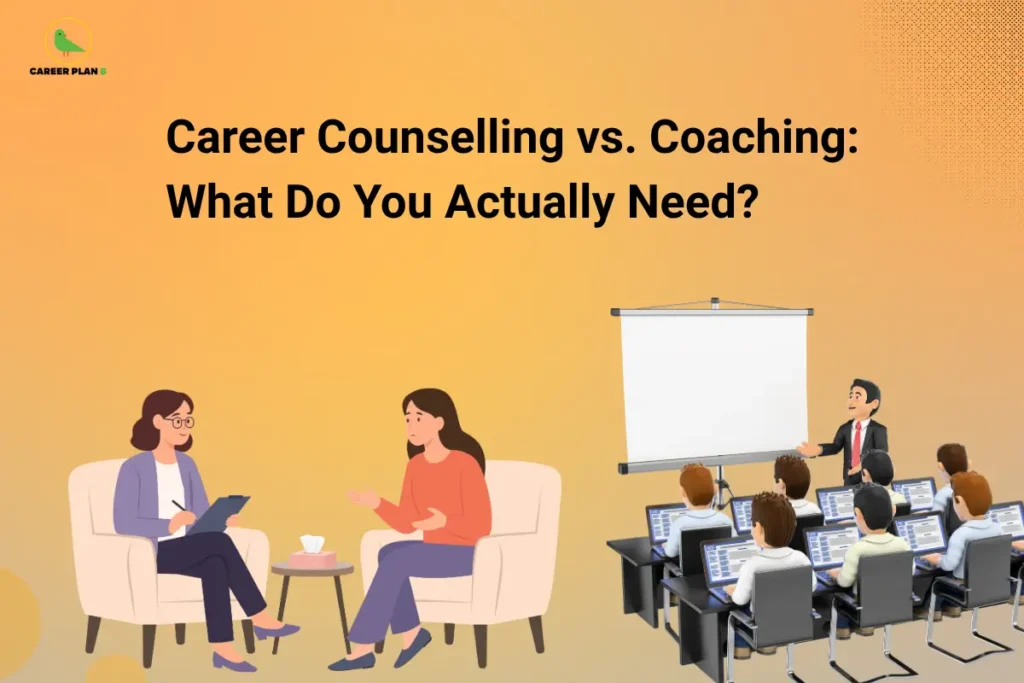
Introduction
Imagine you are standing at a crossroads. One path feels familiar but wrong. The other looks promising but is blurry. You know you need help, but you are not even sure what kind of help to ask for. This is exactly where millions of Indians find themselves every year, and it is precisely where the confusion between career counselling vs. coaching begins.
The two terms are often used as though they mean the same thing. They do not. And choosing the wrong kind of support or going in without understanding what you actually need can mean spending real time and money without getting any closer to clarity. According to a WHO and ILO joint policy brief published in 2022, an estimated 12 billion workdays are lost every year globally due to depression and anxiety conditions that poor career fit and chronic professional confusion directly feed into. In India, the scale of career confusion is striking: surveys indicate that nearly 70% of Indian students and professionals feel uncertain about their career path.
When the confusion runs this deep, the question of whether you need counselling or coaching is not a small one. Getting it right could change everything.
They sound the same. They Are Not.
Here is the simplest way to think about it.
Career counselling is about understanding who you are before deciding what you should do. It works from the inside out. It asks, ‘What are your genuine interests?’ What are you actually good at, not just what you have been told you are good at? What kind of life do you want, and what do your personality, your emotional pattern, and your values suggest about the career that would suit you? Counselling slows down. It explores. It often uncovers things the person did not know about themselves.
Career coaching, on the other hand, typically starts from a position of relative self-awareness. The person already knows, broadly, what they want or at least which direction they are facing. Coaching asks: How do you get there more effectively? What skills do you need to build? What habits are holding you back? And what is your action plan for the next six months? Coaching moves forward. It is goal-oriented, structured, and outcome-focused.
The two are not in competition. They are simply designed for different moments in a person’s career journey.
Confused about your next steps? Get a personalized roadmap tailored to your career goals.
The Real Difference: Where You Are Right Now
The most reliable way to understand which one you need is to be honest about where you are right now, not where you think you should be.
If you are a student who genuinely does not know what stream, course, or career direction feels right, if you are picking subjects based on pressure, peer choice, or parental expectation rather than any real sense of yourself, you need counselling, not coaching. You cannot be coached toward a destination you have not yet chosen.
If you are a professional who has been in a field for several years and feels stagnant, confused about whether to continue, switch, upskill, or take a break, but has no clear picture of where this discomfort is actually coming from, you need counselling first. The confusion has roots. Coaching over unresolved confusion often produces a very polished plan that leads to the same wrong place, just faster.
If you are a professional who knows exactly what they want – a promotion, a transition to a specific role, building a particular skill, or preparing for a specific exam or interview – and simply needs structure, accountability, and a practical roadmap to get there, coaching is what fits.
The trouble is that very few people in India are in that third category by the time they seek help. Most are still in the first or second. And that is not a failing; it is the honest result of a system that rarely teaches self-awareness alongside academics.
Why This Confusion Is So Common in India
There is a reason so many Indian students and professionals do not know what kind of support they need. The education system, for all its rigour, does not spend much time helping young people understand themselves. Stream choices happen in Class 10; major life decisions happen in Class 12, and by the time someone is 22 or 25 and professionally unhappy, they have spent a decade making important choices based on external signals, marks, peer choices, parental expectations, and societal trends, rather than any honest internal map.
The result is a peculiar kind of confusion: a person who is intelligent, capable, and often high-achieving but genuinely uncertain about what they want, what they are suited for, and whether they are on the right path. That person does not need a coach who will help them execute faster. They need a counsellor who will help them understand more deeply.
A 2024 study by FLAME University noted that while 68% of Indian students report some access to career guidance, a significant proportion receive no structured support whatsoever, and even those who do often receive generic advice rather than anything genuinely personalised to who they are. The National Education Policy 2020 explicitly acknowledges this gap, calling for holistic career guidance as a necessity across educational institutions. The policy intention is clear. The ground reality, for most students, is still far from it.
A Practical Guide: Which One Do You Need?
| Situation | What You Actually Need |
| “I don’t know what career is right for me.” | Career Counselling |
| “I chose my stream under pressure, and I’m not sure it was right.” | Career Counselling |
| “I feel stuck in my job, but I don’t know why.” | Career Counselling |
| “I want to switch careers, but I have no idea what to switch to.” | Career Counselling first, then coaching. |
| “I know I want to move into [specific field]. How do I get there?” | Career Coaching |
| “I want to prepare for a promotion or a specific exam.” | Career Coaching |
| “I need help with my resume, interview skills, or LinkedIn profile.” | Career Coaching |
| “I’m performing well, but I feel unfulfilled – not sure what’s missing.” | Career Counselling |
| “I need accountability and a structured plan to reach a clear goal.” | Career Coaching |
The pattern is consistent. Confusion, identity questions, and misalignment – that is the territory of counselling. Goal clarity, execution, skill-building, and accountability – that is where coaching earns its place.
The Role of Psychometric Assessment in All of This
One thing that distinguishes genuine career counselling from a casual conversation with a well-meaning relative or a senior at work is the use of structured, research-backed psychometric assessments. This is what makes the process reliable rather than impressionistic.
A proper psychometric assessment does not just tell you what job titles might suit you. It maps your aptitude – what you are actually good at, separate from what you have been trained in. It looks at your interest patterns – not just what you enjoy casually, but what genuinely energises you over sustained periods. And it examines your personality and values the kind of work environment, autonomy, collaboration, pace, and purpose that you are most likely to thrive in.
Without this kind of structured self-understanding, even the most well-intentioned counselling remains guesswork. And coaching built on guesswork tends to lead to polished activity in the wrong direction.
This is also why the sequence matters: understand yourself first, then plan. Not the other way around.
When You Might Need Both and in What Order
There is a scenario many people find themselves in, particularly working professionals in their late twenties and early thirties: they have some self-awareness, they broadly know their strengths, but they are at a genuine crossroads and need both clarity and a practical plan.
In this case, the right sequence is almost always counselling first, coaching second.
Start by getting an honest, structured picture of who you are, what you value, and what direction genuinely fits through a counselling process that includes a psychometric assessment. Then, once that direction is clear, use coaching to build the specific skills, habits, networks, and plans that help you move there effectively.
Reversing this sequence, jumping into coaching before counselling when you are still genuinely unclear, is one of the most common and most expensive mistakes people make. You end up with a very well-executed plan for a life you did not fully choose.
A Note for Parents Reading This
If you are a parent reading this on behalf of your child, here is the most important thing to understand: what your child needs first is not a plan. It is a mirror, something that honestly reflects who they are, separate from who you hope they will be or who their school rank suggests they might become.
Career counselling at the right stage, Class 8, 9, or 10, gives students the self-awareness they need to make stream and course decisions from a place of genuine understanding rather than guesswork and pressure. That early investment in clarity saves years of costly misdirection later.
Coaching has its place. But it works best when the person being coached already knows, at least broadly, where they are headed. For most students and many professionals in India, that foundational clarity still needs to be built.
How Career Plan B Helps
Career Plan B has worked with students and professionals for over 15 years across Gurugram, Bengaluru, Kolkata, Pune, Bihar, and Jharkhand, and one of the most consistent patterns they have observed is that people arrive seeking a plan when what they actually need first is understanding.
- Career Counselling for Students helps students from Class 8 upward build genuine self-awareness before making stream, course, or career decisions through a structured process, not guesswork
- Career Counselling for Working Professionals supports professionals who feel stuck, unfulfilled, or genuinely unclear with honest, research-backed guidance that goes well beyond a conversation about job titles
- PsycheIntel Assessment Career Plan B’s proprietary psychometric tool measures aptitude, interests, personality, and values together, giving individuals a research-backed foundation for every career decision that follows
- ManoMitra addresses the emotional dimension of career confusion: the anxiety, fear, and pressure that often sit underneath the surface of what looks like a straightforward career question
- For students specifically, the career counselling for students programme actively includes parents in the process, because the most honest career decisions are made when everyone involved is working from the same understanding
Get In Touch With Us
Frequently Asked Questions
What is the main difference between career counselling and career coaching?
Career counselling focuses on self-understanding, helping you figure out who you are, what suits you, and what direction genuinely fits before making major decisions. Career coaching assumes you already have direction and focuses on helping you move toward a specific goal more effectively. The two serve different needs and work best in sequence: counselling first, coaching second.
Can I go directly to career coaching without career counselling?
You can, but it works well only if you already have genuine clarity about what you want. If you are still confused about direction, values, or what kind of work suits you, coaching will help you execute efficiently toward a goal you have not fully chosen yet, which can be counterproductive.
At what age should career counselling begin in India?
Ideally, structured career counselling should begin around Class 8 or 9, well before stream selection in Class 10. This gives students enough time to understand themselves before making decisions that shape their academic and professional future. Career Plan B’s PsycheIntel Assessment is available from Class 8 onwards precisely for this reason.
Is a psychometric test the same as career counselling?
No, a psychometric test is a tool used within career counselling, not a replacement for it. A test generates data about your aptitude, interests, personality, and values. A counselling process interprets that data, maps it against real-world career options, and helps you build a personalised direction from it. The test alone, without expert interpretation, gives you numbers without meaning.
Can career counselling help working professionals, not just students?
Absolutely. Career confusion does not end at graduation. Many professionals in their late twenties, thirties, and even forties seek counselling when they feel unfulfilled, stagnant, or uncertain about whether to continue in their current field, switch industries, or pursue further education. Career Plan B’s career counselling for working professionals is specifically designed for exactly this stage of life.
Conclusion
Career counselling and coaching are both valuable, but they are not interchangeable, and using one when you actually need the other rarely helps. Counselling gives you the map. Coaching helps you navigate it. Most people need the map first.
In a country where so much of career decision-making still happens under pressure, by default, or through imitation rather than genuine self-understanding, the most important investment you can make is not in a faster plan; it is in an honest, accurate picture of who you are.
The real question worth sitting with is not “Which one should I choose?” It is “Do I actually know myself well enough yet to benefit from either?”