Team Career Plan B · October 8, 2026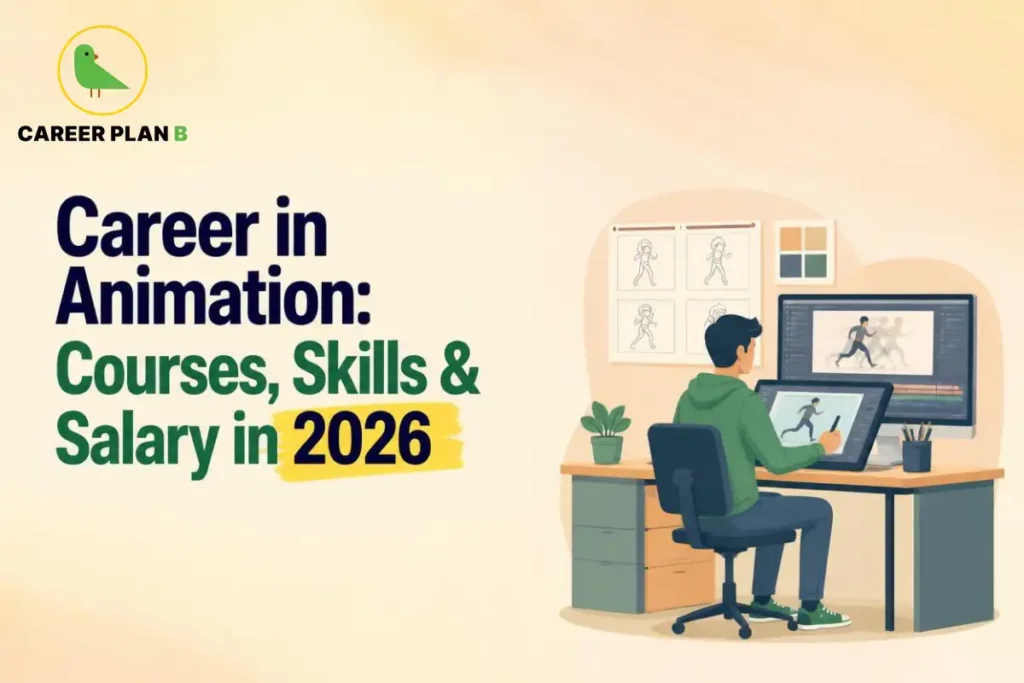
Introduction
Ever watched a cartoon, a video game character, or a movie’s visual effects and wondered who actually brings those frames to life? That’s a career in animation, and right now, it’s one of the most exciting paths a student can choose. From Bollywood blockbusters to mobile games to YouTube explainer videos, animators are quietly powering the content the whole world watches.
If you’re in Class 8 to 12 and you love drawing, storytelling, or just spend hours doodling in the margins of your notebook, this field might be calling your name. A career in animation isn’t just about “cartoons” anymore—it covers film VFX, gaming, advertising, architecture visualization, and even medical illustration.
In this blog, we’ll walk through the courses you can pursue after 12th, the skills that actually matter, what’s known (and not known) about salaries in India, and where the opportunities are heading in 2026 and beyond. Let’s break it all down in a way that actually makes sense for your next steps.
Animation Courses After 12th
There isn’t one single route into animation. Depending on your interests, budget, and location, here are the paths students in India typically consider:
- Government design institutes – The National Institute of Design (NID) offers a Bachelor of Design (B.Des.) with a specialization in Animation Film Design, focused on visual storytelling, character design, and both traditional and digital animation techniques. Entry is through the NID entrance process after Class 12.
- Government film institutes – The Film and Television Institute of India (FTII), Pune, runs certificate-level programmes in Animation & Visual Effects Design, giving students hands-on exposure to industry tools and workflows.
- Private animation and design colleges – Several private institutes across India offer diploma and degree programmes in 2D/3D animation, VFX, and game design. Always verify current fee structures, faculty, and placement claims directly with the institute rather than trusting third-party listings.
- Skill-based certification – Under the Skill India Mission, the Media & Entertainment Skill Council (through NSDC) has defined the “Animator” job role, with standardized National Occupational Standards that shorter, skill-focused training programmes can align to.
Among these, Animation Courses After 12th generally fall into two buckets: full-time degree/diploma programmes (2–4 years) and shorter skill certification courses (a few months to a year). If you’re still in school, it helps to start building a portfolio now—sketch, animate short clips on free software, and enter student competitions.
A quick tip: don’t chase a college purely because of a “best college” ranking you saw online. These rankings are usually made by private education portals, not any government body, so always cross-check facts like eligibility, entrance exams, and curriculum directly on the official website of the institute you’re considering.
Animation Skills You Need to Build
Talent matters, but animation is also a craft you sharpen with practice. Here are the core Animation Skills recruiters and top colleges look for:
- Drawing and observation – Even in a 3D or digital-first world, understanding form, movement, and anatomy through drawing is foundational.
- Storytelling and storyboarding – An animator who can’t tell a story with images is just moving pixels. Storyboarding turns a script into a visual sequence.
- Software proficiency – Familiarity with industry-standard tools (2D animation software, 3D modelling and rendering tools, compositing software) is essential. FTII’s animation programme, for instance, trains students across both 2D tools and advanced 3D and compositing software.
- Timing and motion principles – Concepts like squash and stretch, easing, and weight distribution are what make animation feel alive rather than robotic.
- Collaboration – Animation is rarely a solo job. You’ll work with writers, directors, sound designers, and other animators, so communication and teamwork matter as much as artistic skill.
Building these Animation Skills doesn’t have to wait until college. Many students start with free tutorials, short courses, or school art clubs to get a head start before formal training even begins.
Read more :- Animation, Gaming & E-Sports: Turning Passion Into a Thriving Career
Animation Salary in India
This is the question every parent and student wants answered clearly—and honestly, it’s also where we have to be careful. There is no single official government database that publishes standardized, sector-wide salary figures for animators in India by experience level, city, or studio. Salary can vary hugely based on your specialization (2D vs. 3D vs. VFX vs. game animation), your city, the size of the studio, and whether you work in Indian or international projects.
Rather than quoting an unverifiable number, here’s what we’d recommend instead when researching Animation Salary in India:
- Check job postings for animator, VFX artist, or 3D modeller roles directly on studio and company career pages to see the range they advertise.
- Speak with alumni or seniors from institutes like NID or FTII about their actual placement experiences.
- Attend industry events or webinars where working animators share real insights about entry-level versus experienced pay.
What we can say confidently is that pay tends to rise significantly with specialization and experience—an entry-level 2D animator’s compensation looks very different from a senior VFX supervisor’s. The safest approach is always to verify current numbers directly with employers or institutes rather than relying on numbers floating around online, since these are often outdated or unverified.
Animation Career Opportunities
The good news: Animation Career Opportunities have expanded well beyond just cartoons and films. Here’s where trained animators are finding work today:
| Sector | What Animators Do |
|---|---|
| Film & TV | Character animation, VFX, background art |
| Gaming | Character rigging, motion design, environment animation |
| Advertising | Explainer videos, animated ad campaigns |
| Ed-tech | Animated learning content, e-learning modules |
| Architecture & Product Design | 3D walkthroughs and visualizations |
| Healthcare | Medical and scientific animation for training |
Graduates from programmes like NID’s Animation Film Design discipline have gone on to work with production houses, TV channels, gaming studios, and UI/UX teams, while others have launched their own independent studios. This shows just how wide the Animation Career Opportunities have become—you’re not limited to one industry once you have the skills.
With India’s growing digital content, gaming, and streaming sectors, demand for skilled animators is only expected to grow through 2026 and beyond, especially for those who combine traditional animation fundamentals with newer AI-assisted workflows.
For Personalized Guidance
Animation Courses 2026
Looking specifically at Animation Courses 2026, a few trends are shaping how and where students are training:
- AI-integrated curricula – Institutes are increasingly weaving AI tools into animation training, since studios are adopting AI-assisted workflows for tasks like inbetweening and rendering.
- Shorter, skill-first certifications – Alongside 3–4 year degrees, more students are opting for focused certificate courses aligned to national skill standards to enter the industry faster.
- Specialization tracks – Rather than a generic “animation” degree, many programmes now let you choose between 2D, 3D, VFX, or game animation tracks early on.
- Entrance exams matter – For top institutes like NID, admission depends on aptitude tests like the Design Aptitude Test, not just your Class 12 marks—so start preparing early if this is your goal.
Whichever route you pick among the Animation Courses 2026, always confirm eligibility criteria, entrance exam dates, and curriculum details on the institute’s own website before applying.
How Career Plan B Helps
Choosing between a design degree, a film institute certificate, or a skill-based course can feel overwhelming—Career Plan B helps students and parents cut through the noise.
- Personalized Career Counselling: We help you understand whether animation truly fits your interests, strengths, and long-term goals before you commit years to it.
- Psychometric & Career Assessment Tests: Our assessments reveal whether your aptitude leans toward creative/artistic work like animation or a related design field.
- Career Roadmapping: We map out a realistic path—from entrance exam prep to portfolio building—tailored to the animation specialization you’re drawn to.
- Admission & Academic Profile Guidance: We guide you on building the right academic and creative profile for institutes like NID and FTII, and help you evaluate other course options honestly.
Get In Touch With Us
Frequently Asked Questions
Q1. Can I pursue a career in animation right after Class 12?
Yes. You can apply to design institutes like NID for a B.Des. in Animation Film Design, or opt for shorter diploma or certificate courses at various institutes after Class 12.
Q2. Do I need to know drawing to become an animator?
Strong drawing skills help, especially for 2D and character animation, but many 3D and VFX roles rely more on software skills and visual understanding, which can be built with practice.
Q3. Is a government entrance exam required for animation courses?
Some government institutes like NID require entrance tests such as the Design Aptitude Test. Private institutes may have their own admission criteria, so always check directly with the college.
Q4. What is the average salary for animators in India?
There’s no official, centrally published salary data for animators in India, since pay varies widely by specialization, experience, and studio. It’s best to verify current figures directly through job postings or institute placement cells.
Q5. Is animation only about making cartoons?
No. Animation today spans gaming, advertising, ed-tech, architecture visualization, and even medical training content, offering far more career paths than just cartoons.
Conclusion
A career in animation today is about far more than childhood cartoons—it’s a genuine, in-demand profession spanning film, gaming, advertising, and beyond. With the right course, consistent skill-building, and a portfolio that shows your creative range, students can turn a passion for drawing and storytelling into a real career.
If you’re a student or parent trying to figure out whether animation is the right fit, and which course or institute actually makes sense for your goals, don’t navigate it alone. Reach out to Career Plan B for personalized guidance that turns uncertainty into a clear, confident path forward.