Careerplanb · July 2, 2026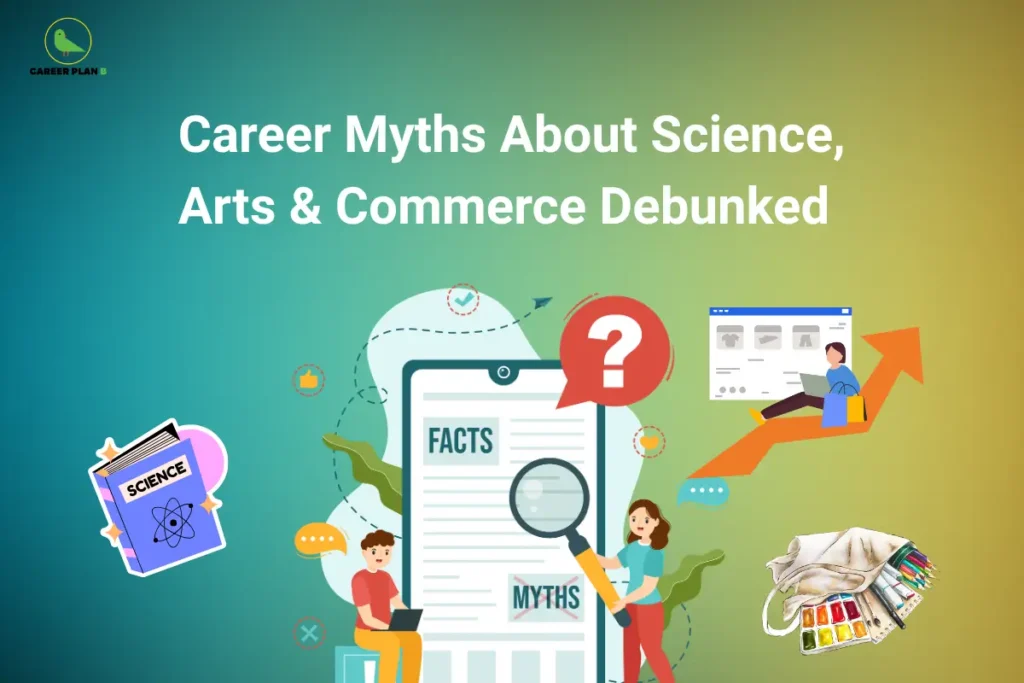
Introduction
Think about the last time a family gathered after Class 10 results. Someone, a relative, a neighbour, or a well-meaning uncle, inevitably said the words, ‘Beta, science le lo. ‘Options khule rehenge. “And the student, who had spent months genuinely enjoying history or business studies, quietly nodded and filed for PCM.
Career myths about science, arts, and commerce have been shaping and quietly damaging the futures of Indian students for decades. These myths are not just harmless opinions. They determine which stream a student chooses, which courses they pursue, and ultimately, whether they spend their working life doing something that fits them or something they were told would keep doors open.
The trouble is, most of these beliefs are either outdated, exaggerated, or simply wrong. And in a labour market that is changing faster than ever, the World Economic Forum’s Future of Jobs Report 2025 projects 170 million new job roles globally by 2030, driven by skills and adaptability. Not clinging to old myths is a risk no student can afford.
Let us go through the ones that do the most damage.
For Personalized Guidance
Myth 1: Science Keeps All Options Open, Other Streams Don’t
This is the most widespread and most harmful myth of all.
The idea is that science is a “safe” choice and that taking PCM or PCB in Class 11 somehow preserves more career options than commerce or arts ever could. Parents believe it. Teachers repeat it. And students choose science not because they love it, but because they are afraid of closing doors.
Here is the truth: Science does give you access to engineering and medicine. It does not give you access to everything else that Commerce and Arts students can also reach. A student from the commerce stream can appear for UPSC Civil Services, get into management, pursue law, build a startup, work in finance, become an economist, or shift into data analytics. An arts student can build a career in journalism, psychology, design, law, public policy, international relations, or digital media fields that are genuinely growing in India and globally.
What science actually does is narrow your subject experience during classes 11 and 12 to a specific set of disciplines. That is useful if those disciplines align with where you genuinely want to go. If they do not, two years of struggling through physics and chemistry you do not enjoy is not keeping options open; it is wasting time that could have been spent building real strength.
The WEF’s Future of Jobs Report 2025 identifies analytical thinking, creative thinking, and leadership as the fastest-growing skill categories globally. None of those is exclusive to science.
Myth 2: Arts Is for Weak Students Who Couldn’t Get Into Science
This one is not just wrong; it is deeply unfair.
The Arts or Humanities stream has somehow earned the reputation of being a consolation prize in Indian education. Students who “couldn’t manage” PCM or PCB end up in Arts, or so the story goes. Parents feel embarrassed to tell relatives their child took Humanities. The stream is treated as a fallback, not a foundation.
The reality is that the humanities produce some of the most intellectually demanding careers in the country. Civil servants who run districts and states come predominantly from an arts background. Lawyers who argue before the Supreme Court studied history and political science. Journalists, psychologists, social workers, public policy researchers, filmmakers, and UX designers – the people shaping how India thinks and communicates – are trained in the humanities.
The academic counselling process at Career Plan B surfaces this pattern consistently: students who genuinely belong in humanities but were pushed into science often struggle not because they are weak, but because the content does not fit how their minds work. The moment these students are in the right environment studying subjects that engage them, their performance changes entirely.
Arts requires sharp reading, strong writing, critical thinking, and the ability to hold multiple perspectives simultaneously. These are not soft skills. They are precisely the skills that the ILO’s India Employment Report 2024 and global labour market research consistently flag as essential for sustainable employment.
Myth 3: Commerce Means CA, and If You Can’t Clear CA, You’ve Wasted the Stream
Commerce students in India often grow up with one benchmark held over them: chartered accountancy. If you took commerce, the assumption is that CA is the obvious destination, and if you cannot clear it (which, given its notoriously demanding pass rates, most students will not), the stream somehow becomes a question mark.
This framing is unnecessarily limiting and ignores the genuine breadth of what commerce opens up.
A commerce background gives students a working understanding of economics, markets, business behaviour, financial systems, and organisational structure. That knowledge is the foundation for careers in investment banking, financial analysis, actuarial science, marketing, entrepreneurship, supply chain management, human resources, e-commerce operations, and digital strategy, none of which require a CA qualification.
MBA programmes, which lead to some of the most respected career trajectories in India and internationally, draw heavily from commerce backgrounds. Government banking examinations IBPS PO, RBI Grade B, and SBI are directly accessible and well-suited for commerce graduates. The Indian Economic Services examination specifically values economics, a core commerce subject.
The problem is not commerce. The problem is that students are told the story of CA or nothing, and when CA does not work out, they feel like the stream itself failed them. It did not. The myth did.
Myth 4: You Must Decide Your Entire Career at Class 10
Perhaps the most anxiety-producing myth of all is the belief that the stream you choose at age 15 or 16 determines the rest of your professional life. That if you pick wrong, something is permanently lost.
This simply is not how careers work in India or anywhere else.
Stream selection shapes your next two years of academic preparation and influences which undergraduate courses you are directly eligible for. It does not seal your fate. Students who studied PCM have shifted into journalism, law, and psychology through postgraduate routes. Arts students have built careers in data analytics by upskilling. Commerce students have become software product managers. These are not exceptional stories; they are common ones.
What stream selection does is create practical advantages when chosen well. A student who genuinely enjoys understanding human behaviour and takes up Psychology and Sociology in Humanities will be far better placed for careers in that direction than someone who spent those two years grinding through organic chemistry, they never wanted to study. The advantage is not about the stream’s status; it is about the fit.
The ILO’s India Employment Report 2024 highlights that India’s youth face significant challenges in accessing quality employment and that overqualification for available roles is a real and growing problem. Choosing a stream based on genuine interest and aptitude, rather than perceived prestige, is one of the earliest ways students can reduce the risk of spending their career in a field they never wanted to be in.
The Real Question: Fit, Not Hierarchy
Every one of these myths rests on the same false assumption that streams exist in a hierarchy, with science at the top and arts somewhere at the bottom, and that the goal is to occupy the highest rung you can manage.
The actual question to ask about stream selection is not “Which stream is best?” It is “Which stream is best for this specific student, with these specific interests, aptitudes, and goals?” Those are very different questions, and confusing them is where most families go wrong.
Sustainable careers, the kind that bring both financial stability and genuine satisfaction, are built on the intersection of what a person is naturally good at and what they genuinely find engaging. Choosing a stream because of what others will think, or because it sounds safer, or because everyone else is doing it, skips the most important part: the student.
How the Myth-Reality Gap Shows Up in Real Life
| Myth | Reality | What It Costs |
| Science keeps all options open | Every stream offers multiple career pathways | Students may spend years studying subjects they dislike |
| Arts is for weak students | Humanities leads to careers in law, psychology, policy, media, and civil services | Talented students can underperform in unsuitable streams |
| Commerce = CA or nothing | Commerce also opens finance, analytics, banking, consulting, and entrepreneurship | Students may feel trapped if one career path doesn’t work out |
| Stream choice is irreversible | Career changes and interdisciplinary transitions are common | Decisions get driven by fear rather than understanding |
| Only Science leads to high-paying careers | Income potential exists across law, business, psychology, media, technology, and public service | Students overlook valuable opportunities in other fields |
How Career Plan B Helps
Career Plan B helps students navigate CUET 2026 private university subject rules with clarity, confidence, and personalized guidance:
- Personalized Career Counselling: Helps students identify universities and programmes that genuinely align with their strengths, interests, and long-term goals.
- Psycheintel & Career Assessment Tests: Provides insights into aptitude, personality traits, learning styles, and suitable academic and career pathways through data-backed assessments.
- Admission & Academic Profile Guidance: Supports students in understanding CUET subject combinations, decoding university-specific eligibility rules, and building strong academic profiles strategically.
- Career Roadmapping: Helps students create a structured long-term plan aligned with their academic choices and future aspirations.
- End-to-End Guidance: Assists students throughout subject selection, university shortlisting, admissions, and career planning so important details, eligibility requirements, and opportunities never slip through the cracks.
For Latest Information
Frequently Asked Questions
1. Can an arts student earn as much as a science or commerce student?
Yes, income depends on the career, not the stream. Senior civil servants, lawyers, psychologists, journalists, and policy researchers, many of whom come from humanities backgrounds, earn competitive salaries. The ILO’s India Employment Report 2024 notes that the quality of employment depends far more on skills and role than on the academic stream taken at age 15.
2. Is it possible to switch careers after choosing the “wrong” stream?
Yes, and it is more common than most people realise. Postgraduate courses, professional certifications, and skill-building programmes allow for meaningful career pivots. That said, choosing the right stream early makes the journey more efficient, which is why taking stream selection seriously, with proper guidance, matters more than most families realise.
3. How do I know which stream genuinely suits my child?
A structured psychometric and aptitude assessment is the most reliable method, far more reliable than marks, family preference, or peer choice. Career Plan B’s PsycheIntel Assessment is specifically designed for this: it measures skills, interests, personality, and values together and maps them to realistic career paths.
5.What should a student do if they chose the wrong stream and are now in Class 11?
First, do not panic. Some boards allow stream changes in the first few weeks of Class 11. Check with your school and board immediately. If a switch is not possible, use the two years to explore your genuine interests through reading, internships, and extracurriculars and make an informed course choice at Class 12. A wrong stream is a setback, not a sentence.
Conclusion
The myths around science, arts, and commerce in India have caused more unnecessary anxiety, more mismatched careers, and more quiet unhappiness than most people will ever publicly admit. They are not based on how the modern job market works. They are based on how it worked or was believed to work a generation ago.
Every stream has depth, every stream has range, and every student has a specific combination of strengths and interests that makes one of them a far better fit than the others.
The real risk is not choosing the “wrong” stream in some abstract sense.
The real risk is choosing a stream without ever asking what actually suits the person who has to live that choice.