Team6 · September 5, 2026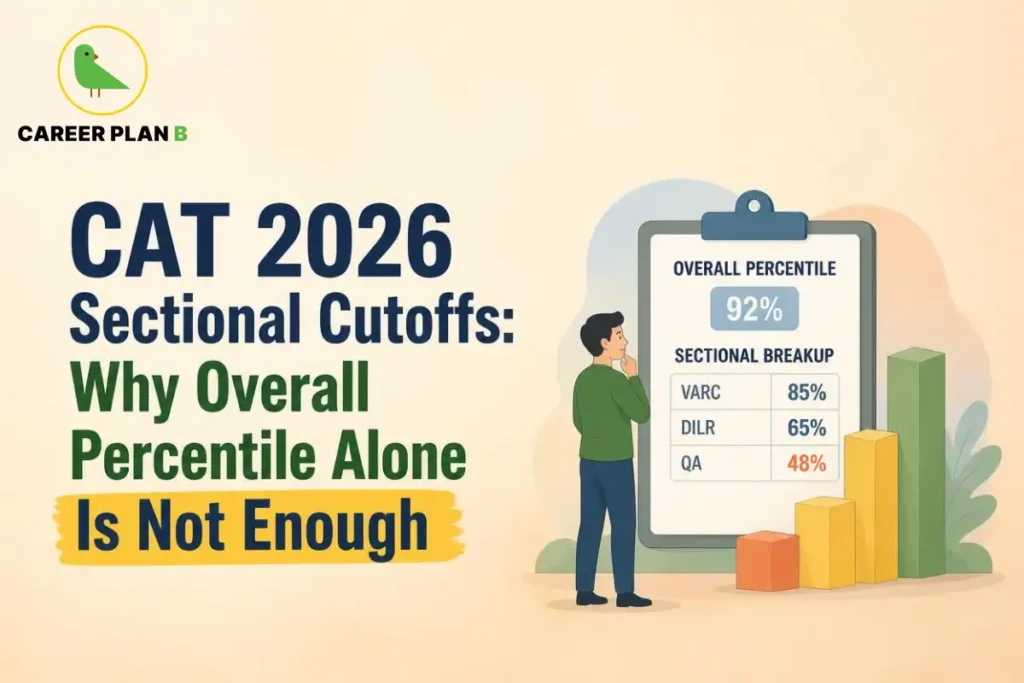
Introduction
Securing a high score in the Common Admission Test (CAT) requires balanced preparation across all subjects. Many candidates assume achieving a high overall score guarantees interview calls. However, understanding the CAT 2026 sectional cutoffs reveals a different reality. The Indian Institutes of Management (IIMs) evaluate candidates using both sectional and total scores. Therefore, scoring high in two areas while failing a third eliminates your chance of receiving an invitation.
Furthermore, analysing why the overall percentile is not enough in CAT helps aspirants avoid costly strategic mistakes. Every elite business school enforces strict baseline criteria. Consequently, a candidate with a 99 overall score can miss out on interview calls if one subject falls below minimum requirements. In this detailed article, we will examine the structure of CAT 2026 sectional cutoffs to help you build a balanced test-taking strategy.
Understanding CAT Overall vs Sectional Per Centile
To build a successful test strategy, you must distinguish total performance from individual paper requirements. The examination features three distinct sections: Verbal Ability and Reading Comprehension (VARC), Data Interpretation and Logical Reasoning (DILR), and Quantitative Aptitude (QA).
Mechanics of Total and Sectional Scores
Your CAT overall percentile indicates your standing relative to all test-takers across the entire paper. However, your CAT sectional percentile measures your comparative performance within a specific topic area.
- CAT VARC Cutoff: Measures reading speed, comprehension accuracy, and logical reasoning skills.
- CAT DILR Cutoff: Evaluates data processing speed, pattern identification, and set selection logic.
- CAT QA Cutoff: Tests mathematical application, speed calculation, and conceptual problem-solving skills.
Understanding this dual evaluation system explains why sectional cutoff matters for IIM admission.
CAT 2026 Sectional Cutoffs Explained
IIMs establish minimum baseline scores for every section to ensure candidates possess balanced analytical abilities. Therefore, failing to clear even one baseline score disqualifies your application.
| Category / Institution | Expected VARC Cutoff | Expected DILR Cutoff | Expected QA Cutoff | Expected Overall Cutoff |
|---|---|---|---|---|
| Top IIMs (A, B, C) | 80–85 Per Centile | 75–80 Per Centile | 75–80 Per Centile | 85–90 Per Centile |
| Old IIMs (L, K, I) | 75–85 Per Centile | 75–80 Per Centile | 75–80 Per Centile | 85–90 Per Centile |
| New & Baby IIMs | 70th Per Centile | 70th Per Centile | 70th Per Centile | 92nd Per Centile |
Reviewing these benchmark figures shows how CAT sectional cutoffs affect IIM calls during actual shortlisting rounds. Furthermore, tracking CAT VARC DILR QA sectional cutoffs helps you set realistic target marks during practice.
Note – This is not the exact cutoff; it will be vary.
Can High Overall Percentile Compensate for Low Sectional Percentile?
A common question among test-takers is, ‘Can a high overall percentile compensate for a low sectional percentile?’ The simple answer is no. Most top management institutes use automated screening filters. Therefore, if your CAT QA cutoff or CAT DILR cutoff falls below minimum criteria, automated system filters discard the candidate profile immediately. Consequently, a 99.5 total score cannot compensate for a 65th percentile in quantitative aptitude.
Also Read – CAT Percentile vs College Options: How to Set Realistic MBA Admission Goals
Why IIMs Mandate Strict Sectional Benchmarks
Management programmes require versatile skill sets. Business administrators analyse visual reports, communicate strategic plans, and manage financial budgets simultaneously.
- Ensuring Academic Balance: Business schools need students who perform well across management communications, data analytics, and corporate finance.
- Eliminating Single-Subject Reliance: Relying on one strong topic creates operational vulnerabilities in corporate decision-making environments.
- Managing High Applicant Volumes: Automated screening filters reduce thousands of candidate files efficiently using mandatory baseline criteria.
Understanding CAT cutoff eligibility for IIMs highlights the necessity of balanced preparation. Therefore, allocating equal study hours across subjects remains essential.
Have Any Doubts?
Strategic Blueprint to Clear CAT 2026 Sectional Cutoffs
To ensure your scores meet institutional requirements, structure your daily schedule wisely. Moreover, executing a balanced strategy prevents last-minute score imbalances.
- Identify Weak Subjects Early: Dedicate 50% of your initial prep time to your weakest topic area.
- Practice Sectional Mocks: Take regular timed sectional tests to build pacing stamina under strict conditions.
- Track Minimal Performance Benchmarks: Focus on securing mandatory minimum marks in weak topics before attempting advanced questions.
Analysing the CAT overall and sectional cutoff relationship ensures your efforts yield interview invitations. Furthermore, reviewing CAT sectional cutoff 2026 trends helps you adjust mock targets effectively.
How Career Plan B Helps
Career Plan B helps CAT aspirants understand CAT 2026 sectional cutoffs, evaluate their percentile requirements, and make informed decisions about B-school selection and MBA admissions.
- Personalised Career Counselling: Evaluates your academic profile, CAT preparation level, sectional performance, target percentile, and career goals to develop a balanced preparation and college-selection strategy.
- Psycheintel and Career Assessment Tests: Assesses your interests, strengths, personality, and aptitude to help identify suitable MBA specialisations and align your CAT preparation with long-term career goals.
- Career Roadmapping: Builds a structured roadmap covering sectional preparation, CAT percentile targets, IIM and B-school selection, MBA specialisation, internships, placements, and long-term career growth.
- Admission and Academic Profile Guidance: Helps you evaluate your academic profile, understand CAT VARC DILR QA sectional cutoffs, shortlist suitable IIMs and MBA colleges, and navigate application and admission requirements.
For Latest Information
Frequently Asked Questions
Q1. What happens if I miss a sectional cutoff by a small margin?
If your score misses an institute’s sectional benchmark, the system filters out your application automatically, regardless of your total score.
Q2. Do non-IIM top business schools enforce sectional cutoffs?
Some premier non-IIM institutions enforce sectional criteria, while others focus primarily on your total percentile. Checking individual institute policies is essential.
Q3. Which section typically has the lowest sectional cutoff in IIMs?
Generally, quantitative aptitude and data interpretation cutoffs sit slightly lower than verbal ability cutoffs in preliminary admission circulars.
Q4. How can I balance prep time across three distinct sections?
Divide your study schedule based on diagnostic mock performance. Allocate extra time to your weakest topic while maintaining consistency in strong areas.
Q5. Are sectional cutoffs lower for reserved category candidates?
Yes, official IIM admission guidelines provide category-wise relaxations for sectional and total percentile criteria.
Conclusion
Achieving a high total score is commendable, but clearing CAT 2026 sectional cutoffs determines your eligibility for interview calls. Relying solely on strong areas while ignoring weak subjects can jeopardise your admission chances. Therefore, maintaining a balanced preparation strategy across VARC, DILR, and QA remains essential for success.
Focus on meeting minimum score requirements in every section during your mock tests. Moreover, evaluating your progress regularly ensures steady, balanced percentile growth. To navigate post-exam calls, explore alternative B-schools, and maximise your admission opportunities, team up with Career Plan B and book a free session with our expert counsellor. Their expert mentorship and profile guidance will help you convert your test results into admission offers at top business schools.