Team Career Plan B · August 13, 2026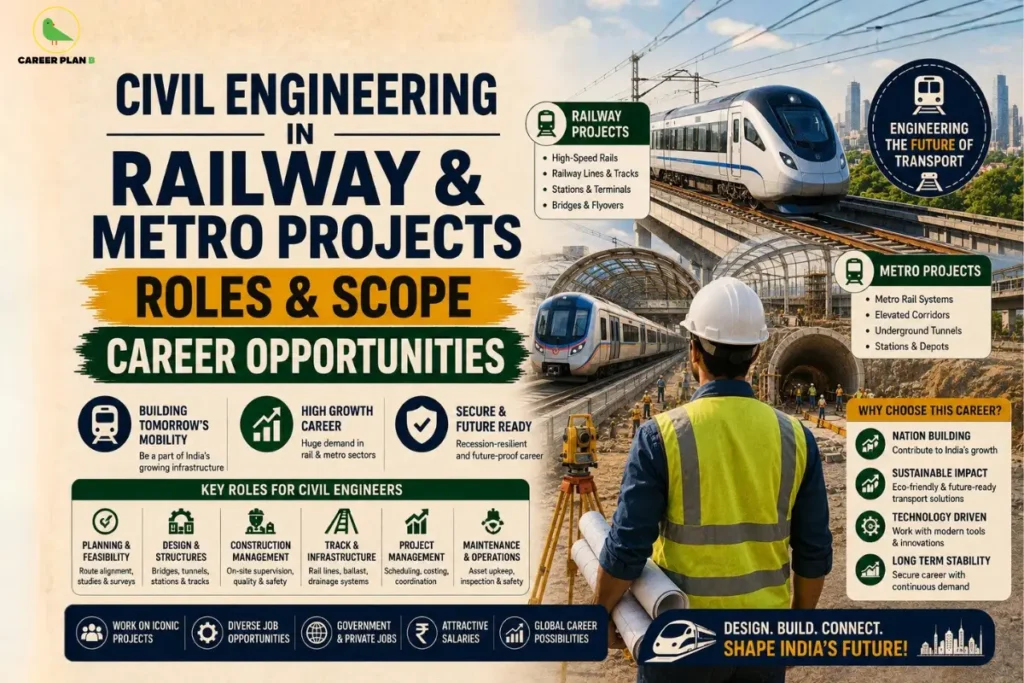
Introduction
India is building one of the world’s largest railway and metro expansion programmes. Civil engineers play a central role in every kilometre of this transformation. They lay tracks across challenging terrain, bore tunnels beneath crowded cities, design long-lasting bridges over major rivers, and construct elevated viaducts through dense urban corridors. The scale and complexity of these projects are truly extraordinary.
Civil engineering in railway and metro projects is one of the most technically demanding and professionally rewarding domains within the entire civil engineering profession. It combines structural engineering, geotechnical engineering, hydraulic design, project management, and construction supervision all on projects that serve millions of people every single day.
Yet many civil engineering students are unaware of just how large and varied the career opportunities in this sector actually are. They know about Indian Railways as an employer, but the full ecosystem of metro corporations, rail PSUs, EPC contractors, design consultancies, and emerging high-speed rail projects is far broader than most students realise.
This blog explains the role of civil engineers in railway and metro projects. It highlights the organisations hiring them, the skills employers value, and the sector’s outlook for the next decade.
Why Railway and Metro Projects Depend on Civil Engineers
Transport infrastructure is, at its core, a civil engineering challenge. The civil engineering scope in the transport sector in India is enormous, and railway and metro projects represent some of the most technically complex work within that scope.
A railway line is much more than a pair of steel rails. It is a carefully engineered system that includes track geometry, embankments, cuttings, bridges, tunnels, drainage structures, stations, yards, and signalling infrastructure. Every component must work together with millimetre-level precision at speeds of 100 to 300 kilometres per hour. Even a small structural failure, drainage issue, or foundation settlement can have catastrophic consequences.
Metro rail systems add another level of complexity. They operate in dense urban areas where space is limited and ground conditions often vary. Construction teams must also protect nearby buildings and underground utilities throughout the project. Civil engineers provide the technical foundation that makes these systems possible.
Key Roles of Civil Engineers in Indian Railways
Track Design and Geotechnical Investigation
Before laying a single rail, civil engineers conduct detailed geotechnical investigations along the proposed alignment. They evaluate soil bearing capacity, groundwater levels, slope stability, and seismic conditions. These factors determine how they design the track formation. Civil engineers then decide whether a section needs an embankment, a cutting, a bridge, or a tunnel. They design each structure to suit the site’s conditions.
Track geometry, the precise alignment, gradient, and curvature of the railway line, is a civil engineering responsibility. Getting this right is critical for safe, high-speed train operations. Even minor deviations from design specifications can cause track deterioration or train instability at speed.
Bridge and Culvert Engineering
India’s railway network crosses thousands of rivers, streams, and road intersections. Civil engineers in Indian Railways design and build railway bridges of every size. These range from small culverts to large multi-span bridges over major rivers. Engineers also design each bridge to withstand the dynamic loads created by moving trains. This makes railway bridge design more complex than most building or road bridge projects.
The Indian Railways network includes over 1.5 lakh bridges, many of which are over a century old and require ongoing inspection, maintenance, and rehabilitation a significant and growing area of civil engineering work.
Station and Yard Construction
Railway stations and marshalling yards are large civil engineering projects in their own right. Platforms, passenger buildings, foot overbridges, underground subways, drainage systems, and utility infrastructure all fall within the civil engineering scope of a station project. Large junction stations and freight terminals involve complex civil works spread over many hectares.
Civil Engineering in Metro Rail Projects
Underground Tunnelling and TBM Operations
Tunnel and bridge engineering in metro projects is arguably the most technically sophisticated work in Indian civil engineering today. Underground metro lines are built using tunnel boring. Machines, TBMs, that drill through soil and rock beneath cities while simultaneously installing precast concrete tunnel lining segments.
Civil engineers are responsible for the geotechnical investigation that informs TBM selection and tunnelling parameters, the design of tunnel cross-sections and lining systems, the monitoring of ground settlement above the tunnel to protect existing buildings, and the construction of underground metro stations using cut-and-cover or NATM methods.
Metro rail construction civil engineering in India has grown rapidly as cities like Delhi, Mumbai, Bengaluru, Chennai, Hyderabad, Pune, Kochi, and Lucknow have expanded their metro networks. The skills developed on these projects, particularly in geotechnical engineering and underground construction, are among the most internationally transferable in the civil engineering profession.
Elevated Viaduct and Station Design
Where metro lines run above ground, civil engineers design and build elevated viaducts. These continuous concrete structures support metro tracks and trains. Engineers design them to withstand the dynamic loads of moving trains, wind forces, seismic activity, and foundation settlement caused by varying urban ground conditions.
Elevated metro stations are architecturally and structurally complex structures that must handle high passenger volumes, integrate with existing road and pedestrian infrastructure, and meet accessibility standards. Civil engineers manage the structural design, foundation engineering, and construction supervision of these stations.
Foundation Engineering in Urban Settings
Foundation design is one of the most challenging aspects of metro civil engineering. Engineers must design pile foundations that avoid existing underground utilities, metro tunnels, building foundations, and drainage systems. At the same time, these foundations must deliver the structural performance needed for a long-lasting public transport system. Achieving this balance requires advanced geotechnical analysis and careful construction management.
Railway Infrastructure Development: What Civil Engineers Build
Railway infrastructure development: India is entering an unprecedented phase of expansion. Beyond the existing broad-gauge network, civil engineers are now working on several transformative projects simultaneously.
The Dedicated Freight Corridors Eastern and Western, being implemented by DFCCIL, are among the largest railway infrastructure projects ever undertaken in India. These corridors involve the construction of entirely new railway lines, bridges, tunnels, and associated infrastructure specifically designed for heavy freight traffic. Civil engineers are involved in every aspect of design and construction.
The National Rail Plan sets out a long-term vision for expanding India’s railway capacity to meet 2050 traffic demands. It includes new lines, doubling of existing lines, electrification, and the development of high-speed corridors, all of which represent significant civil engineering work over the coming decades.
The Mumbai-Ahmedabad High Speed Rail project, India’s first bullet train corridor, is introducing a completely new class of civil engineering challenges, including viaducts designed for 350 km/h operations, deep-sea tunnels, and seismic-resistant structures in earthquake-prone zones.
Top Organisations Hiring Civil Engineers in Railway and Metro Sector
RVNL DMRC civil engineering jobs represent just two of the many career pathways available in this sector. Here is a broader picture of the key employers:
Indian Railways is the largest employer of civil engineers in India, with recruitment through the Railway Recruitment Board for various grades and specialisations.
RVNL (Rail Vikas Nigam Limited) implements railway infrastructure projects, including new lines, doubling, electrification, and major bridge and tunnel works on behalf of Indian Railways.
DMRC (Delhi Metro Rail Corporation) is one of Asia’s most technically advanced metro organisations. It is expanding its network through Phase IV. This expansion has created significant opportunities for civil engineers.
DFCCIL (Dedicated Freight Corridor Corporation of India Limited) is implementing the Eastern and Western Dedicated Freight Corridors, with large-scale civil engineering recruitment.
IRCON International, a Government of India enterprise implementing railway and highway projects in India and abroad, offers civil engineers international project exposure.
RITES Limited provides consultancy, inspection, and project management services for railway and urban transport projects, hiring civil engineers for technical and management roles.
NHSRCL (National High Speed Rail Corporation Limited) implementing the bullet train project, with highly specialised civil engineering requirements.
Various state metro corporations, including MMRCL (Mumbai), BMRCL (Bengaluru), CMRL (Chennai), and HMRL (Hyderabad), are also significant employers of civil engineers for ongoing metro expansion projects.
Most PSU recruitments in this sector happen through GATE scores in Civil Engineering, making GATE preparation a critical step for anyone targeting these organisations.
Have Any Doubts?
Skills and Tools Required
To build a strong career in the civil engineering railway sector in India, you need a combination of core civil engineering knowledge and sector-specific technical skills.
Structural analysis and design using STAAD Pro and AutoCAD is fundamental. Geotechnical engineering knowledge, including soil investigation, foundation design, and slope stability analysis, is essential for both railway and metro projects. For metro work specifically, knowledge of tunnelling methods, TBM operations, and underground construction is highly valued.
BIM (Building Information Modelling) is increasingly being adopted on large railway and metro projects for design coordination and project management. GIS skills are important for route alignment planning and land acquisition management. Project management expertise, including familiarity with contract management and construction supervision, becomes increasingly important as engineers move into senior roles.
For those targeting PSU employment, clearing GATE in Civil Engineering is the standard pathway. The GATE Civil syllabus covers most of the core technical areas relevant to railway engineering, structural analysis, geotechnical engineering, fluid mechanics, and transportation engineering.
Future Scope India’s Railway and Metro Expansion Roadmap
The career in civil engineering railway sector in India has never looked more promising. Several major programmes will drive demand for civil engineers in this sector for the next two decades.
The expansion of India’s metro network is accelerating. Cities including Patna, Varanasi, Surat, Agra, Indore, and Bhopal are in various stages of metro planning and construction. The Metro Neo and MetroLite concepts, lighter, more affordable elevated metro systems, are being introduced to extend rapid transit to smaller cities, creating a new wave of civil engineering projects.
The Regional Rapid Transit System being developed by NCRTC is connecting Delhi to surrounding cities Meerut, Gurugram, Alwar, and Panipat with high-speed rail-based transit. This programme involves complex civil engineering across urban, semi-urban, and rural environments simultaneously.
The expansion of the Vande Bharat train network requires track upgrades, station improvements, and bridge rehabilitation works across thousands of kilometres of existing railway lines. The government’s commitment to one hundred per cent railway electrification and the development of new freight corridors add further to the civil engineering workload in this sector.
Internationally, Indian railway PSUs like IRCON and RITES are executing projects in Africa, South Asia, and Southeast Asia, giving civil engineers the opportunity to work on overseas railway and infrastructure projects while employed by Indian government organisations.
How Career Plan B Helps
If you are a civil engineering student or graduate interested in building a career in railway and metro projects but unsure where to start, which organisations to target, whether to pursue GATE, or which specialisation to develop, Career Plan B can help you build a clear and focused plan. Through Psycheintel-based aptitude and interest assessments, personalised one-on-one career counselling, and structured roadmapping, Career Plan B helps you identify the specific pathway within the railway and metro sector that aligns with your strengths and ambitions and then maps out exactly how to get there.
For Latest Information
Frequently Asked Questions (FAQs)
Q1. What is the role of civil engineers in metro rail projects specifically?
Civil engineers in metro projects handle geotechnical investigation, underground tunnelling design and supervision, elevated viaduct and station structural design, foundation engineering in urban environments, and construction project management. They are involved from the initial feasibility stage to the final handover of completed infrastructure.
Q2. Which organisations offer the best civil engineering jobs in the railway and metro sector in India?
Key employers include Indian Railways, RVNL, DMRC, DFCCIL, IRCON, RITES, NHSRCL, and various state metro corporations. Most PSU recruitment in this sector happens through GATE Civil Engineering scores.
Q3. Is GATE compulsory for civil engineering jobs in railway PSUs?
GATE is the primary route for entry into most railway sector PSUs, including RVNL, DFCCIL, IRCON, and RITES. However, Indian Railways also recruits civil engineers through the Railway Recruitment Board for certain grades. Private EPC contractors working on railway projects hire directly without requiring GATE scores.
Q4. What specialisations are most valued in civil engineering for railway and metro careers?
Geotechnical engineering, tunnel engineering, structural engineering for bridges and viaducts, and project management are the most valued specialisations in the railway and metro sector. BIM and GIS skills are increasingly important for senior technical and management roles.
Q5. Are there international opportunities for civil engineers in the railway sector through Indian PSUs?
Yes. IRCON International and RITES Limited both execute railway and infrastructure projects internationally, including in Africa, Nepal, Bangladesh, Sri Lanka, and Southeast Asia. Civil engineers employed by these organisations can be posted on international projects, gaining overseas experience while working for a Government of India enterprise.
Conclusion
Civil engineering in railway and metro projects sits at the intersection of technical complexity, national importance, and long-term career stability. Every new metro line that opens in an Indian city, every railway bridge that carries freight across a major river, and every high-speed corridor that connects two regions represents years of civil engineering effort and decades of career opportunity for the engineers who build them.
India’s railway and metro expansion is not slowing down. If anything, the pace is accelerating. For civil engineering graduates who understand this sector and position themselves well through GATE preparation, the right specialisations, and clear career planning, the opportunities are genuinely exceptional.
Visit Career Plan B to get personalised career guidance and start building the roadmap that takes your civil engineering career into one of India’s most important and fast-growing infrastructure sectors.