Team Career Plan B · August 13, 2026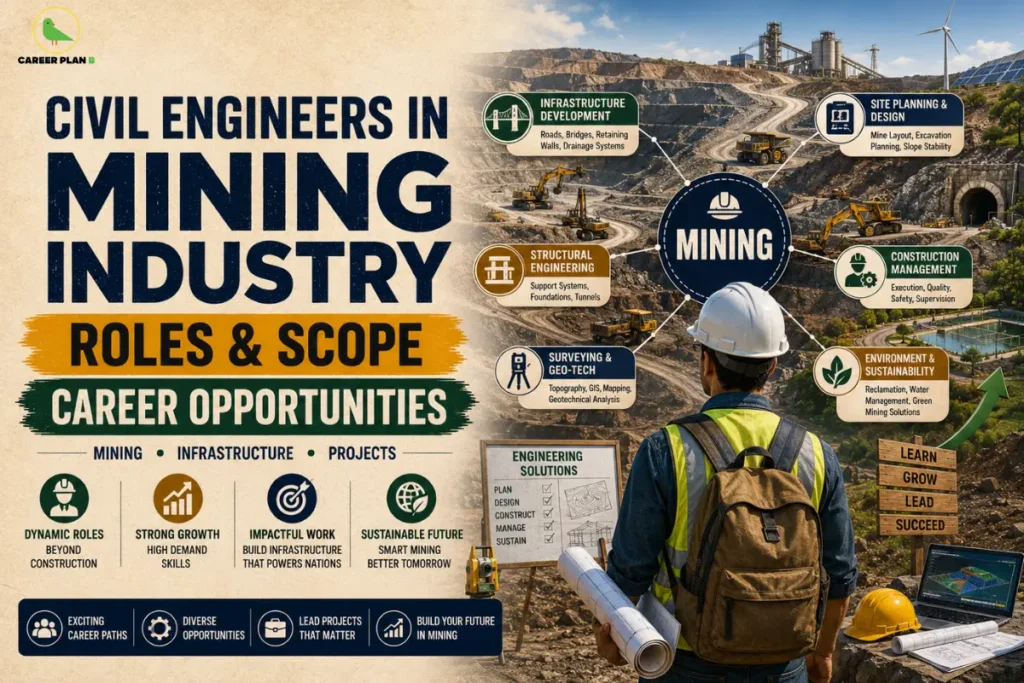
Introduction
Before a single tonne of coal or iron ore is extracted from the ground, a civil engineer has already been on that site for months. Surveying the land. Testing the soil. Designing access roads. Planning drainage systems. And yet, when most people think about the mining industry, they picture geologists or mining engineers, rarely civil engineers.
This is one of the most underrated career intersections in India today. Civil engineers in mining industry settings play a foundational role that makes extraction possible, safe, and sustainable. Without their work, there would be no stable mine structure, no functional transport corridor, no tailings dam to contain waste, and no worker township to house thousands of employees.
India’s mining sector is on a significant growth trajectory. With the government’s push under the National Mineral Policy and the critical minerals mission, the demand for skilled civil engineers in this space is only going to rise.
In this blog, we cover exactly what civil engineers do in the mining industry, which organisations hire them, what skills they need, and what the career path looks like in India.
Why Does the Mining Industry Need Civil Engineers?
Mining is not just about digging. It is a massive engineering operation that requires infrastructure at every stage before, during, and after extraction. This is where civil engineering scope in the mining sector in India becomes significant.
A mine is essentially a construction project in a hostile environment. The terrain is often remote, the ground conditions are unstable, and the infrastructure requirements are enormous. Roads must be built to connect the mine to the nearest highway or railhead. Structures must be designed to withstand ground movement and heavy load. Water must be managed to prevent flooding and contamination.
Civil engineers bring the structural, geotechnical, and construction expertise that makes all of this possible. They work alongside mining engineers and geologists to ensure that the physical infrastructure of a mine is safe, efficient, and built to last.
Key Roles Civil Engineers Play in the Mining Sector
Site Investigation and Geotechnical Engineering
Before any construction begins at a mining site, the ground must be thoroughly understood. Civil engineers specialising in geotechnical engineering in mining conduct soil tests, rock mechanics studies, and slope stability analyses. This work determines how safely a mine can be excavated, how steep the walls of an open-pit mine can be, and what kind of foundations are needed for heavy equipment and structures.
Geotechnical work is also critical for underground mining operations, where the risk of ground collapse is a constant concern. Civil engineers assess rock strength, design support systems like rock bolts and shotcrete linings, and monitor ground movement throughout the life of the mine.
Designing Mine Infrastructure
Civil engineers design the physical infrastructure that supports mining operations. They plan ore processing plants, crusher stations, conveyor support structures, warehouses, administrative buildings, and workshops. Every structure on a mining site must withstand heavy industrial use, extreme loads, and challenging environmental conditions.
In both underground and surface mining projects, civil engineers oversee construction to ensure compliance with safety codes and budgets. They also make sure every structure can operate reliably for decades.
Construction of Access Roads and Transport Corridors
One of the most visible contributions of civil engineers in the mining sector is road and transport infrastructure. Mines are often located in remote areas with little or no existing connectivity. Civil engineers design and supervise the construction of haul roads within the mine, access roads connecting the mine to the main road network, and sometimes railway sidings for bulk ore transport.
These are not ordinary roads. My haul roads carry extremely heavy vehicles, sometimes weighing over 300 tonnes, and must be designed to handle this load without failure.
Mining Infrastructure Development: What Civil Engineers Build
Mining infrastructure development in India is a broad and growing field. Beyond roads and buildings, civil engineers in the mining sector are responsible for some of the most technically complex structures in industrial engineering.
Tailings dams are one example. When ore is processed, the leftover waste material called tailings must be stored safely. Civil engineers design and build tailings storage facilities, which are essentially large dams that must contain toxic or chemically active material for decades. The structural integrity of these dams is a matter of both environmental safety and regulatory compliance.
Civil engineers also design water management systems to handle the large volumes of water generated in mining operations. This includes dewatering systems, effluent treatment plants, and rainwater drainage networks. Worker townships with housing, roads, and utilities for thousands of employees are another area where civil engineers contribute significantly.
Have Any Doubts?
Project Management and Safety Compliance
Mining is one of the most regulated industries in India, and for good reason. The Directorate General of Mines Safety under the Ministry of Labour and Employment is responsible for overseeing safety standards across all mining operations in the country.
Civil engineers working in mining project management civil engineering roles are responsible for ensuring that all construction activity complies with DGMS regulations and other applicable standards. They prepare project schedules, manage contractor teams, monitor construction quality, and maintain safety records.
Structural failures in mining, a collapsed slope, a breached tailings dam, or a flooded underground tunnel can be catastrophic. Civil engineers are the professionals who prevent these failures through rigorous design, inspection, and monitoring.
Top Organisations Hiring Civil Engineers in Mining
A career in civil engineering’s core sector in India often leads to some of the most prestigious and stable public sector employers in the country. Here are the major organisations that hire civil engineers for mining-related roles:
Coal India Limited, the world’s largest coal producer, is a major employer of civil engineers across its subsidiaries, including BCCL, ECL, CCL, and SECL.
NMDC Limited is India’s largest iron ore producer, with major mining operations in Chhattisgarh and Karnataka.
MOIL Limited, India’s leading manganese ore producer.
SCCL Singareni Collieries Company Limited, a major coal mining company in Telangana.
SAIL Steel Authority of India Limited, which operates captive iron ore and coal mines.
Hindustan Copper Limited is a government of India enterprise involved in copper mining and processing.
Most of these PSUs recruit civil engineers through GATE scores, making GATE preparation a critical step for anyone targeting this sector.
Skills and Tools Required
To thrive as a civil engineer in the mining industry, you need a combination of core civil engineering knowledge and domain-specific skills.
Technical skills include geotechnical analysis, slope stability assessment, structural design for industrial facilities, and construction project management. Software proficiency in AutoCAD, STAAD Pro, and geotechnical tools like PLAXIS or RocScience products is highly valued.
Field skills matter equally. Civil engineers in mining spend significant time on site, so the ability to read and interpret site conditions, manage large contractor teams, and maintain safety standards in challenging environments is essential.
For those targeting PSU roles, clearing GATE in Civil Engineering is the standard pathway.
Future Scope Mining and Civil Engineering in India
The future of civil engineering roles in the core sector, especially mining, looks promising. The Government of India’s National Mineral Policy 2019 provides a long-term framework for sustainable mining development. It focuses on infrastructure, technology, and environmental responsibility. Civil engineers play a key role in each of these areas.
India’s push to secure critical minerals such as lithium, cobalt, nickel, and rare earth elements will drive the development of new mining projects. These minerals are essential for electric vehicle and electronics manufacturing. Every new project will require civil engineers from the planning stage through construction.
The PM Gati Shakti National Master Plan is also improving connectivity to remote mining regions across India. This initiative is creating new opportunities for civil engineers in roads, railways, and logistics infrastructure that support the mining sector
How Career Plan B Helps
If you are a civil engineering student or graduate looking to build a career in the mining industry, Career Plan B can help you find the right direction. Through personalised career counselling and psychometric-based aptitude assessments, Career Plan B helps you identify whether mining roles match your strengths and long-term goals. It also creates a structured career roadmap with clear steps to help you enter the industry.
For Latest Information
Frequently Asked Questions (FAQs)
Q1. Do civil engineers need a separate mining engineering degree to work in the mining sector?
No. Civil engineers are hired directly by mining companies and PSUs for roles in infrastructure design, geotechnical engineering, project management, and construction. A B.Tech. in Civil Engineering is sufficient, though domain knowledge of mining operations is an advantage.
Q2. Which PSUs hire civil engineers for mining roles in India?
Major PSUs include Coal India Limited, NMDC, MOIL, SAIL, Hindustan Copper Limited, and SCCL. Most recruit through GATE scores in civil engineering.
Q3. What is geotechnical engineering in mining and why does it matter?
Geotechnical engineering in mining involves studying soil and rock conditions at mining sites to ensure safe excavation, slope design, and structural foundations. It is one of the most critical disciplines in mine planning and safety.
Q4. Is the mining sector a stable career option for civil engineers in India?
Yes. Mining is a core sector with consistent government investment and long project lifespans. PSU roles in mining offer job security, structured pay scales, and career growth, making them a strong option for civil engineering graduates.
Q5. How does GATE help civil engineers get into the mining sector?
Most public sector mining companies recruit civil engineers through GATE scores. A strong GATE rank can open doors to PSU roles at Coal India, NMDC, SAIL, and other organisations involved in mining operations.
Conclusion
The role of civil engineers in mining industry operations is far larger than most people realise. From the first geotechnical survey to the final infrastructure handover, civil engineers are present at every critical stage of a mining project. With India’s mining sector expanding under strong policy support and rising demand for critical minerals, this is one of the most promising yet underexplored career paths for civil engineering graduates.
If you are a civil engineer looking to build a career in the core sector, the mining industry offers stability, challenge, and long-term growth. The key is knowing how to position yourself and which path to take.
Visit Career Plan B to explore personalised guidance and take the first step toward a career that truly matches your potential.