Team Career Plan B · August 13, 2026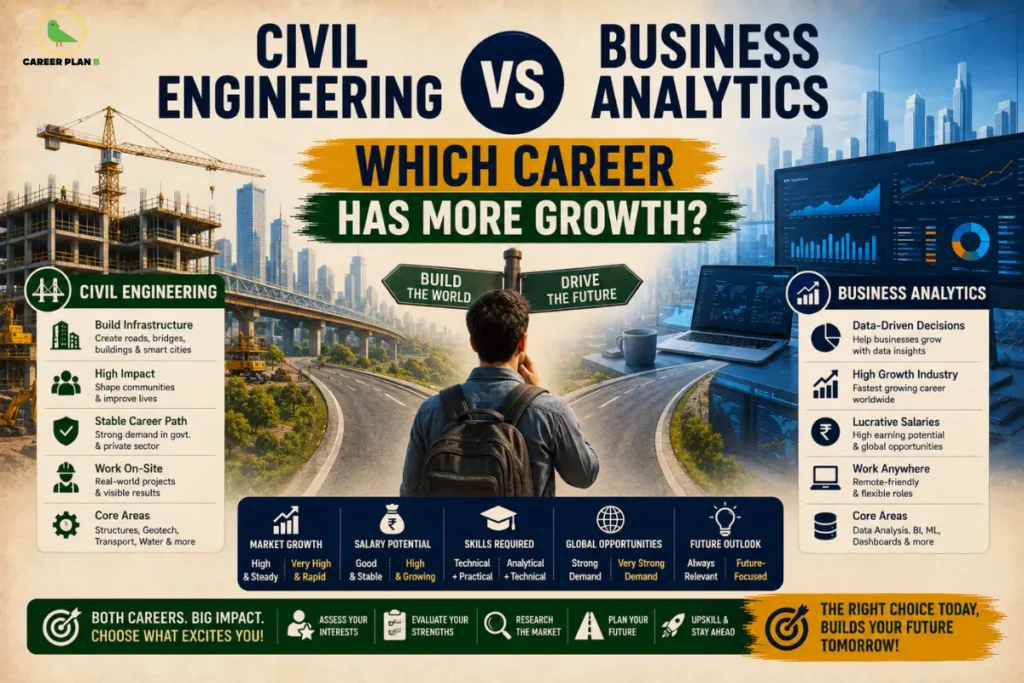
Introduction
One career builds highways, bridges, and smart cities. The other builds strategies, forecasts, and business decisions from data. Both are growing. Both are in demand. And right now, thousands of students and early professionals are standing at exactly this crossroads: civil vs business analytics, trying to figure out which direction offers more growth, more opportunity, and more alignment with who they are.
It is not a simple question. Civil engineering is backed by one of the largest government infrastructure investments India has ever seen. Business analytics is riding a wave of digital transformation that is reshaping every industry from banking to healthcare. Both paths have genuine futures, but they lead to completely different places.
This blog puts both careers side by side across every parameter that matters: growth potential, salary, skills, job market, and long-term trajectory so you can make an informed, confident decision rather than guessing based on what is trending on social media.
What Is Civil Engineering and Where Is It Headed?
Civil engineering is the branch of engineering responsible for designing, building, and maintaining the physical infrastructure that holds society together: roads, bridges, dams, buildings, water supply systems, urban drainage, and more.
In India, the civil engineering future scope has never looked more promising from a sheer volume perspective. The National Infrastructure Pipeline (NIP) has committed over ₹111 lakh crore in infrastructure investment through 2026. The PM Gati Shakti National Master Plan, Smart Cities Mission, AMRUT, and Jal Jeevan Mission are all generating sustained, large-scale demand for civil engineers across government and private sectors.
Civil Engineering Career Scope in 2026 and Beyond
The civil engineering career scope extends well beyond construction. Senior civil engineers move into urban planning, infrastructure consulting, project management, policy advisory, and international development roles. The career path is long, structured, and increasingly well-compensated at senior levels.
What Is Business Analytics and Where Is It Headed?
Business analytics is the practice of using data, statistical analysis, and quantitative methods to help organisations make better decisions. It sits at the intersection of data science, management, and strategy, and it is relevant to virtually every industry that generates data, which today means every industry.
A business analyst or analytics professional might be forecasting sales for an e-commerce company, identifying fraud patterns for a bank, optimising supply chains for a manufacturer, or building dashboards for a healthcare network.
Business Analytics Career Growth in India
The business analytics career growth trajectory in India is steep. According to NASSCOM, India is one of the fastest-growing markets for analytics talent globally. The analytics industry in India is projected to grow at a CAGR of over 23%, driven by digital adoption across BFSI, e-commerce, consulting, and public sector data initiatives.
Civil vs Business Analytics: Head-to-Head Comparison
Here is an honest, detailed look at data analytics vs civil engineering across the parameters that matter most:
| Parameter | Civil Engineering | Business Analytics |
|---|---|---|
| Core Education | B.Tech Civil Engineering | B.Tech (Any Stream) + Analytics Skills / MBA / M.Sc. |
| Primary Skills | Structural Design, GIS, AutoCAD, Site Management | Excel, SQL, Python/R, Tableau, Statistics, Business Acumen |
| Work Environment | Office + Fieldwork (Outdoor Exposure) | Primarily Desk-Based, Remote-Friendly |
| Entry-Level Salary (India) | ₹4.5–7 LPA | ₹5–9 LPA |
| Mid-Level Salary (India) | ₹10–18 LPA | ₹14–25 LPA |
| Senior-Level Salary (India) | ₹20 LPA+ | ₹30–50 LPA+ |
| Government Job Scope | Very High (NHAI, PWD, UPSC ESE) | Moderate but Growing |
| Remote Work Flexibility | Low; Site Presence Often Required | Most Roles Fully Remote-Compatible |
| Growth Speed | Steady and Structured | Fast, Skill- and Performance-Based |
| Job Market Demand (India) | Stable, Government-Backed | Rapidly Expanding, Private Sector-Led |
Growth Potential Civil Engineering Career Scope
The civil engineering career scope in India is directly tied to government spending, and right now, that spending is at a historic high. Key programmes generating civil engineering demand include:
- PM Gati Shakti National Master Plan
- Smart Cities Mission
- AMRUT (Atal Mission for Rejuvenation and Urban Transformation)
- National Highways Authority of India (NHAI)
- Ministry of Road Transport and Highways (MoRTH)
- UPSC Engineering Services Examination for central government roles
The growth in civil engineering is volume-driven and long-term. Senior roles like Project Director, Urban Infrastructure Consultant, and Chief Engineer carry strong compensation and significant national impact. However, the growth curve is gradual; it rewards patience, expertise, and years of experience.
Growth Potential: Business Analytics Career Growth
Business analytics career growth in India is currently one of the fastest among all professional fields. The engineering vs analytics jobs comparison tilts heavily toward analytics in terms of salary ceiling and speed of progression, particularly in the private sector.
Key sectors actively hiring analytics professionals in India:
- BFSI (Banking, Financial Services, Insurance) fraud detection, credit risk, customer analytics
- E-commerce and Retail demand forecasting, pricing optimisation, personalisation
- Healthcare patient outcome prediction, operational efficiency
- Consulting strategy analytics, market intelligence
- Public Sector government data initiatives under MeitY and NITI Aayog
Official resources supporting a career in business analytics development in India:
- MeitY (Ministry of Electronics and Information Technology) for digital economy and data skill initiatives
- NITI Aayog for data governance and analytics in public policy
- NPTEL for free analytics, statistics, and data science courses
- National Skill Development Corporation (NSDC) for analytics skilling programmes
The growth curve in analytics is steep and performance-driven. Professionals who continuously upskill and build strong portfolios can reach senior analytics leadership roles within 6–8 years.
Can a Civil Engineer Move Into Business Analytics?
This is one of the most relevant questions in the civil vs. business analytics conversation, and the answer is a clear yes, with the right preparation.
Civil engineers already possess several skills that translate directly into analytics:
- Quantitative thinking from structural calculations and data-heavy project work
- Project data management experience from large infrastructure projects
- Problem-solving under constraints a core analytical mindset
- Familiarity with GIS a direct bridge to spatial analytics and smart city data roles
What you will need to add for a successful transition:
- Excel and SQL foundational data tools
- Python or R for statistical analysis and automation
- Tableau or Power BI for data visualisation
- Statistics and probability: the mathematical backbone of analytics
- Business domain knowledge: understanding how organisations use data to make decisions
The intersection of construction analytics, infrastructure project data, and smart city intelligence is an emerging niche where civil engineers with analytics skills have a unique competitive advantage as the best career for engineers looking to pivot.
For Personalized Guidance
How to Choose 5 Questions to Ask Yourself
Still undecided on the civil vs. business analytics question? These five questions will bring you closer to your answer:
- Do you prefer building physical things or solving business problems with data? Civil engineering delivers tangible, visible outcomes. Analytics delivers insights and decisions. Which outcome excites you more?
- How comfortable are you with coding and statistics? Business analytics requires genuine proficiency in both. If the idea of writing Python code or running regression models energises you, analytics may be your path. If it feels draining, civil engineering’s more physical and spatial skill set may suit you better.
- Do you value government job security or private sector earning potential? Civil engineering has deep government job roots with strong stability. Business analytics thrives in the private sector with higher salary ceilings but less traditional job security.
- What does your ideal workday look like? Civil engineers split time between office and site. Business analysts work almost entirely at a computer, often remotely. Your honest preference here matters more than you might think.
- What is your ten-year vision? Picture yourself at 35. Do you want to be managing a highway project or leading a data strategy team? Neither is better. But one of them is yours.
How Career Plan B Helps
Choosing between civil vs. business analytics is not just about comparing salary tables or job trends; it is about understanding your own aptitude, working style, and long-term fit. Career Plan B helps you make this decision with clarity and confidence. Their Psycheintel Career Assessment Tests are designed to evaluate your natural strengths and identify which career path aligns with how your mind actually works. Their personalised career counselling gives you a one-on-one space to explore both options honestly, without the noise of peer pressure or trending career narratives. For students who have made their choice and are ready to move forward, Career Plan B’s Career Roadmapping and Admission and Academic Profile Guidance services help you build the right plan whether you are targeting M.Tech in civil specialisations or postgraduate programmes in business analytics.
For Latest Information
Frequently Asked Questions (FAQs)
- Which pays more, civil engineering or business analytics?
In the short- to mid-term, business analytics roles in the private sector tend to offer higher salaries, especially at the senior level where analytics leaders can earn ₹30 to ₹50 LPA and above. Civil engineering offers competitive salaries with strong government pay scales, job security, and benefits that private analytics roles typically do not provide. The right comparison depends on which sector and level you are targeting.
- Can a civil engineering student transition to business analytics?
Yes, and it is increasingly common. Civil engineers bring strong analytical thinking and quantitative skills to the table. Adding proficiency in SQL, Python, and data visualisation tools through platforms like NPTEL or a postgraduate programme in analytics makes the transition very achievable.
- Which career has more job stability in India?
Civil engineering traditionally offers stronger stability, particularly through government recruitment via UPSC ESE and state PSCs. Business analytics job stability is more skill-dependent; professionals who continuously upskill remain highly employable, but the field moves fast and requires ongoing learning.
- What qualifications do I need to start a career in business analytics?
A bachelor’s degree in any quantitative field combined with proficiency in Excel, SQL, Python or R and a data visualisation tool like Tableau or Power BI is the typical entry requirement. An MBA with an analytics specialisation or an MSc in data science significantly strengthens your profile.
Conclusion
The civil vs business analytics debate does not have a single right answer; it has a right answer for you. Civil engineering offers nation-building impact, government career stability, and a structured path with strong long-term rewards. Business analytics offers rapid growth, high earning potential, and the flexibility to work across virtually every industry.
Both careers have strong futures. The real question is which future fits your strengths, your working style, and your ten-year vision.
If you are still unsure, do not leave this decision to chance. Visit Career Plan B to take a career assessment, speak with an expert counsellor, and get a personalised roadmap that gives you a clear, confident answer.
Growth is not just about the industry you choose; it is about finding the path where your strengths can truly compound.