Team6 · July 20, 2026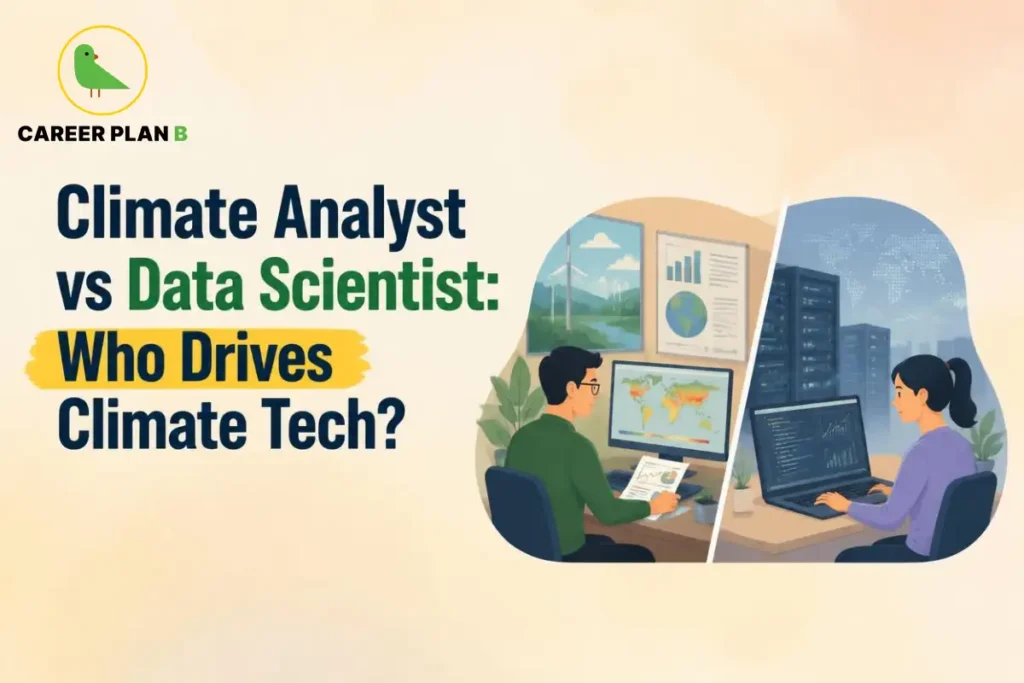
Introduction
Climate tech has become one of the fastest-growing areas in the job market, and two roles keep coming up at the centre of it: climate analysts and data scientists. The climate analyst vs data scientist debate often confuses people exploring this space, since both roles work heavily with data and both touch climate-related problems in some way. But the training, tools, and day-to-day responsibilities behind each title are actually quite different.
Climate change is measurable, trackable, and increasingly urgent. NOAA’s National Centres for Environmental Information reported that May 2026 ranked as the second-warmest May on record, with global surface temperatures running 1.93°F above the 20th-century average. Numbers like these are exactly what fuels demand for people who can interpret climate data and turn it into something companies, governments, and researchers can actually use. Let’s break down what each of these roles brings to that effort.
What Does a Climate Analyst Actually Do?
A climate analyst typically focuses on interpreting climate data within a specific context, whether that’s assessing physical climate risk for a company, supporting policy decisions, or analyzing long-term weather patterns for a research project. The climate analyst’s responsibilities usually include working with historical climate records, running risk assessments, and translating scientific findings into reports that non-technical stakeholders can understand. This role tends to require a strong background in earth science, meteorology, or environmental science, paired with a working knowledge of the tools used to analyze this kind of data. Domain expertise is really the heart of this role. A climate analyst understands not just what the data says but why it matters in a given real-world context.
What Does a Data Scientist in Climate Tech Actually Do?
A data scientist working in climate tech comes at the problem from a different angle. Their core strength is technical: building models, applying machine learning techniques, and working across large, often messy datasets to find patterns that wouldn’t be obvious otherwise. The data scientist role in this space is often industry-agnostic at its foundation, meaning the same statistical and programming skills that apply to finance or healthcare can be pointed at climate problems just as easily. Someone in this role might build a model that predicts flood risk, forecast energy demand based on weather patterns, or help a climate tech startup make sense of satellite data at scale. The technical depth here tends to run deeper than the climate-specific domain knowledge, at least initially.
Where the Two Roles Overlap
Despite coming from different starting points, these roles overlap more than people often expect. Both work extensively with climate data analysis, and both may contribute to climate modelling projects, whether that’s short-term weather prediction or long-term climate projections. In many climate tech companies, these two roles end up working side by side on the same projects, with the data scientist handling the technical modelling and the climate analyst providing the domain context needed to make sure the model’s outputs actually make sense. Neither role tends to function as well in isolation as it does alongside the other.
Have Any Doubts?
Key Differences in Education, Skills, and Tools
Even with the overlap, there are some clear differences worth understanding if you’re deciding which path to pursue.
| Aspect | Climate Analyst | Data Scientist |
|---|---|---|
| Typical Background | Earth science, meteorology, env. science | Comp. Science, statistics, applied math |
| Core Skill | Interpreting climate data in context | Building models, working with large datasets |
| Common Tools | Climate databases, GIS software | Python, machine learning, cloud computing |
| Typical Employers | Govt, research institutions, consulting | Climate tech startups, tech companies |
This kind of split helps explain why the two roles are often more complementary than competitive, even though they can look similar from the outside.
So, Who Really Drives Climate Tech?
Here’s the honest answer: neither role drives climate tech on its own. Careers in climate technology depend on both technical modelling skill and genuine domain expertise, and the strongest teams usually have a mix of both. Data science in sustainability work often runs into trouble when it’s disconnected from real climate science, since a technically sound model built on the wrong assumptions can produce misleading results. At the same time, climate expertise without the technical tools to scale that knowledge limits how much impact it can have. The field genuinely needs both, working together rather than in competition.
How Career Plan B Helps
Career Plan B helps students choose the right climate tech career path through personalized guidance, assessments, and career planning.
Personalized Career Counselling: Helps identify whether a climate analyst or data scientist role matches your interests and career goals.
Psychometric & Career Assessment Tests: Evaluate skills, strengths, and preferences to find suitable career opportunities.
Career Roadmapping: Provides a step-by-step plan for education, skill development, and career growth in climate technology.
Admission & Academic Profile Guidance: Supports students in selecting the right courses, colleges, and learning pathways.
Get In Touch With Us
Frequently Asked Questions
1. Do climate analysts need coding skills?
Basic data analysis skills help, but deep programming expertise isn’t always required the way it is for data scientists.
2. Can a data scientist become a climate analyst?
Yes, with enough domain knowledge in climate science, though it usually requires additional study or hands-on experience in the field.
3. Which role has better job prospects in climate tech?
Both are in demand, since climate tech companies typically need a mix of domain expertise and technical modelling skills to function well.
4. What degree do I need for a climate tech career?
It depends on the path: environmental or earth science for climate analysis, or computer science and statistics for data science roles.
5. Is climate data analysis a good specialization for data scientists?
Yes, it’s a growing niche that combines strong technical skills with meaningful, real-world impact.
Conclusion
The climate analyst vs data scientist comparison isn’t really about picking a winner; it’s about understanding how these two roles complement each other. Climate analysts bring the domain expertise needed to make sense of climate data in context, while data scientists bring the technical firepower to model and scale that knowledge. Together, they form the backbone of most serious climate tech work happening today.
If you’re trying to figure out which path suits your strengths, Career Plan B can help you explore both directions and build a realistic plan to get there. Climate tech isn’t slowing down anytime soon, and there’s genuine room for people from both backgrounds to make a real difference in this space.