Team Career Plan B · September 4, 2026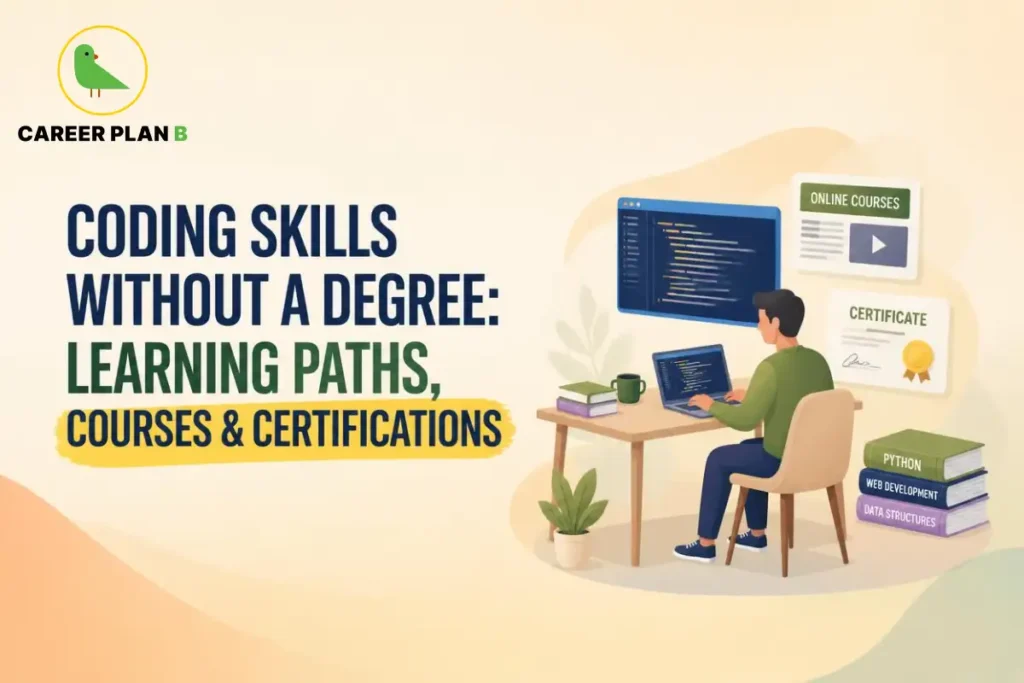
Introduction
The modern technology sector prioritizes practical technical competence over traditional university qualifications. Consequently, acquiring industry-ready coding skills has become the most direct pathway for non-traditional candidates.
Many aspiring developers regularly ask: can you learn coding without a degree and how to get into coding without a degree? Furthermore, learners from diverse academic streams explore how to become a programmer without a degree and how to learn computer science without college.
Digital skilling programs in India are supported by the Ministry of Electronics and Information Technology (MeitY) and the Ministry of Education (MoE). Standardized online technical courses are delivered through the SWAYAM Portal and NPTEL under the All India Council for Technical Education (AICTE).
This comprehensive guide details practical learning pathways, course recommendations, certification options, and recruitment strategies.
Why Coding Skills Matter More Than a Traditional Degree
The technology ecosystem values verifiable problem-solving ability, clean code execution, and system design. Therefore, mastering demonstrable coding skills without a degree allows candidates to compete directly with university graduates.
Major technology enterprises have officially removed mandatory four-year degree filters for developer roles. As a result, hiring panels evaluate GitHub repositories, technical interview scores, and deployed projects.
Moreover, practicing through interactive compilers and cloud IDEs delivers real-world programming experience. Consequently, becoming a proficient self-taught programmer is fully achievable in today’s software industry.
Can You Learn Coding Without a Degree?
Prospective learners frequently ask: can you learn coding without a degree and how to become a coder without a degree? The answer is an absolute yes.
Online platforms, open-source repositories, and developer communities offer complete computer science educational materials. Furthermore, cloud development platforms allow self-learners to deploy production-grade software independently.
Therefore, any determined applicant can learn coding without a degree with disciplined, continuous practice.
Proven Coding Learning Paths for Non-Degree Developers
Selecting a defined technical track prevents confusion during self-directed study. Following structured coding learning paths provides steady progression for beginner software builders:
| Specialization Track | Core Programming Languages | Key Frameworks & Technologies | Target Job Profiles |
|---|---|---|---|
| Full-Stack Web Development | JavaScript, TypeScript, Python | React, Node.js, Express, PostgreSQL | Full-Stack Developer, Frontend Engineer |
| Data Science & AI | Python, SQL, R | Pandas, NumPy, Scikit-Learn, PyTorch | Data Analyst, Junior Data Scientist |
| Cloud Computing & DevOps | Python, Bash, Go | Docker, Kubernetes, Linux, AWS, Terraform | Cloud Associate, DevOps Engineer |
| Mobile App Development | Dart, Kotlin, Swift | Flutter, React Native, Firebase | Mobile Application Developer |
Note: Beginners should focus on one specialization track for at least six months before exploring additional frameworks.
Best Programming Courses for Beginners & Non-CS Learners
Beginners often wonder how to choose a coding course without a CS background. Choosing well-structured programming courses for beginners ensures continuous skill development:
- NPTEL & SWAYAM Initiatives: Access university-level computer science lectures designed by premier IIT faculties.
- Harvard CS50x (Open Courseware): Master fundamental computer science principles, memory management, and algorithmic thinking.
- The Odin Project & FreeCodeCamp: Build real-world web applications through hands-on, project-based curriculums.
- Coursera & edX Specializations: Complete guided industry-partnered tracks in backend architecture and cloud administration.
Note: Many online coding courses for beginners provide free audit options for lecture content. However, proctored certification examinations may require nominal registration fees.
Value of Coding Certifications Without a Degree
Earning verified coding certifications without a degree provides third-party validation for entry-level resumes. While certifications cannot substitute for real applications, they demonstrate technical commitment.
Valuable coding courses and certifications include:
- Government Certifications: NPTEL Elite certificates in Data Structures, Algorithms, and Object-Oriented Programming.
- Cloud Infrastructure: AWS Certified Cloud Practitioner or Microsoft Certified Azure Fundamentals.
- Linux Administration: Red Hat Certified System Administrator (RHCSA).
- Database Management: Oracle Certified Associate (MySQL) or MongoDB Certified Developer.
Additionally, standardized coding certification courses help candidate profiles clear corporate automated tracking filters.
For Personalized Guidance
How to Learn Computer Science Without College: Core Subjects
Succeeding in software development without a degree requires mastering foundational computer science concepts:
Data Structures and Algorithms (DSA)
Master arrays, hash maps, linked lists, binary trees, and sorting algorithms. These topics form the core evaluation criteria during technical interview rounds.
Operating Systems and Networking
Understand process scheduling, concurrency, TCP/IP networking protocols, and HTTP communication cycles. These principles are essential for scalable system design.
Database Management Systems (DBMS)
Learn relational database schemas, indexing optimizations, transaction safety (ACID), and non-relational database storage.
Building a Portfolio for Tech Jobs Without a Degree
Securing tech jobs without a degree requires a public portfolio demonstrating coding skills for jobs. Hiring teams examine developer codebases before issuing interview invitations.
Follow these proven steps to showcase your technical readiness:
- Deploy Production Web Apps: Host at least three complete, responsive applications on live cloud servers.
- Maintain Version Control Discipline: Push regular commits to GitHub to demonstrate git workflow proficiency.
- Contribute to Open Source Projects: Submit documentation fixes and code pull requests to public repositories.
- Publish Technical Explanations: Write brief technical summaries explaining your database schema decisions and bug fixes.
Salary Expectations for a Coding Career Without a Degree
Starting a coding career without a degree offers competitive compensation that increases rapidly with performance:
| Career Designation | Average Entry-Level Salary (INR) | Mid-Level Salary (3–5 Years) |
|---|---|---|
| Junior Frontend Developer | ₹3,60,000 – ₹6,00,000 | ₹8,00,000 – ₹14,00,000 |
| Backend Developer (Node / Python) | ₹4,20,000 – ₹7,50,000 | ₹10,00,000 – ₹18,00,000 |
| Full-Stack Software Engineer | ₹5,00,000 – ₹9,00,000 | ₹12,00,000 – ₹22,00,000 |
| Cloud / DevOps Associate | ₹4,80,000 – ₹8,50,000 | ₹11,00,000 – ₹20,00,000 |
| Data Analyst / Junior Scientist | ₹4,00,000 – ₹7,00,000 | ₹9,50,000 – ₹16,00,000 |
Note: Salary packages depend heavily on problem-solving speed, system design capability, and practical project complexity.
Overcoming Obstacles While Learning Programming Without a Degree
Self-directed technical education presents distinct challenges that require personal consistency:
- Avoiding Tutorial Traps: Do not passively watch video lectures without coding. Always build original projects independently after completing a module.
- Managing Imposter Feelings: Comparing your progress to degree holders is natural. Focus instead on solving daily coding challenges and completing project milestones.
- Maintaining Daily Consistency: Irregular practice harms algorithmic problem-solving retention. Therefore, dedicate at least one to two hours daily to coding.
How Career Plan B Helps
Transitioning into technical software roles without an engineering degree requires strategic roadmap design. Career Plan B assists aspiring software developers through:
- Personalised Career Counselling: We evaluate your background, learning pace, and career goals. As a result, we build a tailored roadmap across web development, data engineering, and cloud domains.
- Psycheintel & Skill Assessments: Our scientific profiling identifies whether your problem-solving mindset aligns with frontend, backend, or systems programming. Consequently, you focus your efforts on the right technical niche.
- Interview Roadmapping: Our mentorship extends beyond basic syntax learning.
Get In Touch With Us
Frequently Asked Questions
Q1. Can I get a software developer job in India without a computer science degree?
Yes, startups, IT consultancies, and product companies actively recruit candidates based on live coding tests and GitHub portfolios.
Q2. How long does it take to learn programming without a degree?
Dedicated candidates typically achieve job readiness within six to nine months of consistent daily practice.
Q3. Which programming language is easiest for beginners?
Python and JavaScript are recommended choices for beginners due to their intuitive syntax and extensive community documentation.
Q4. Are expensive coding bootcamps required to become a programmer?
No, commercial bootcamps are entirely optional. Many successful engineers achieve job readiness through open-source documentation and free online courses.
Q5. What is the most important skill for a self-taught programmer?
Independent debugging ability, consistent algorithmic problem-solving, and clear version control habits are the most critical competencies.
Conclusion
Building strong and verifiable coding skills can provide a practical, self-driven pathway into today’s fast-growing software and technology ecosystem. By following a structured learning roadmap, working on real-world projects, practicing problem-solving consistently, and earning relevant certifications, aspiring developers can strengthen their technical expertise and improve their career prospects.
Choose a programming specialization that aligns with your interests and career goals, build a portfolio that demonstrates your abilities, and keep upgrading your skills as technology evolves. Not sure which tech career or learning path is right for you? Explore Career Plan B for personalized guidance on courses, skills, and alternative career pathways that match your goals.