Careerplanb · July 2, 2026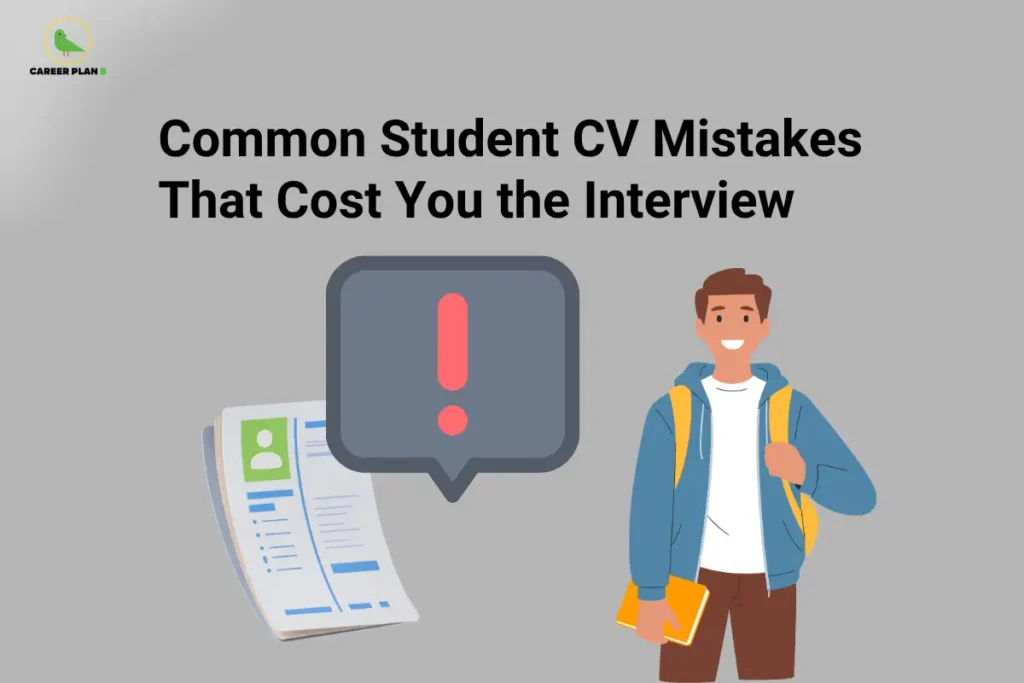
Introduction
You spent weeks building your skills, completing your coursework, and maybe even doing an internship or two. And then, in the final stretch of getting a job or an internship, the thing that lets you down is a document you put together in a few hours because you thought a CV was just a formality.
Common student CV mistakes are responsible for far more rejections than most students realise. According to a 2024 survey of 418 hiring professionals conducted by ResumeGo, 81% of recruiters spend less than one minute on a CV during the initial screening. A separate eye-tracking study by TheLadders found that in that brief window, recruiters spend the majority of their time on just a handful of elements: name, current or most recent role or course, previous experience headings, dates, and education. Everything else is secondary until the first impression earns a longer read.
That is not much time to make the case for yourself. Which means that mistakes, even small, fixable ones, have an outsized cost at the screening stage. This guide goes through the most common student CV mistakes in India and what to do instead.
For Personalized Guidance
Mistake 1: Writing an Objective Statement That Says Nothing
Open almost any student CV in India, and the first thing you will read is something like, “Seeking a challenging position in a reputed organisation where I can utilise my skills and contribute to the growth of the company.”
This sentence has appeared, word for word or close to it, on millions of CVs. It tells a recruiter nothing about who you are, what you can do, or why you are applying for this specific role. It is a placeholder masquerading as a professional introduction.
The objective statement as a format is outdated. What works far better, especially for freshers and students, is a two- to three-line professional summary that states who you are, what you have studied or done, and what kind of role or contribution you are looking for. It should be specific enough to be meaningful and short enough to be read in ten seconds.
Compare these two:
Outdated: “Seeking a challenging position in a reputed company where I can utilise my skills.”
Effective: “Final-year B.Com student with hands-on experience in financial modelling and data analysis through a summer internship at a Gurugram-based fintech startup. Looking to apply quantitative skills in a business analyst or financial analyst role.”
The second version gives a recruiter an immediate, clear picture. The first gives them nothing to work with.
Mistake 2: Using a Design-Heavy Template That Blocks ATS
Canva resumes look beautiful. Multi-column layouts, subtle colour gradients, icons for each section, and a photo placeholder in the corner make them feel polished and professional.
They also frequently fail applicant tracking systems completely.
ATS software, which most companies with a formal hiring process in India now use, reads CV text in a linear flow. When a CV uses multiple columns, tables, text boxes, or graphic elements, the ATS often misreads or entirely skips sections of the document. A skills section placed in a sidebar column may not be read at all. Contact details embedded in a header graphic may be invisible to the system. The recruiter shortlisting candidates never sees your CV; it simply does not match the keywords and gets filtered out.
For most student applications in India, particularly for campus placements, corporate internships, and formal job applications, use a clean, single-column layout in Microsoft Word or a simple PDF. Standard fonts, clear section headings, no columns, no text boxes, no icons. The structure should be so obvious that even automated software can read it without confusion.
If you are applying to a creative role in design, media, or advertising, a visually expressive CV can sometimes make sense, but even then, it is safer to send a design-forward version alongside a clean, ATS-readable version rather than relying solely on the visual format.
Mistake 3: Describing Responsibilities Instead of Outcomes
This is the single most damaging mistake on student CVs and also the most fixable.
A CV that lists responsibilities tells a recruiter what you were supposed to do. A CV that describes outcomes tells them what you actually achieved. Recruiters are interested in the second, not the first.
Here is the difference:
Responsibility-focused: “Responsible for managing social media accounts for the college fest.”
Outcome-focused: “Managed Instagram and Twitter handles for the college annual fest; grew combined followers from 800 to 2,400 in six weeks and achieved 40% higher engagement than the previous year.”
The second version is specific, credible, and memorable. It answers the question any recruiter is silently asking when they read your CV: so what?
Not every bullet point will have a number attached to it, and that is fine. But ask yourself for every line: does this describe what I was told to do, or does it describe what actually happened as a result of my efforts? Where there are numbers, attendance figures, percentage improvements, amounts raised, users reached, and projects completed, use them. They make your experience real in a way that generic descriptions never can.
Mistake 4: Including Everything You Have Ever Done
A CV is not a record of your life. It is a curated argument for why you are right for a specific role.
Most student CVs grow organically over three or four years of college, accumulating every workshop attended, every committee participated in, and every certification completed, regardless of relevance. The result is a two-page document packed with information that dilutes the impact of genuinely strong experience.
A fresher CV for most roles in India should be one page. Every item on the CV should earn its place by being relevant to the role you are applying for, demonstrating a transferable skill, or signalling something meaningful about how you work or what you have built.
This means making deliberate choices. A participation certificate from a workshop in the first year does not need to be on a CV you are submitting in the final year. A leadership role in a college society, even an informal one, is more useful than a list of ten webinar attendances. One genuinely good project, described clearly with outcomes, is worth more than four briefly mentioned ones.
Cutting is hard when you have worked for something. But a leaner, more focused CV consistently outperforms a comprehensive one at the screening stage.
Mistake 5: Listing Skills Without Evidence
“Skills: Communication, Teamwork, Leadership, Problem-Solving, MS Office, Time Management.”
This appears on the majority of student CVs. And it communicates almost nothing.
Every applicant lists these skills. Recruiters have stopped reading generic skills sections because they cannot distinguish between students who genuinely have these abilities and those who simply copied a list from a template. Listing “communication” as a skill is the CV equivalent of writing “I am a good person” on a personal statement.
There are two ways to make your skills section meaningful. First, be specific about technical skills, not “MS Office” but “Excel (pivot tables, VLOOKUP, data visualisation)” or “Python (Pandas, NumPy, basic data analysis)”. Specificity signals genuine knowledge. Second, let your experience bullets prove your soft skills implicitly rather than stating them explicitly. If you led a team project and can describe the outcome, you have demonstrated leadership; you do not need to list it as a skill separately.
Mistake 6: Sending the Same CV to Every Application
This is the CV equivalent of sending a form letter. And recruiters can always tell.
A CV that has been genuinely tailored for a specific role where the summary, the highlighted skills, and the ordering of experience all reflect the particular requirements of that job description is meaningfully stronger than a generic one. Keywords from the job description, when incorporated naturally into your CV, both help ATS matching and signal to a human reader that you actually read the role before applying.
Tailoring a CV does not mean rewriting it from scratch each time. It means adjusting the summary, reordering bullet points so the most relevant experience appears first, and ensuring the skills you emphasise match what the role is asking for. This takes twenty minutes per application, and the difference it makes to your callback rate is significant.
Mistake 7: Unprofessional Email Address and Missing Contact Details
This one sounds obvious, and yet a remarkable number of student CVs arrive from addresses like funkyprince2003@gmail.com or girl_ritu_21@yahoo.com. First impressions begin before a recruiter reads a single line of your experience. Your email address is part of that first impression.
Use a professional email, ideally a variation of your name. Create one specifically for job applications if necessary.
On the other end of the problem are CVs that leave out contact details entirely, or include a phone number but no email, or list an email but no LinkedIn profile when one exists. Recruiters should be able to reach you within thirty seconds of deciding they want to. Make that as frictionless as possible.
Quick Diagnostic: CV Mistakes at a Glance
| Mistake | What It Signals to a Recruiter | What to Do Instead |
| Generic objective statement | Copy-paste mindset, little preparation | Use a targeted professional summary |
| Design-heavy Canva template | ATS compatibility concerns | Use a clean single-column format |
| Responsibility-only bullet points | No measurable impact shown | Highlight outcomes and achievements |
| Two-page CV as a fresher | Weak prioritisation skills | Keep it concise and relevant |
| Generic skills section | Looks identical to other applicants | List specific, demonstrable skills |
| Same resume everywhere | Little interest in the role | Tailor the resume for each application |
| Unprofessional email address | Poor first impression | Use a professional name-based email |
How Career Plan B Helps
Career Plan B helps students navigate CUET 2026 private university subject rules with clarity, confidence, and personalized guidance:
- Personalized Career Counselling: Helps students identify universities and programmes that genuinely align with their strengths, interests, and long-term goals.
- Psycheintel & Career Assessment Tests: Provides insights into aptitude, personality traits, learning styles, and suitable academic and career pathways through data-backed assessments.
- Admission & Academic Profile Guidance: Supports students in understanding CUET subject combinations, decoding university-specific eligibility rules, and building strong academic profiles strategically.
- Career Roadmapping: Helps students create a structured long-term plan aligned with their academic choices and future aspirations.
- End-to-End Guidance: Assists students throughout subject selection, university shortlisting, admissions, and career planning so important details, eligibility requirements, and opportunities never slip through the cracks.
For Latest Information
Frequently Asked Questions
1. How long should a student’s CV be in India?
For freshers and students applying to their first job or internship, one page is the standard and the expectation. Two-page CVs are generally appropriate only for candidates with three or more years of relevant work experience. Every section on a student’s CV should justify its presence; if it does not make you a stronger candidate for the role you are applying to, it should not be on the page.
2. Should I include a photo on my CV in India?
Unless the job description specifically asks for one, it is generally advisable to leave the photo out. Including a photo adds no professional value to most job applications and can invite unconscious bias at the screening stage. Let your experience and skills speak first.
3. What is an ATS, and why does it matter for student CVs?
ATS software filters resumes before recruiters see them. To pass this screening, use a clean format and include keywords that match the job description.
4. Is it acceptable to include college projects on a fresher’s CV?
Yes, and for most freshers, college projects are among the most important items on the CV precisely because they demonstrate applied skills and genuine initiative. The key is to present them the same way you would present professional experience: describe what the project was, what your specific contribution was, and what the outcome or result was. A project that shows real thinking and effort is far more valuable than a long list of generic extracurricular activities.
Conclusion
The frustrating truth about student CV mistakes is that almost all of them are fixable; none of them requires you to have done more or achieved more. They just require you to represent what you have already done with more honesty, specificity, and care.
A CV is not a list of everything you have been involved in. It is an argument, made in under a minute, for why someone should spend more time finding out who you are.
The students who get callbacks are rarely the most qualified people in the pile.
They are almost always the ones whose CVs made that argument most clearly.