Team Career Plan B · September 28, 2026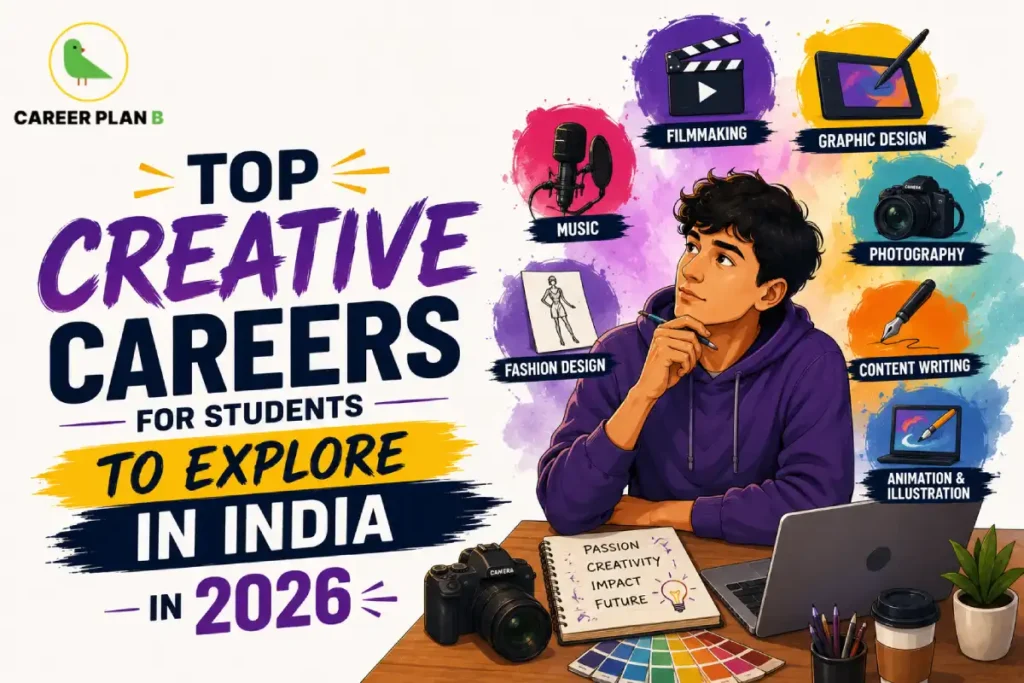
Introduction
For years, creative careers in India stayed on the edge of serious career conversations. People found them interesting but not dependable. That perception is now several years behind reality.
The Union Budget 2026–27, presented by Finance Minister Nirmala Sitharaman, formally recognised India’s creative industries as the “Orange Economy.” It identified them as drivers of growth, employment, and innovation, not cultural afterthoughts. The Press Information Bureau confirmed that India’s AVGC sector (Animation, Visual Effects, Gaming, and Comics) may need nearly two million skilled professionals by 2030.
The government is setting up AVGC Content Creator Labs in 15,000 secondary schools and 500 colleges. The Indian Institute of Creative Technologies (IICT) in Mumbai supports this initiative with a ₹250 crore allocation. According to a report by the Motion Picture Association and Deloitte, India’s film, television, and streaming industry generated USD 61.2 billion in total economic contribution in 2024. India’s Ministry of Information and Broadcasting supported the report.
Creative careers for students in India in 2026 are not a backup plan. For the right student, they offer a career path supported by government investment, documented sector growth, and long-term demand. Here are six significant creative career paths worth exploring today.
Animation, VFX and the AVGC Sector
India’s animation and VFX sector grew from USD 1.3 billion in 2023 to USD 2.2 billion by 2026. That represents a 69% increase in three years, according to a CII GT report cited by IBEF.
The AVGC Promotion Task Force was established in April 2022 under the Ministry of Information and Broadcasting. It projected that the sector would need nearly two million skilled professionals by 2030. These roles span content production, design, and technology. India currently employs approximately 2.6 lakh professionals in this field. This creates a significant gap between current supply and future demand.
The opportunities extend beyond drawing and animation. Studios need 3D modellers, compositors, visual effects artists, motion graphics designers, technical directors, and production coordinators. Generative AI is transforming animation workflows by automating tasks such as rigging and in-betweening. Professionals who understand both creative and technical aspects of animation production are becoming increasingly valuable.
Students typically enter this field through a B.Des. or a specialised diploma from NID, NIFT, or another recognised design institution. They then build a demonstrable portfolio. The National Centre of Excellence for AVGC-XR is now operational at the NFDC campus in Mumbai. It has begun offering structured courses and represents a major institutional commitment to developing this workforce.
UX and UI Design
Every digital product used in India today requires design decisions. Every app, website, and government portal needs someone to decide how it should feel to use. That person is a UX or UI designer.
India’s digital economy continues to expand across healthcare, fintech, edtech, and e-commerce. This growth has increased demand for designers who understand user psychology and visual communication. UX and UI design has become one of the technology sector’s consistently in-demand skill areas.
India’s media and entertainment (M&E) and digital sector grew 9% in 2025. Digital media crossed INR 1 trillion in revenue for the first time, according to the FICCI-EY India report released in March 2026. Companies across this digital economy need UX expertise.
Entry-level UX designers in India typically earn between ₹3.5 and ₹6 LPA. Mid-level professionals earn ₹8–15 LPA, while senior UX roles at technology companies and well-funded startups can exceed ₹20 LPA.
Students from different educational backgrounds can enter this field. Design entrance exams such as UCEED for IIT design programmes, NID DAT for NID, and NIFT for fashion and communication design accept students from arts, commerce, and science streams.
A B.Des. in communication design or interaction design offers a structured academic route. However, a strong portfolio built through practical projects also carries significant weight in UX hiring.
Game Design and Development
India’s online gaming sector reached ₹23,200 crore in 2024, according to official government data released by the Press Information Bureau on 16 February 2026. It became the fourth-largest revenue segment in India’s media and entertainment ecosystem, ahead of the film industry.
The FICCI-EY M&E Report 2026 projects that video gaming revenue will reach ₹92 billion by 2028. It forecasts a 13% compound annual growth rate (CAGR) and positions India as a potential global gaming export hub.
India’s gamer base crossed 520 million players in 2025, making it the world’s second-largest. The industry needs professionals to design, build, test, and manage games for this vast audience.
Game design offers several career paths. These include game designers, level designers, character artists, narrative designers, game programmers, and quality assurance testers. The field accommodates both artistic and technical skills.
The Ministry of Information and Broadcasting is setting up AVGC Content Creator Labs in schools and colleges. These labs explicitly include game development training.
Students can start building game development skills through tools such as Unity and Unreal Engine. They can also learn game mechanics and player psychology. These skills can help them prepare for the industry’s growing workforce needs.
Fashion Design
India’s fashion and apparel market ranks among the largest globally. The National Institute of Fashion Technology (NIFT), established under the Ministry of Textiles, operates 18 campuses with over 5,000 seats. It remains a recognised institutional pathway into fashion design in India.
NID Ahmedabad’s textile and product design programmes also hold significant market value. They are particularly relevant to brand-facing and technology-related design roles.
Students should understand the realities of fashion design careers. Entry-level roles for NIFT or NID graduates typically offer ₹2.5–5.5 LPA in traditional fashion houses.
Salaries can rise significantly when graduates join fashion technology companies such as Myntra, Nykaa Fashion, and Ajio. These companies pay ₹15–30 LPA for senior design roles. Such positions require design and commercial integration, data awareness, and digital skills alongside aesthetic ability.
In 2026, several fashion design areas are expanding. These include D2C brand design, sustainable fashion, OTT costume design, and e-commerce product photography and visual merchandising.
These roles form part of the commercial core of India’s fashion economy. Students who understand both the business and craft of fashion can access a wider range of career opportunities.
Content Creation and Digital Media
The FICCI-EY India M&E Report 2026 recorded 44% growth in live events in 2025. Advertising grew 13% to INR 1.5 trillion. Digital media is now the largest segment of India’s media and entertainment industry.
Content drives much of this growth. Every branded video, OTT series, digital campaign, and podcast requires creative professionals. These include content creators, video editors, scriptwriters, creative strategists, and social media specialists.
Content creation has matured into a formal career since 2020. It now offers defined roles, structured hiring, and professional compensation.
Branded content studios, digital agencies, media houses, and OTT platforms hire professionals for content strategy, video production, scriptwriting, and creative direction. These are full-time, salaried positions that demand genuine creative and strategic skills.
The Ministry of Information and Broadcasting is investing in this workforce through its AVGC Content Creator Labs initiative. The programme will place production infrastructure in 15,000 secondary schools.
Students with strong communication, visual, or storytelling skills can explore this career path. The sector has clear institutional support and documented growth in 2026.
Graphic Design and Visual Communication
Graphic design covers brand identity, typography, print and digital communication, packaging, and visual systems. It remains one of the most widely applicable creative careers.
Every company with a market presence needs graphic design capabilities. In 2026, that includes virtually every company. Professionals work in advertising agencies, design consultancies, in-house brand teams, publishing, and freelance practice.
India’s advertising sector grew 13% in 2025, reaching INR 1.5 trillion, according to the FICCI-EY Report 2026.
Graphic designers who understand AI-assisted design tools can explore a wider range of opportunities. These tools include Figma, Adobe Creative Suite, and Midjourney for concept exploration. Combining these tools with traditional design thinking helps designers meet the needs of agencies and in-house teams.
Entry-level graphic designers typically earn ₹3–5 LPA. Experienced professionals in metropolitan markets can earn considerably more. Digital branding and UI skills can further expand opportunities for designers with traditional visual communication expertise.
For Personalized Guidance
The Table Every Student Needs
| Creative Career | Key Entrance Exams | Typical Entry Qualification | Entry-Level Salary | Sector Backing |
|---|---|---|---|---|
| Animation and VFX | NID DAT, UCEED, NIFT | B.Des / Specialised Diploma | ₹3–6 LPA | AVGC Task Force; Union Budget 2026–27; IICT |
| UX and UI Design | UCEED, NID DAT, NIFT | B.Des.B.Des Communication/Interaction Design | ₹3.5–6 LPA | Digital economy; FICCI-EY M&E Report 2026 |
| Game Design | NID DAT, UCEED, B.Tech Game Dev | B.Des / B.Tech / Diploma | ₹3–5 LPA | PIB gaming data Feb 2026; FICCI-EY 2026 |
| Fashion Design | NIFT Entrance Exam, NID DAT | B.Des Fashion / B.FTech | ₹2.5–5.5 LPA | Ministry of Textiles; NIFT 18 campuses |
| Content Creation | Portfolio-based; NIFT Communications | Degree + Portfolio + Applied work | ₹3–5 LPA | AVGC Content Creator Labs; MIB initiative |
| Graphic Design | UCEED, NID DAT, NIFT | B.Des. Visual Communication | ₹3–5 LPA | Advertising sector INR 1.5 trillion; FICCI-EY |
Sources: PIB February 2026; FICCI-EY M&E Report March 2026; IBEF Animation VFX Report; PIB AVGC Content Creator Labs February 2026
The Question That Changes Everything
The data above makes one thing clear: creative careers in India in 2026 are not a gamble. The government has committed ₹250 crore to building creative infrastructure in schools. The budget formally named the creative economy as a growth priority. The sector needs two million professionals in less than four years.
What the data cannot tell you is which of these directions is right for you specifically. Animation and UX design are both creative fields, but they attract very different kinds of minds and reward very different kinds of working styles. Fashion design requires a fundamentally different sensibility from game design. Content creation and graphic design overlap in some technical tools but diverge sharply in what daily professional life actually involves.
Knowing which creative direction genuinely fits you, not just which sounds exciting in a blog, requires honest self-reflection about how your mind works, what problems interest you, and what kind of output makes you feel satisfied. That is a question that data cannot answer. But it is one that structured guidance, combined with the right kind of self-assessment, can.
How Career Plan B Helps
At Career Plan B, creative career decisions are among the most frequently mishandled, not because students lack talent, but because they choose a direction based on what looks impressive without a clear understanding of what the daily work actually involves or whether their natural strengths align with it.
- The PsycheIntel Assessment maps each student’s genuine creative strengths, working style, and values, helping surface whether they are better suited to conceptual and user-focused work like UX, technically intensive fields like animation and game design, or expressive and trend-driven fields like fashion.
- Career Plan B’s career counselling for students helps students understand which entrance exam to target, which institutions to consider, and how to build a portfolio and preparation strategy that gives their application real strength, not just intention.
- For students who are currently in Class 11 or 12 from any stream and are seriously exploring creative careers, the counselling process helps them understand that stream background is not a barrier; creative design programmes are accessible from science, commerce, and arts, and what matters most is clarity of direction and quality of preparation.
Get In Touch With Us
Frequently Asked Questions
Q1. Are creative careers financially viable in India in 2026?
Yes, with specialisation and applied skill. Entry-level salaries across animation, UX design, game design, and graphic design range from ₹3–6 LPA. Mid-level professionals with three to five years of experience earn ₹8–15 LPA in most creative fields, with senior roles at technology companies and established studios reaching ₹20–30 LPA and beyond.
Q2. Which stream should I take in Class 11 if I want a creative career?
All major design entrance examinations, NIFT, NID DAT, and UCEED for IIT design programmes, are open to students from science, commerce, and arts streams. No stream restriction applies to most creative career pathways.
Q3. What is the AVGC sector, and why does it matter for creative careers?
AVGC stands for Animation, Visual Effects, Gaming, and Comics, a sector formally recognised by the Government of India as a priority growth area. The Union Budget 2026–27 allocated ₹250 crore to set up AVGC Content Creator Labs in 15,000 schools and 500 colleges through the IICT in Mumbai.
Q4. How do I get into NID or NIFT for a creative career after Class 12?
Admission to NID (National Institute of Design) requires qualifying for the NID Design Aptitude Test (DAT), a two-stage examination covering creativity, observation, drawing ability, and design reasoning. Admission to NIFT requires the NIFT Entrance Examination, a combination of a Creative Ability Test and a General Ability Test, followed by a Situation Test for shortlisted candidates.
Conclusion
Creative careers for students in India in 2026 are not a niche choice or a risky one. They are a documented, government-prioritised, data-backed set of professional directions that the Indian economy is actively building infrastructure to support. The sector needs people not in the abstract future, but now and over the next four years, in a volume that current supply cannot meet.
The work of finding your specific place within this landscape is not about following the most popular creative trend. It is about understanding which kind of creative work genuinely matches the way your mind works and what you want to build over a career.
Before you decide which creative field to pursue, do you know the difference between finding a career interesting and finding the actual work it involves genuinely fulfilling?